Year 2002, the Notting Hill district, London. A new dining venue has become the place everyone wants to visit. Halfway between a grocery store, the restaurant, the bakery, and with take-away dishes, its striking creations have won over a clientele that must adhere to the demanding pace of life in the capital yet also wants to enjoy eating. The recipe for success: dishes full of color in which vegetables are the protagonists, prepared with ingredients unknown to the average English person.
The people behind this novel way of understanding gastronomy are Sami Tamimi and Yotam Ottolenghi, a Palestinian chef and another Israeli, both born in Jerusalem in 1968, who met years earlier while working in a bakery. This working relationship evolved into a great friendship and they decided to embark on their own entrepreneurial venture with this venue, which they named after the surname of the second. Almost a quarter of a century and seven venues later they have begun their international expansion, opening in March their first space in Amsterdam.
Throughout that time, Ottolenghi has written culinary columns for the British newspaper The Guardian and the American The New York Times, has presented several television specials and, together with Tamimi or other collaborators, has published a dozen cookbooks. The latest of them, More Simple (Salamandra, 2026), which revives the concept that began in 2018 with Simple and which was a best-seller in several countries.
The Pleasure of Simplicity
“When it was published I realized that many people weren’t cooking my dishes because they seemed too complicated. But when they tried them they would say, “Ah, at last I can cook your food!” And I discovered that there are many people who only want easy, quick, and simple recipes,” the Israeli chef explains in a video call about that book. In these eight years, new ideas have emerged to create a repertoire of recipes that were sufficiently special.

Cover of More Simple, the new cookbook by Yotam Ottolenghi.
But to publish this culinary sequel now, he acknowledges there was another reason: the state of the world. “There is so much noise, so much anger, even if you are not involved in a conflict, you can feel it. We are also very glued to devices, to our phones and tablets. And cooking is an excellent way to escape that noise, but things must be accessible, easy, and comforting. So I thought that if we needed an antidote for the world of 2026, simple cooking is it,” he confesses.
Thinking Green
Ottolenghi’s culinary philosophy was shaped, unconsciously, in the Jerusalem where he grew up, “where there were always plenty of vegetables in the markets.” And although they are the central axis of his ideology, the chef clarifies that he does not approach vegetables from a moralistic perspective, as if he believed that everyone should eat them because it is important to do so, but because they offer enormous possibilities in cooking.
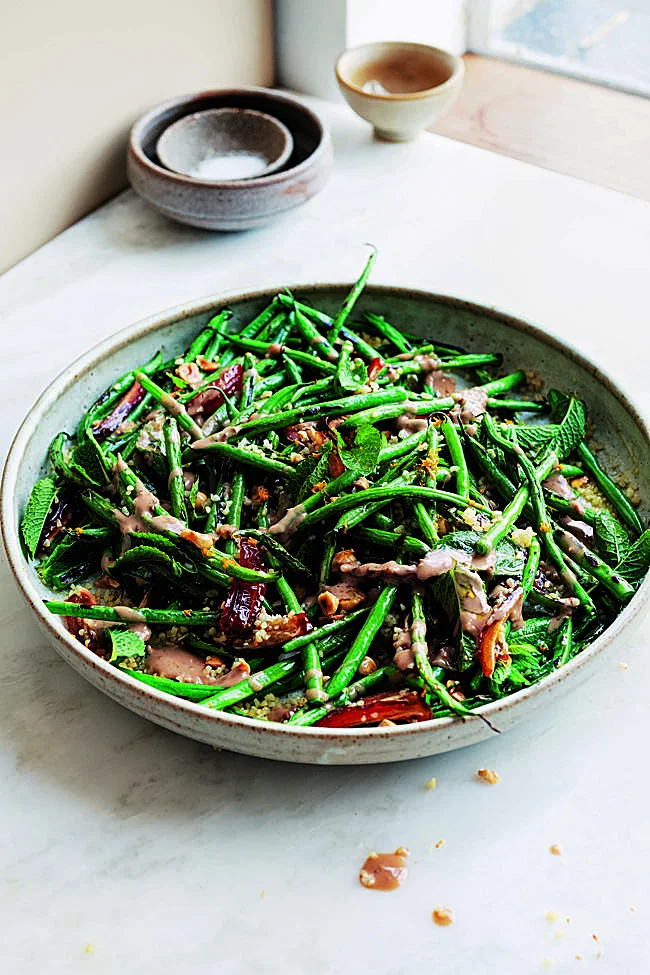
Ensalada de judías verdes braseadas, una de las recetas de Ottolenghi en Más Simple.
«Se puede obtener de ellos muchísimo sabor, se puede elaborar una transformación con las verduras que a veces no se puede conseguir con la carne o el pescado. Por ejemplo, cuando asas una coliflor, se parte en gajos, se mezcla con harissa, aceite y especias y se deja asar. Y así se transforma por completo y se obtienen hojas crujientes y flores masticables, y se convierte en algo muy, muy diferente. Puedo decir lo mismo de todas las verduras posibles, tienen un potencial enorme», defiende.
In More Simple, Ottolenghi admits that his way of cooking has always been an eclectic mix of everything happening around him: “Restaurants I have loved, the people I cook with, the places I travel to.” But he also acknowledges himself as that mortal person who “gets hungry at 7 o’clock on a Tuesday evening and needs an answer to the question, what’s for dinner?” The culinary question that marks daily life, or the week, for the whole world and that, to be solved, needs a grocery list, a supermarket, and the will to cook.
The Secret Ingredients
The philosophy of the world’s most famous Israeli chef invites us to do so by crafting dishes with accessible and familiar ingredients but in which spices, sauces, vinaigrettes, and seasonings from different origins are the differentiating element. Something that, according to him, should not require a big change in our way of cooking because Spanish gastronomy “is very influenced by Muslim and Middle Eastern” traditions, from garlic to lemon, including chilies and other spices; in those culinary traditions he sees many similarities. “I haven’t traveled to Spain many times, but whenever I’ve been I’ve enjoyed its food. Fewer spices are used, but the use of olive oil is very similar,” he notes.
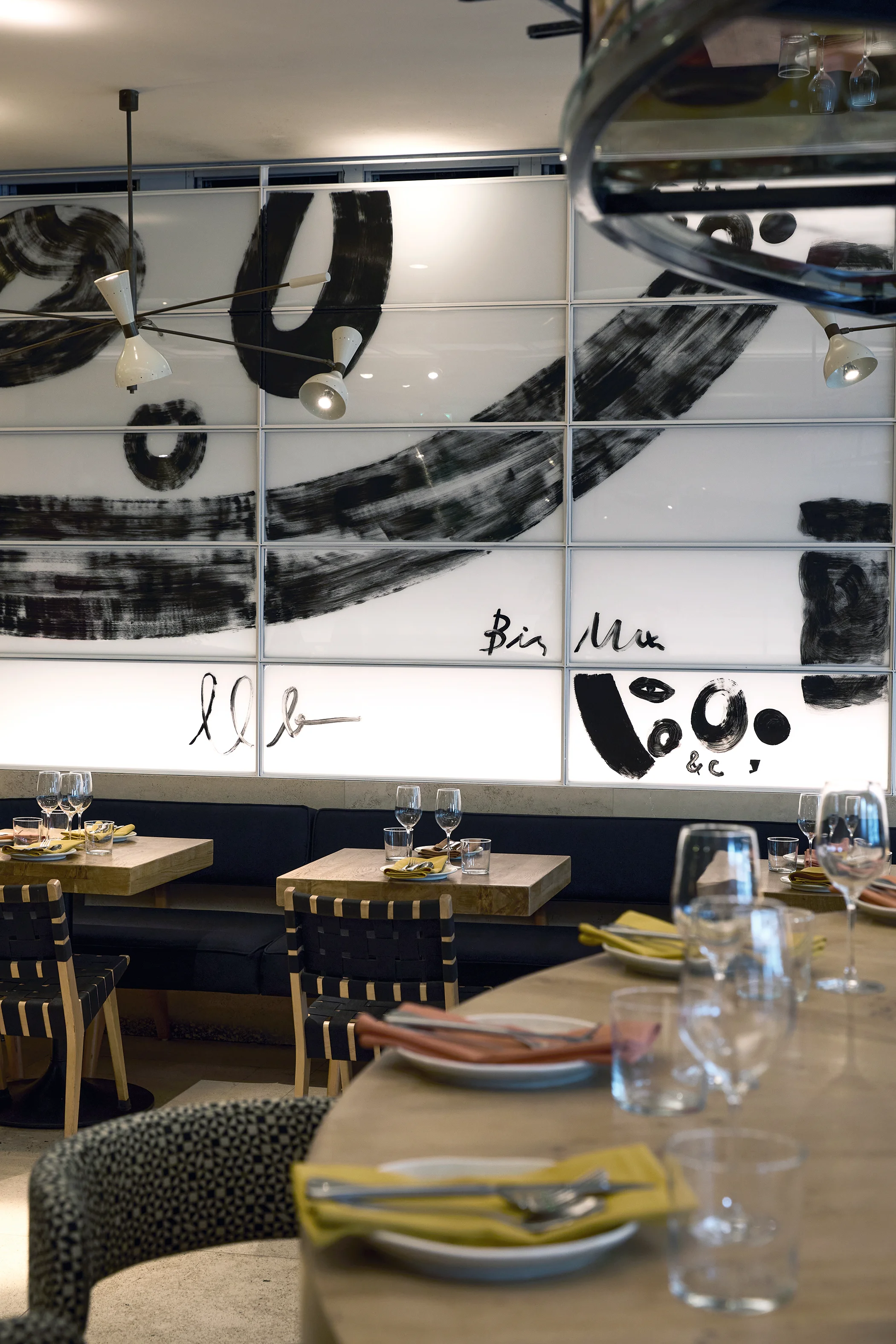
El comedor de Rovi, uno de los restaurantes londinenses de Yotam Ottolenghi.
His experience, which in recent years has focused on writing, creating and testing recipes for his books, columns and venues, coincides with a time in which many people turn to AI before stepping into the kitchen. Ottolenghi acknowledges that, over these years, his conception of cooking has changed, and previously he would have said that “you have to cook legumes, soak them the night before, and boil them in the morning, and now there are jars of pre-cooked legumes that are excellent.”
But he is reluctant to rely on technology when designing dishes “because you cannot taste or draw conclusions about the final preparation and because when you cook, sometimes the small things make a big difference. For example, the size of the pan can be responsible for something turning out crispy or remaining soft and mushy.”
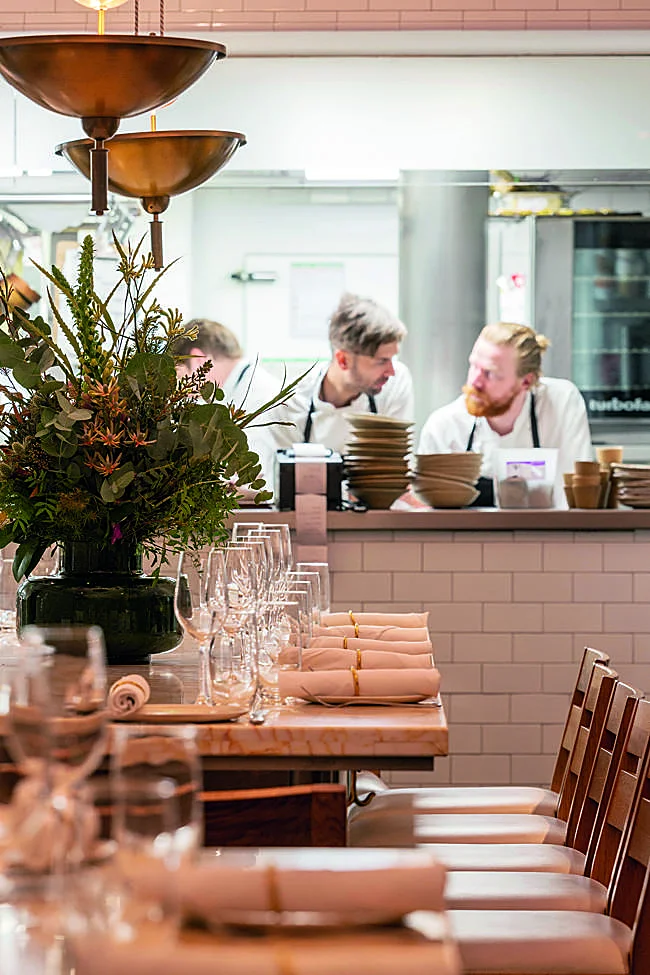
View of Nopi, one of Yotam Ottolenghi’s London restaurants.
With respect as the base ingredient of his life, he argues that “each person should adjust their level of cooking to what suits them” and even smiles, saying: “It’s okay not to cook because there are wonderful places to eat or you can always find a friend who will do it. No matter how you cook, no one is judging you and you shouldn’t judge yourself, you should simply go to the kitchen and craft something that feels easy.”
It was precisely in simplicity where his culinary passion was born. “My mother bought me a children’s cookbook when I was 9 or 10, because I always wanted to cook. But when it came to using a knife or putting something in the oven the recipe said, ‘now you have to call an adult to help you because it’s dangerous.’” One of the early dishes I remember was egg in bread: you take the bread, cut a circular hole in the middle and put the egg inside, fry it and when it sets you flip it,” he explains. Half a century later, that simple spirit continues to inspire his celebrated cooking.