France is full of towns that have long fascinated painters, whether they were impressionists or not. From Collioure, which flooded Matisse’s canvases with Fauvism, to Barbizon, where Millet, Corot, or Rousseau gathered. Not to forget the Honfleur harbor, which drew Boudin or Monet. This time, our feet take us to Pont-Aven, another town equally beloved by the muses that must be sought not at the edge of the Mediterranean, nor in the vicinity of Paris, nor in Normandy, but in Brittany, in the French Finistère.
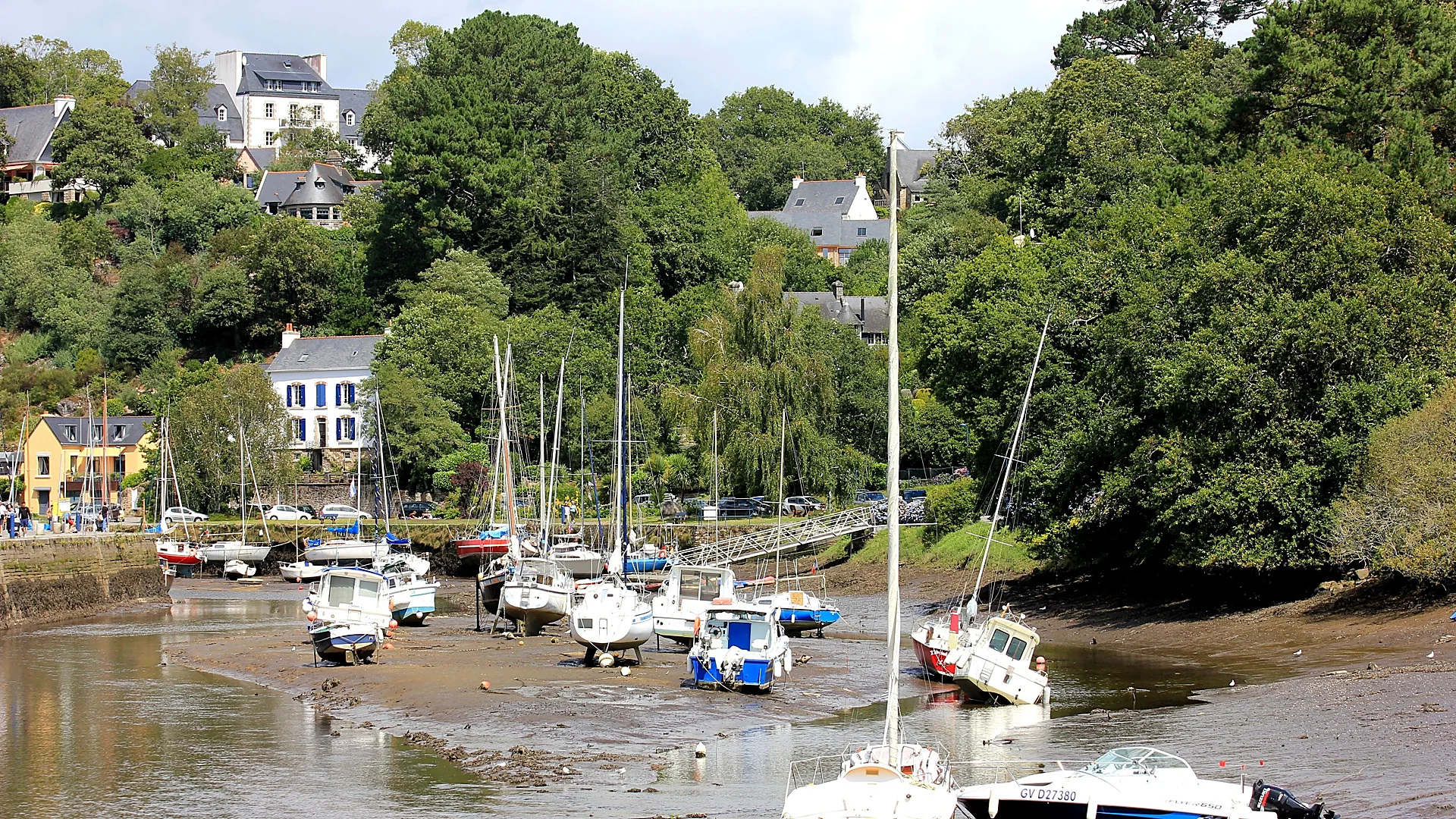
Pont-Aven lies, as its name indicates, crossed by the Aven River, which flows its waters into the turbulent nearby ocean. In this milling town, therefore, Atlantic winds blow, which drive the sails of boats moored along its banks. A harbor that, joined with the eminently rural scenes, soon captured the attention of numerous artists, to the point of creating a school. Its bohemian spirit, embodied in numerous galleries, remains.
The man who discovered this town was Henry Bacon, who studied painting in Paris, like many other Americans at the time. It was 1864. As the Paris studios closed in summer, Bacon convinced Robert Wylie and Charles Way to go together. The railway line that linked the capital with the neighboring Quimper, opened just two years earlier, made it easy. Little by little, painters from England, the Netherlands and France began to arrive. Until Gauguin dropped by there in 1886, seeking rural peace, which provided an inexhaustible source of inspiration, and also—times were hard—a cheap place.
Pont-Aven and Gauguin
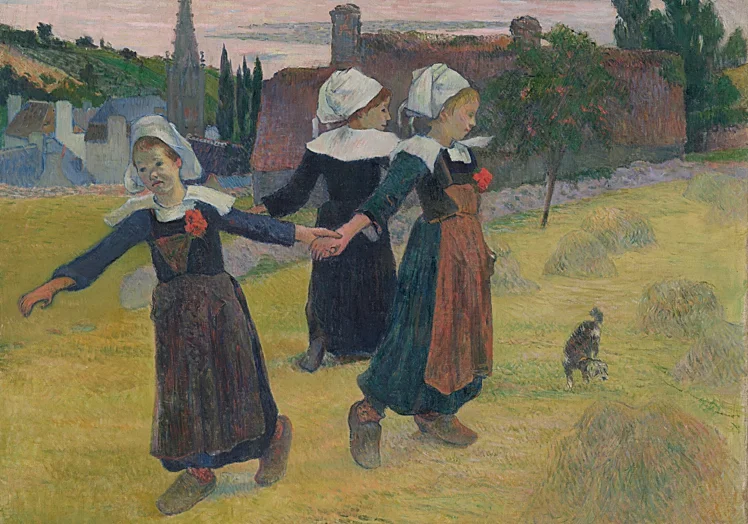
To this era belong his Four Breton Women, The Breton Shepherdess, The Round of the Little Breton Girls, or The Young Breton Woman. An ode, no doubt, to this land. The exaltation of a world where virginal naivety still persisted. Aside from worldly noise, Pont-Aven represented, in a sense, the lost paradise, which the Parisian would later seek in Panama and eventually find in Martinique and Tahiti. By the way, the cited The Round of the Little Breton Girls (now in French) was donated by Paul and Rachel Bunny Mellon to the National Gallery of Art in Washington, where it is on display.
La Ronde des petites Bretonnes, pintado por Gauguin en 1888 en Pont-Aven.
In about fifteen years Pont-Aven had become the preferred destination for anyone touched by the elfin spirit and who regarded this Breton corner as a return to the origins. Traditional attire, old trades, and the endless well of oral tradition still persisted. The Pontavenistes posed for them and lent barns and sheds for use as studios. In their eyes, they were “the Americans.”
Many of these painters stayed at the Gloanec pension, which became famous for Marie-Jeanne Gloanec’s skillful cooking. Between 1886 and 1894 it was Gauguin’s independent republic and his circle, which included another great innovator, Émile Bernard, who would later form a group with Van Gogh and Toulouse-Lautrec. Paul and Émile created Synthetism, a push for vivid colors, bold outlines, and a geometric approach. With them, the Pont-Aven School was born.
An Artist Pension
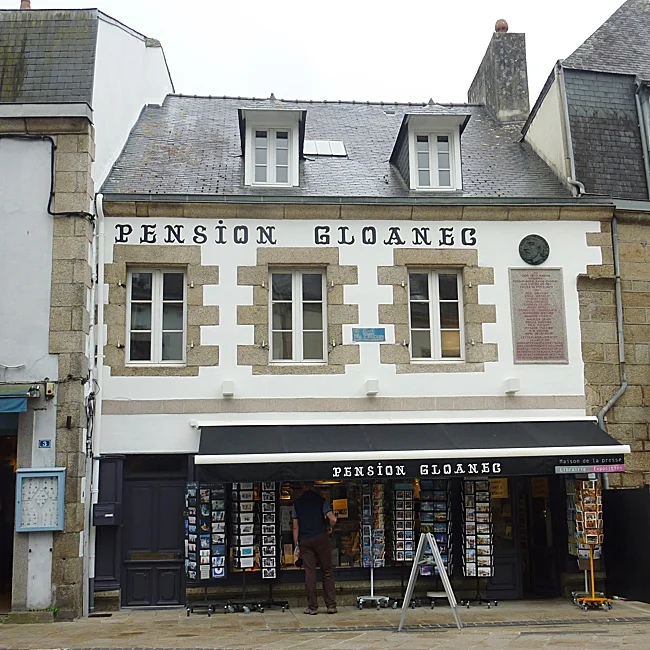
With hardly any means and still no fortune in the craft, they left their paintings at the pension in exchange for bed and meals or negotiated payment facilities. Today, the historic Gloanec Pension operates as a bookstore, a cultural center, and an exhibition space. Later, the Hôtel de la Poste would take over, first run by Julia Correlleau and later by her daughter Nicole. At La Poste, from the twenties through the eighties, painters sat alongside sailors, tourists, and locals.
La pensión Gloanec, donde se alojaba Gauguin en Pont-Aven.
These artists had also found inspiration in the Bois d’Amour, beside the river, just as Barbizon painters found theirs in Fontainebleau. To this forest they dragged their easels, something you can imagine when walking the beech and oak-filled path that traces their footsteps. In this Forest of Love, Bernard painted his sister Madeleine, and the small chapel of Trémalo hides there, famous for its asymmetrical roof that almost touches the ground and for housing the crucifix Gauguin turned into his Yellow Christ.
The Village of the Mills
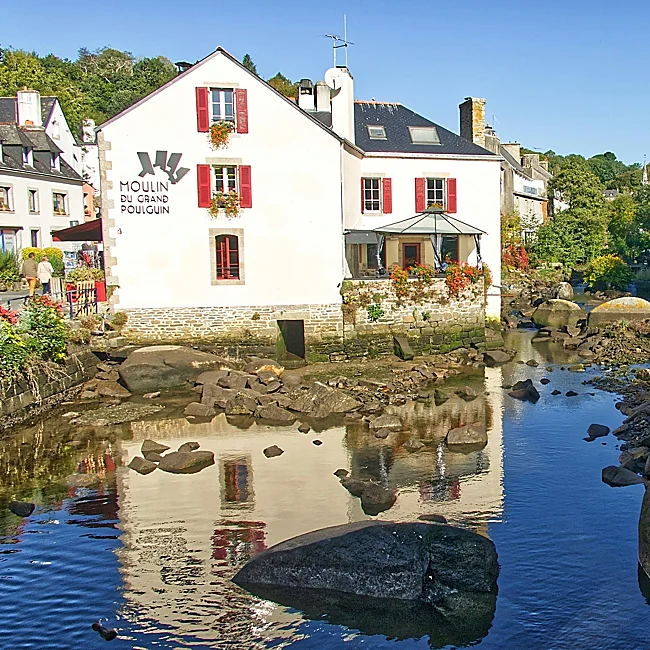
Besides the route through this enchanted forest, there is also the route that runs through the 14 mills (or what remains of them), which operated at full tilt until the early 20th century. There are washhouses, sluices and canals. As a witness to their activity, a flour mill remains, preserving the tradition and supplying bakeries and private individuals. Each mill keeps its own history. The Moulin de Kermentec was immortalized by Gauguin in 1894. The one at Petit Tourte even functioned as a provisional chapel, with a bell hung from a fig tree. And the Grand Poulguin is now a restaurant.
El Moulin du Grand Poulguin es hoy un restaurante.
In a village like this, a museum could not be missing, and it is not. In the Museum of Pont-Aven you can see a permanent exhibition with around 5,000 works and documents related to Paul Gauguin and his circle. It is complemented by temporary exhibitions on a wide variety of trends. Now open is the title In the era of Camille Claudel: being a sculptor in Paris (until November 8). It also boasts a garden where the same plants and flowers grow as in the paintings. This museum was the Hôtel Julia, run by Julia Guillou, another haven for artists.