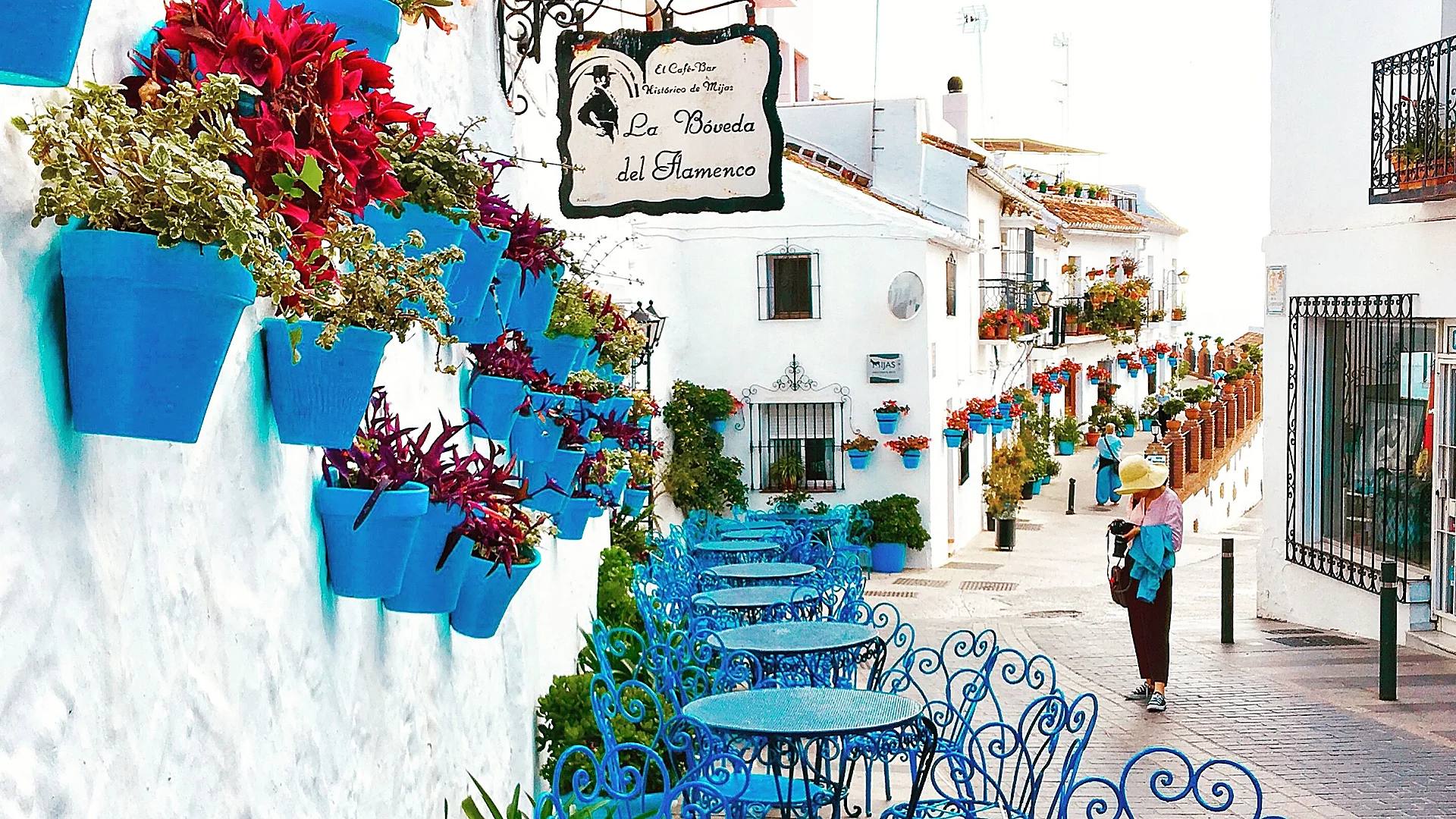
A whitewashed wall with flowers in pots, narrow labyrinthine streets, and the promise of the sea. It could be Frigiliana, but it is Mijas. On this occasion, we are not heading to the Málaga Axarquía, but to the Algarbía, which is how the Arabs called this east and west, respectively. In this case, Algarbía would be the prototypical Costa del Sol; that is, the one of Torremolinos, Benalmádena, Fuengirola or Marbella. The one that became an international tourist destination in the 1950s, energized by the presence of Grace Kelly, Marlon Brando, Frank Sinatra or Brigitte Bardot.
In reality, there are three Mijas in one. There is Mijas Pueblo proper, perched on the slope of the Mijas Sierra, which reaches 1,150 meters. There is Mijas Costa, known as Las Lagunas. And there is La Cala, the central nucleus of the twelve kilometers of coastline that the municipality possesses. The first and main one, for being the origin, was already declared at the end of the 1960s a historic-artistic complex, given its beauty and the way it has been preserved over time.
Mijas is a typical Andalusian village, as Olvera in Cádiz or Parauta in Málaga. It has a church at the highest part, dedicated to the Immaculate Conception and built on the ruins of the old mosque, from which the Mudéjar tower was repurposed; with the small and charming Hermitage of San Sebastián, and with another one also starkly white, the Nuestra Señora de los Remedios, in the quaint Plaza de los Siete Caños, named after its eighteenth-century fountain.
What to see in Mijas
Additionally, one should not miss the Parque de la Muralla, the botanical garden built on the ground where the old wall stood, with a privileged viewpoint. Nor the Center for Contemporary Art (CAC), which houses the world’s second most important collection of Picasso ceramics after the Picasso Museum in Paris. And he is not the only artist represented. Dalí is also present, whom we seek in these three towns of Girona, Braque or Miró.
The Hermitage of Our Lady of Remedies is in the Seven Spouts Square.

The CAC Mijas, managed by the Remedios Medina Foundation, is housed in two 19th-century houses that were loaned by the City Council for this purpose. It adds the Villa House Museum, a historic-ethnographic museum, and another that has nothing to do with either and that will delight curious minds. It is the Museum of Miniatures, known as Carromato de Max, where you can find pieces as rocambolesque as a portrait of Abraham Lincoln painted on the head of a pin or The Last Supper, by Leonardo da Vinci, on a grain of rice.
The donkey-taxi controversy
We stay in Mijas Pueblo, famous for its donkey taxis, which give animal-rights organizations a headache, as they continually denounce the living conditions of these animals. However, locals and visitors defend this service as part of tradition and as a cultural icon of the town. They even have their own parking lot, with capacity for the 60 that make up this curious mobile park, plus eight carriages, the other means of tourist transportation.
Mijas stands out for its whiteness against the green Sierra.

Despite its proximity to the coast, this town remains mountainous. And there lies its charm, that there is no need to fall into the classic dilemma sea or mountains. Mijas itself does not. In Las Lagunas, right at the foot of the Mediterranean, are the sports and cultural facilities, the latter led by the theater-auditorium that bears its name, a work of architect José Seguí. While in La Cala one can breathe a fishing and seafaring atmosphere. There stands one of the most important watchtowers of Mijas, the Torreón de la Cala, which functions as the Center for Interpretation of the Watchtowers.
One can discover tower after tower along the Senda Litoral, the backbone of the Costa del Sol, from beach to beach, also passing through dunes, sands and corners from which to spot seabirds or cetaceans. All this along seven kilometers. Calahonda Beach combines urbanized areas with virgin ones, and beach bars with lush vegetation. Beside it, Charcón Beach offers the most pristine side of Mijas. Bombo Beach is perfect for diving enthusiasts. The Calaburras Lighthouse Beach is a true paradise, as is La Luna. And Butibamba attracts people with its golden sand right on the promenade. There are many more.
Where to eat and what to buy
In addition to its status as a white town perched in the mountains and its proximity to the sea, Mijas also grows large thanks to its craftsmanship. Here esparto (straw), wicker, silver repousé, or inlay work (taracea) are made. In fact, there is an Association of Artisans of Mijas and a route that runs through its workshops. From Angulo Ceramic Art, the workshop of José Angulo Jerez, who makes tile murals, to the Centro de Recuperación Artesanal, by Lourdes Díaz, focused on leatherworking. Along with the jewelry and leather goods by Liana Popa or Sonia Lekuona’s esparto work in Musketa.
La Bodega del Pintor adds a blue touch to the white of Mijas.

There are many international restaurants, given how cosmopolitan its population is, but also those that continue to serve the local cuisine. That is, gazpacho, gazpachuelo, sopa de maimones, the Mijeño salad, or ajo blanco. Among the sweets, churros? No, buñuelos, garrapiñadas and hornazos are at the forefront. In Mijas Pueblo you can go to Pampa Tablas y Tapas, to Koco Bistro, to Oscars Tapas Bar, to La Bodega del Pintor or to the eclectic Tomillo Limón. In La Cala, to the sophisticated Figaro Restaurant, to Cyrano Bar & Grill or to El Cortijillo. Without ceasing to (ad)mire the whiteness of Mijas and the sea.