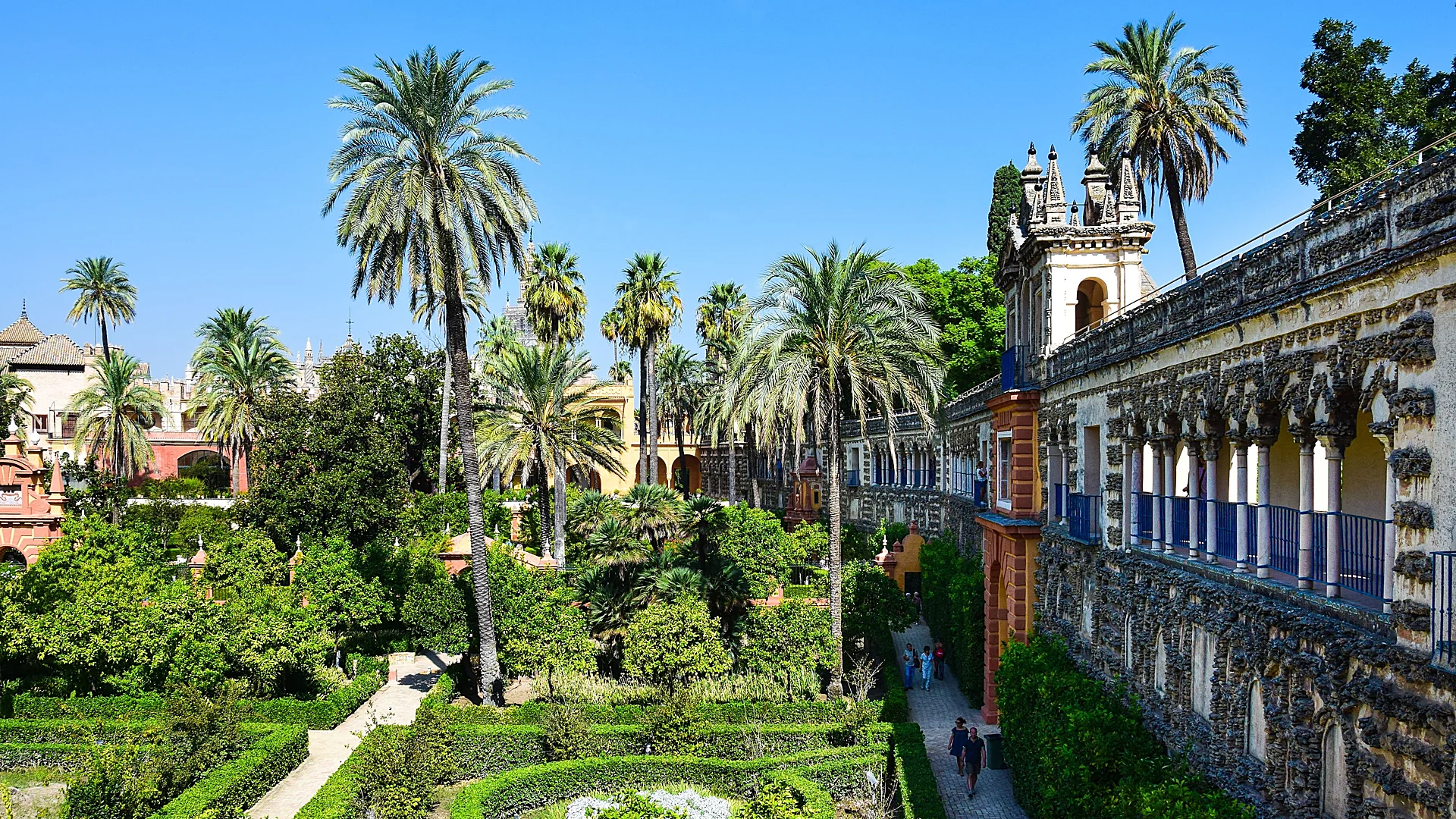
They say that the orange marmalade consumed by Queen Elizabeth II of England was made with the oranges gathered in these gardens. They are in the oldest royal palace in Europe still in use. A palace that has nothing to do with the rest. It was ordered to be built by Abd-ar-Rahman III over the ancient Basilica of Saint Vincent in the years 913-914. It was inhabited by caliphs, emirs and kings such as Al-Mutamid, until Ferdinand III the Saint conquered the city and it became the residence of the kings of Castile. They are the Royal Alcázars of Seville, in the plural. A UNESCO World Heritage Site together with the cathedral, or rather the Giralda, and the Archivo de Indias. “Seville to wound!” cries Federico García Lorca in the Poem of the Cante Jondo.
That beauty that wounds is among these walls, not squared but cubed, a superb blend of Islamic art, Mudéjar, Gothic, Renaissance, Mannerist and, as is typical in Seville, Baroque. Only the Lion Gate, which opens the outer wall, is impressive. Formerly it was called the Montería Gate because here the king would go hunting with his hunting party. The enclosure remains of kings. In fact, although municipally owned, it serves as the residence of the members of the Spanish royal family when they visit the city. As it was for the Catholic Monarchs, for Philip V, Isabel de Farnesio and the future Charles III, for Ferdinand VII and for Queen Isabella II.
There is much to see in the Seville Alcázar. The Court of Justice, the Courtyard of Plaster, the Palace of Pedro I, the Courtyard of the Dolls, the Courtyard of the Maidens, the Royal Bedroom, the Hall of the Ceiling of Charles V, the Hall of Ambassadors… and a very long etcetera. A genuine display of prowess, a testimony to unbounded splendor and to a pomp worthy of One Thousand and One Nights, exalted after the conquest of the Americas. Along the way, a rich history lesson.
Royal Gardens
However, it is the gardens that attract us because it is autumn and not spring. Because Seville has a special color beyond the albero that adorns the Plaza de España and so many historic buildings. The gardens of the Seville Alcázar, which Sorolla painted, are the oldest in the city and have also transformed through the centuries. As early as the 10th century, the Muslims endowed the fortress with small garden courtyards and large orchards. In the 16th century they were remodeled, preserving the Muslim heritage, both the partitioned gardens and the low fountains and the azulejería (tilework).
The Grutesque Gallery with its water organ is one of the jewels of the Seville Alcázar.
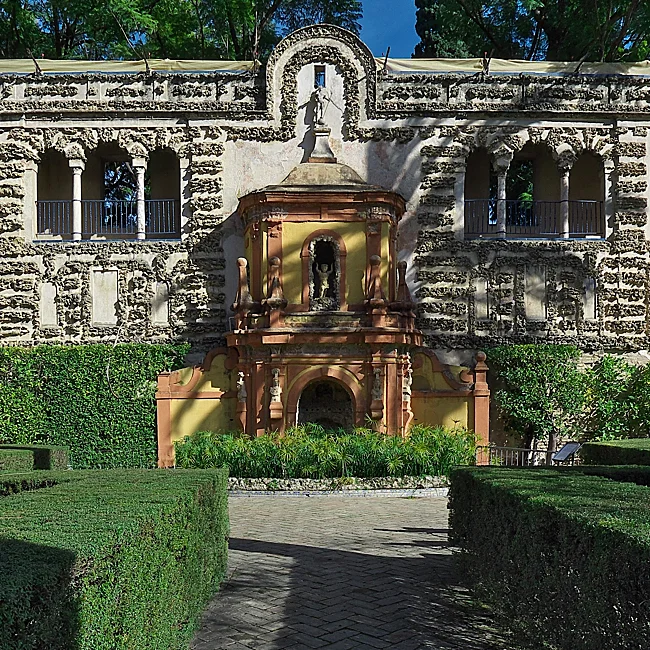
It is not a single garden, but several. With all kinds of decorative elements and corners for leisure. There is the proverbial Mercury Pond, with the Renaissance statue of the Greek god in the middle and the Grutesque Gallery in the background, opened by the Gate of Privilege. This gallery, which can be climbed to contemplate the enclosure in its vastness, is a 160-meter wall that was a canvas of the Almohad wall, decorated with rows of stones, imitations of marbles and frescoes with mythological scenes. A water organ is added, producing musical notes. It is the so-called Fountain of Fame, unique in Spain. Perhaps the most picturesque place in the Alcázar.
From Mercury to Troy
From the Mercury Pool you descend to the Garden of the Dance by some stairs. It is named thus because of the statues of a satyr and a dancing nymph that stood at the entrance, today gone. It is square, has a low fountain from the 16th century and two prominent magnolias. From here you reach the María Padilla Baths, vaulted passages from the 12th century where water acts as a mirror. There is even a Troy Garden, with a gallery of round arches and grotesque details, as well as a fountain with a marble basin.
This latter connects with the Garden of the Galley, with four beds, which in turn leads to the sumptuous Palace of Pedro I. In the Garden of the Flowers there remains a small 16th-century grotto, where a bust of Charles I can be seen. From this you go to the Garden of the Cross, after passing through Hercules’ Gate in what is confirmed as a mythical stroll. Next to it, is the Prince’s Garden, so named because it connects to the Prince’s chamber, where Prince Juan, the second son of the Catholic Monarchs, was born. They are no longer the gardens in themselves, their parterres and groves, but the façades that overlook them, usually with columns and arcades.
The Victoria Eugenia Garden
All of them, as you can see, have their privileged place in history. The Ladies’ Garden, a rectangle divided into eight sections by myrtle hedges, with a large monumental fountain in the center, was laid out in 1526 for the wedding of Charles I and Isabella of Portugal. It connects to the Grutesque Gallery. The English Garden was created at the request of Victoria Eugenia of Battenberg, next to the Alcoba Garden, in Mudéjar and Renaissance style, where the Charles V Pavilion rises. Here archaeologists found Roman, Visigothic and remains of three Almohad houses.
The Poets’ Garden was created by one of them, Romero Murube.
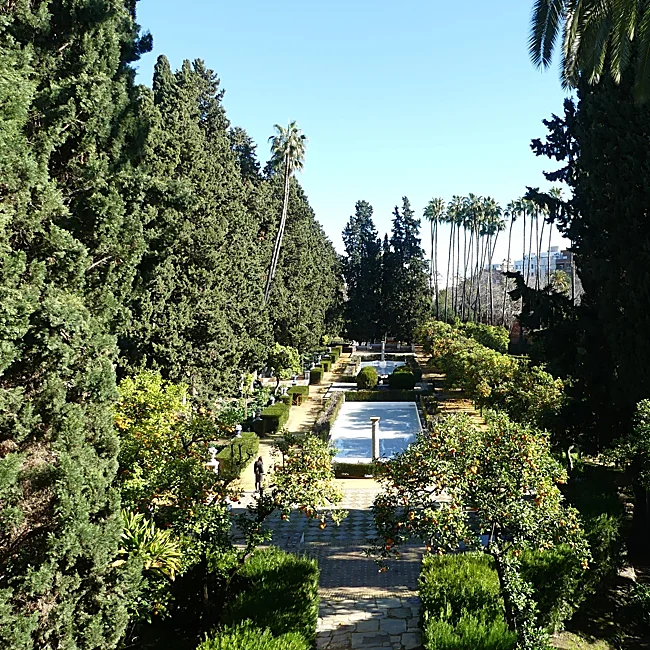
Also the garden of the Marquis of Vega-Inclán was first an orchard, the Retiro. It is entered by the very beautiful Gothic Gate of Marchena, coming from a palace abandoned by the dukes of Arcos in the Seville town of that name. Curiously, Alfonso XIII acquired it at an auction of the Osuna House goods. A Poets’ Garden could not be missing, although they all are. This was the work of the then-curator of the Royal Alcázars, the Sevillian poet Joaquín Romero Murube, a member of the Generation of 27. The same man who called the cedars the “cathedral of the forests,” “with memories of centuries,” that “drive into the sky a thirst for a fountain,” where “the sun rests on them with a sleep-lit clarity.”