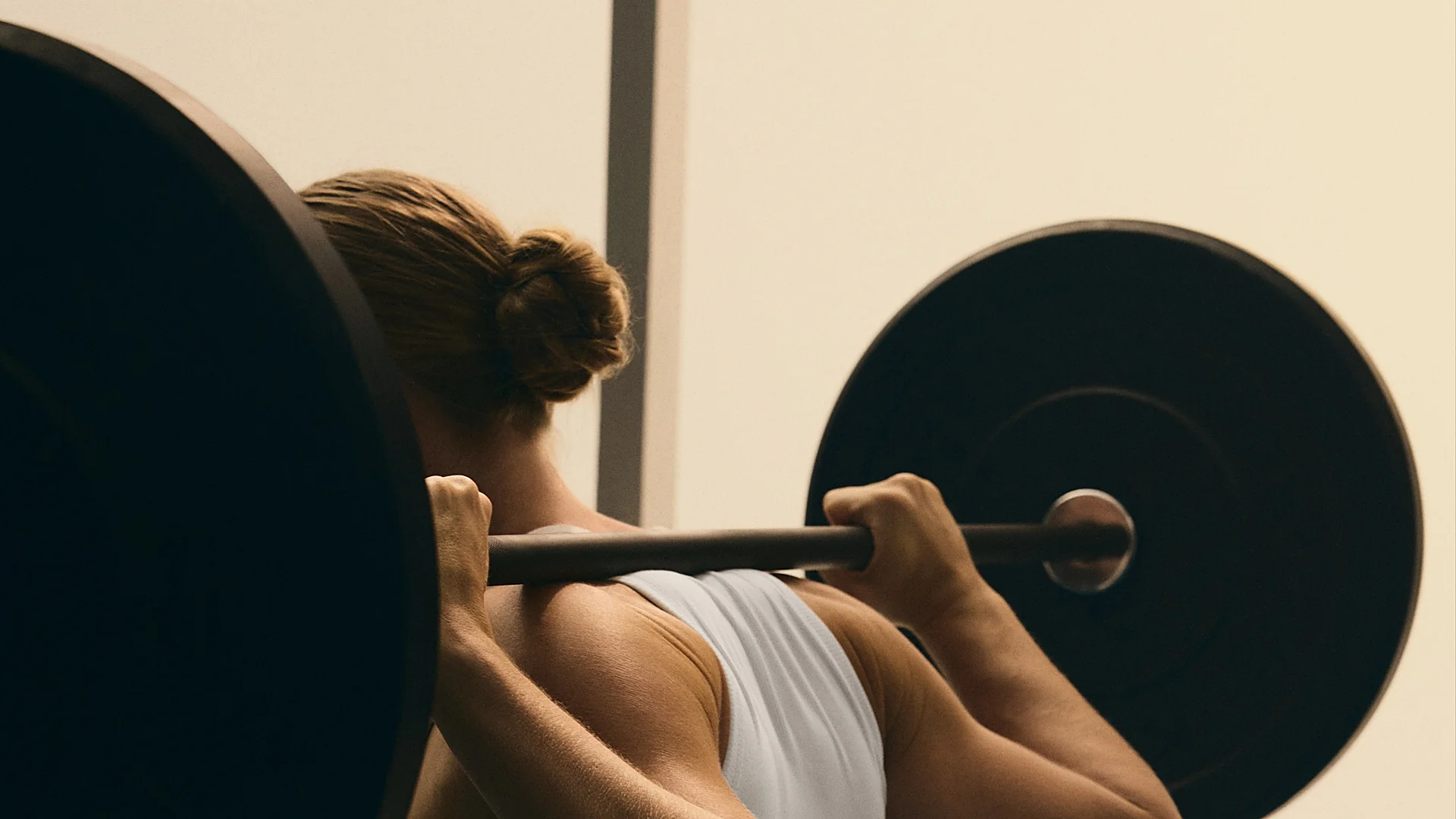
Picking up a box, lifting a suitcase, moving something heavy off the floor. All those everyday gestures have something in common with the deadlift. Sheila Ruiz, a trainer at David Lloyd Clubs, explains why she considers it one of the most complete exercises: “It is especially interesting because it trains a fundamental movement in our daily life: the hip hinge, that is, learning to bend and lift a load using mainly the hips and legs, rather than loading all the effort onto the back.”
After 45, maintaining strength and muscle mass becomes more important, and the deadlift can be an excellent tool to achieve it. “I wouldn’t start directly with a heavy barbell. First I would teach the movement pattern without load or with very little weight and, once mastered, gradually increase the resistance,” says Ruiz.
Although it is usually associated only with legs and glutes, the deadlift mobilizes almost the entire posterior chain. “The main players are the glutes, hamstrings and back muscles, but the abdomen and the rest of the core also participate to stabilize the trunk, the lats to keep the load close to the body, the quadriceps, as well as forearms and hands for the grip,” Ruiz details. All those muscles work in a coordinated manner, not in isolation, in a pattern that is repeated constantly in daily life.
Strength training provides a mechanical stimulus beneficial to bone. “The deadlift can be very interesting because it allows progressive work with relatively high loads,” explains Ruiz. It particularly strengthens the glutes, hamstrings and the extensor muscles of the back, a strong posterior chain that is key to moving and lifting loads safely.
The benefits for women over 45
It is not the only exercise capable of delivering these benefits. “I wouldn’t say it provides benefits that no other exercise can achieve: squats, lunges, hip thrusts, rows or loaded exercises are also excellent. The great advantage of the deadlift is that it brings together many of these stimuli within a single movement pattern,” notes Ruiz.
How to learn it from scratch
Everything starts without weight. “I would first learn the hip hinge without weight. For example, placing a stick in contact with the head, back and sacrum while we move the hip backward. The goal is to understand that we are not doing a squat: the hip moves back while we keep the trunk stable,” explains Ruiz. Then you can work with a kettlebell or dumbbell elevated on a box, before gradually lowering to the floor.
There is no universal starting weight valid for everyone. “For a beginner, the appropriate load is the one that allows her to learn the movement without altering the technique and finish each repetition with a sense of control,” Ruiz notes. Turning the deadlift into a kind of squat, bending the knees too much, is one of the most common mistakes; the opposite extreme, keeping the legs rigid and driving the movement from the back, is also common.
Ruiz does not believe in a milimetric back position that guarantees safety by itself. “The body tolerates different positions. The important thing is that the person has control, capability and an appropriate loading progression. Often the problem is not the deadlift itself, but trying to lift a load for which we are not yet prepared,” she explains.
Is it really the most complete exercise for women over 45? “There is no single indispensable exercise nor can we claim that the deadlift is objectively the best for all women over 45,” Ruiz clarifies. She does consider it one of the most interesting strength movements, because it develops leg and hip strength, trunk stability and grip strength all at once.
To those who avoid it for fear of injuring their back, Ruiz would tell them that there is no need to start by lifting a heavy bar from the floor. “You can start by learning a hip hinge without weight and later progress with a dumbbell or kettlebell from an elevated position. The exercise should adapt to the person, not the person to the exercise,” she summarizes. The goal after 45 is not to fear lifting loads, but to learn to do so with enough technique to safely meet the demands of daily life.