The Olympus is the dwelling of the Greek gods, the so-called Olympian gods, twelve in number. You know, Zeus and family, although the Muses and the Graces also dwell there. Homer refers to it in the Odyssey as «the everlasting and secure mansion of the deities, to which winds do not shake it, nor rain wet it, nor snow cover it». In short, there the blessed gods enjoy «perennial happiness».
However, no matter how mythological it may be and how much we resort to it as a metaphor, Olympus exists, located to the north of Greece, where else, and it is the highest mountain in the country, as it could not be otherwise. The blame for us now seeking it in the Mediterranean geography is not just Christopher Nolan, or not only, but UNESCO. The United Nations organization has just named it World Heritage for being “a natural and cultural asset of exceptional universal value to humanity”.
This declaration has only elevated even more this celestial massif that reaches 2,918 meters, between the regions of Thessaly and Macedonia. It has been a Greek natural reserve since 1938, in addition to a Biosphere Reserve since 1981. Now it becomes, and officially so, one of the “most emblematic monuments” of the world, as declared by its Ministries of Culture and Environment and Energy. Or, as its euphoric prime minister Kyriakos Mitsotakis said, in “a mountain for all humanity.” To reach it, you must fly to Thessaloniki. Or if you are in Athens, drive 420 kilometers, crossing a large part of the country.
Olympus and the Aegean
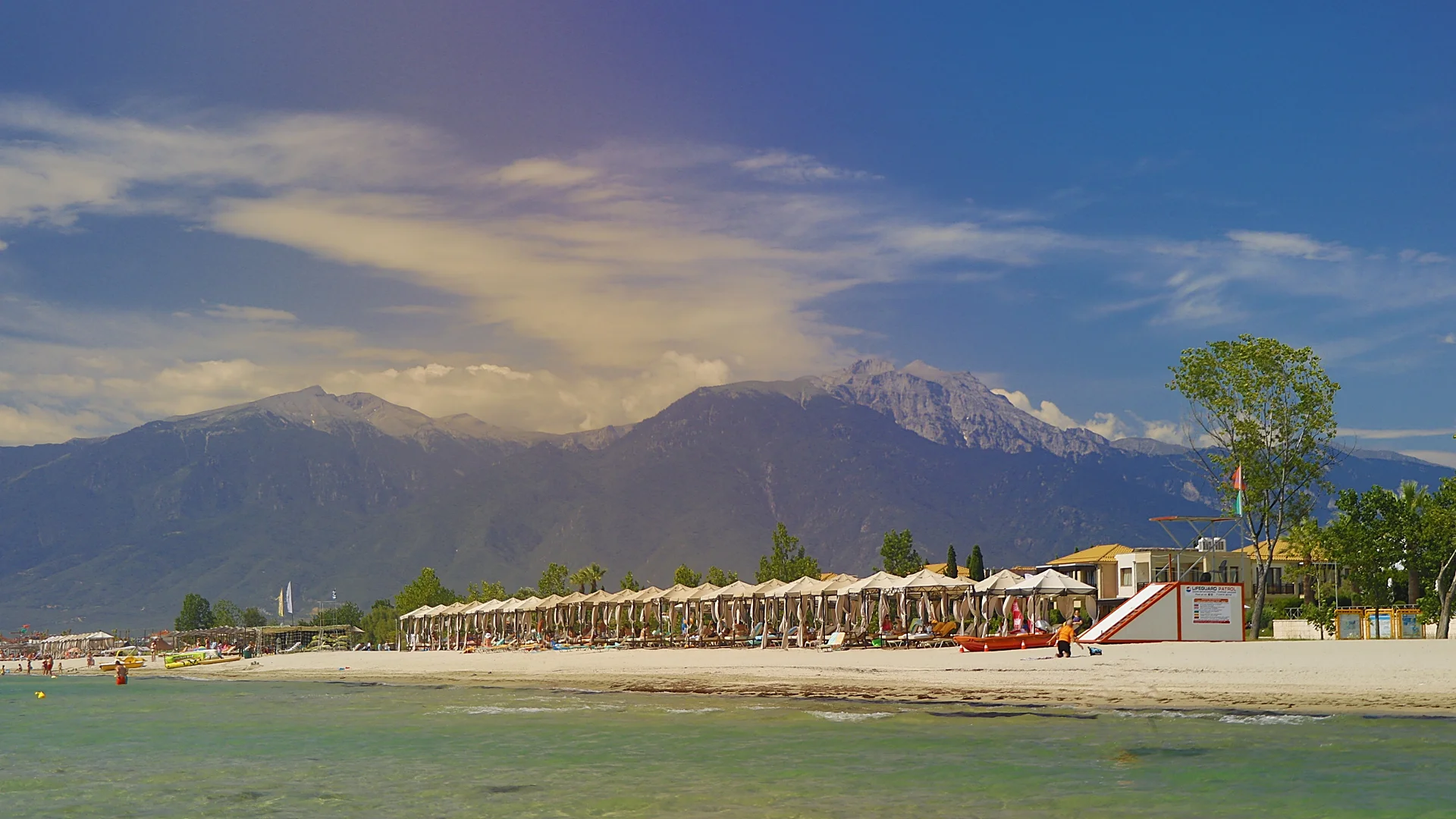
Indeed, the gods, among them Hera, Poseidon, Aphrodite, Athena, Apollo or Hermes, knew what they were doing. From a human point of view, Olympus is an ecosystem blessed with great diversity, both in flora and fauna, thanks to its microclimate, the result of its abrupt elevation and the proximity to the sea. The Aegean lies only 18 kilometers from Litochoro, the main starting point to reach the summit (and the glory), the Mytikas peak. That said, two days must be invested and one must spend the night in one of its refuges. It may seem like a dream, but it is anchored in reality.
Mount Olympus seen from the small town of Petra.
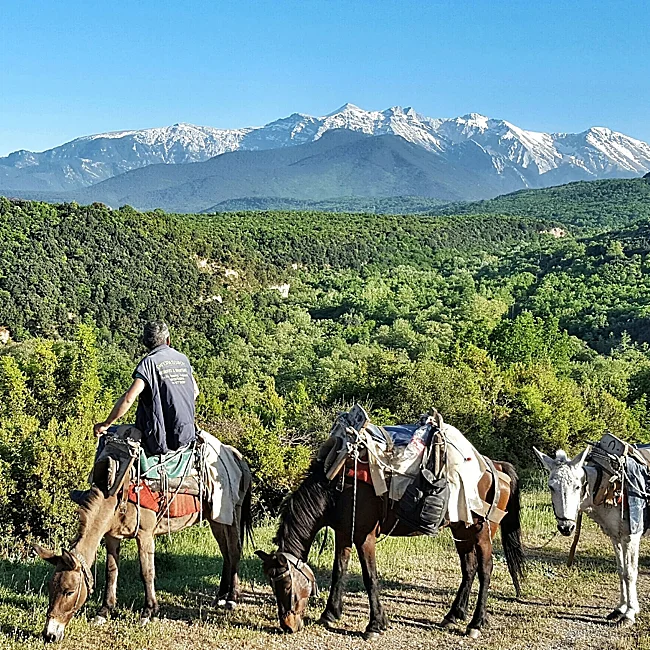
A landscape this is where the Enipeas River carves an impressive gorge, while the Orlias descends plunging in cascades and pooling in crystal-clear pools. Hiking is mandatory, as is visiting the villages that dot its slopes. At its feet, the picturesque Litochoro, with its winding streets, taverns where one can drink tsipouro (grappa) and its buildings of traditional Macedonian architecture, made of stone and wood. Not every day are you between Olympus and the Aegean.
The Most Olympian Villages
To Ano Skotina, at about 700 meters high, it is surrounded by forest and more forest. The houses are from the 17th and 18th centuries, but its church of Agios Athanasios dates to the 14th. It also offers sea views and tempting hiking routes. As for Palaios Panteleimonas, it presents the typical image of a traditional village. And the same goes for Palaioi Poroi, with the same charm, the one of narrow and steep streets, the historic buildings and the Byzantine churches. Always in the shadow of the giant Olympus.
One must not forget Dion, famous for its top-tier archaeological site and a museum of equal standing. It is not surprising, because it was the great sanctuary of the Kingdom of Macedon, that of Philip II and his son Alexander the Great. It is mentioned by the historian Thucydides; it earned a place in mythology, and its name owes to its proximity to the Temple of Zeus Olympios. After serving as a Roman colony, in the fourth century a Christian basilica was built there. It hosts every summer the Olympus Festival, now in its 55th edition.
Litochoro lies at the foot of Olympus and is the starting point to summit it.
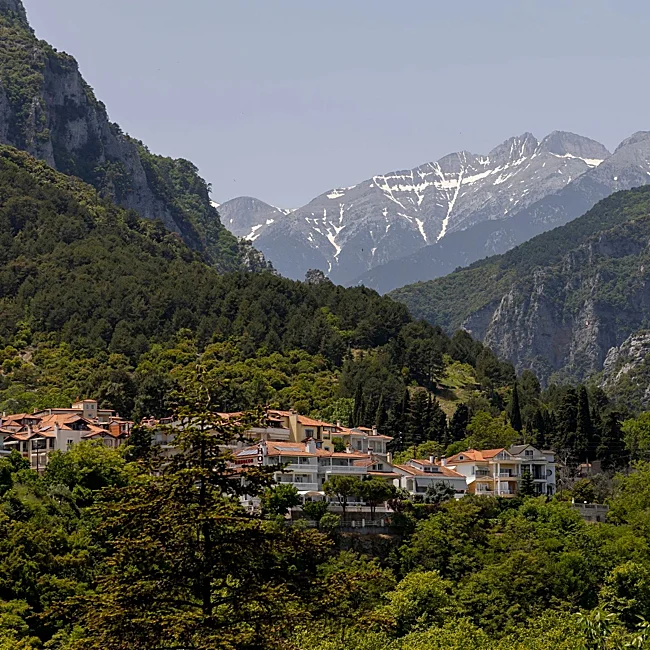
Although the mountain keeps insisting on coming, like an old bolero, the surrounding villages are of a nature that invites you to stay. It happens to Karya, at an altitude of 900 meters, another meeting point for climbers and mountaineers. It happens to Kokkinopilos, the highest of them all, at 1150 m, with a fabulous landscape. And it happens to Elassona, which has preserved almost intact its Homeric name, Olosson. It hosts monuments such as the Panagia Olympiotissa monastery or the Varosi Ottoman mosque. In September it celebrates the Feta Cheese Festival.
Moreover, around the divine mountain rises the Monastery of Agios Dionysos, founded in 1542, at about 830 meters in altitude and in the heart of the Enipeas Gorge, beside the cave where it is said Saint Dionysius prayed. Not far away, near Sparmos, the monastery of Agia Triada, whose origins date back to the sixteenth century. As for the rest, it should be noted that Mount Olympus is unique, but not the only one. There are Olympus peaks in Cyprus, in Turkey, in the United States and even on Mars.