“There is no dog in the Residence of Students. The nights are of absolute silence. In one room medicine is practiced; in another, infinitesimal calculus; in another, legislation; in another, history; in another, roads, bridges toward eternity, verses.” These words by the poet and painter José Moreno Villa help to convey what this Madrid cultural center was like in the twenties and thirties, the years before the war. A hive of activity. Those “bridges toward eternity, verses” to which the Andalusian, tutor of “the Resi,” referred to could have been forged by Federico García Lorca, who arrived from Granada in 1919, or by Rafael Alberti, who came from his Cádiz later on (1924).
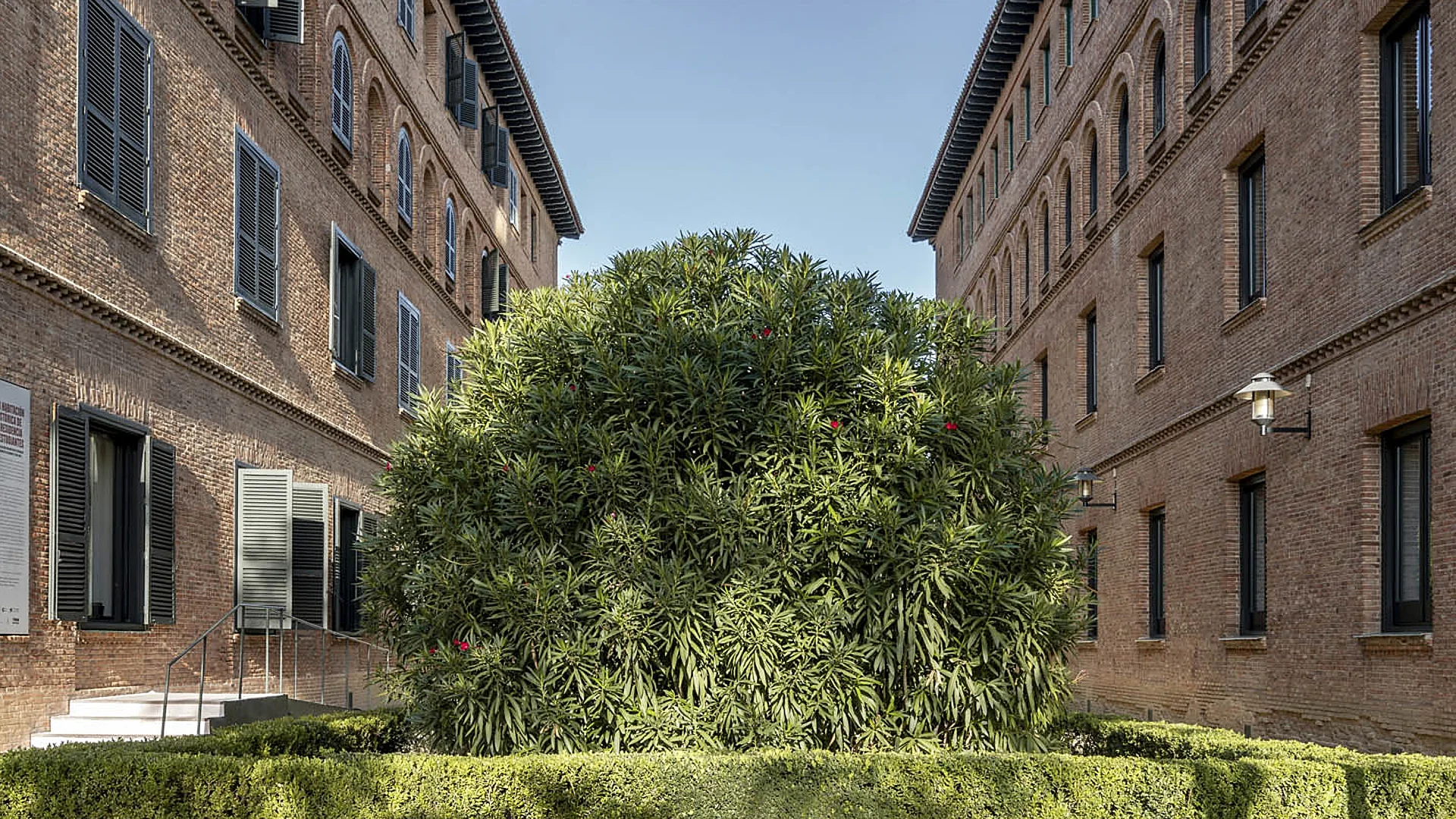
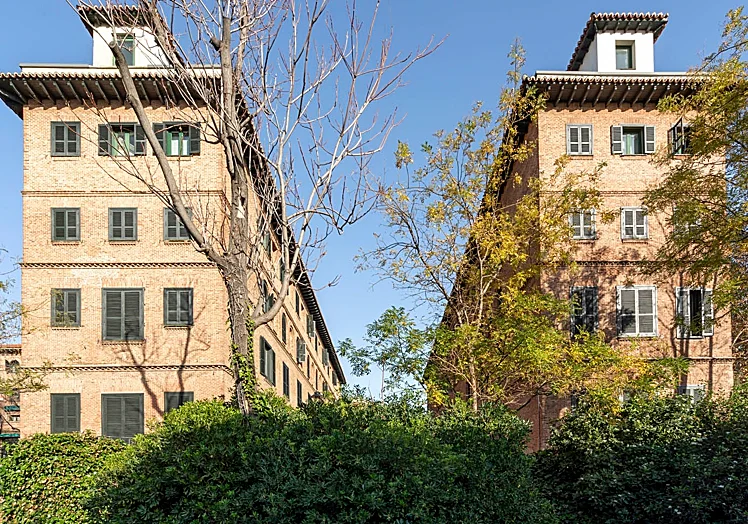
At the same time, in those rooms that Moreno Villa spoke of, the residents stayed—and still stay—within the Twin Pavilions, the first to greet you when you walk up Pinar Street. Each of those pavilions “contains 24 alcobas of 4 by 4 meters, on three floors, with south-facing windows,” as described in the 1914 Report of the Junta para Ampliación de Estudios, the mother house. It is impossible to know which room belonged to Lorca or which to Dalí, who turned up there in 1922. Information was lost after the war. But, to our consolation, one room has been recreated that was not anyone’s, yet could have been everyone’s.
What is known is that they gathered in the rooms to chat endlessly over a cup of tea, with surrealism, which made them go wild with rebellious, anti-bourgeois fervor, in the veins, which could be translated into a daring poem turned inside out or a putrefied one. This is testified by the photo in which Federico is seen in an improvised costume, perhaps a sultan, and the dedication “To Pepín. Memory of our room at the Residence. 1924-25.” Pepín is Pepín Bello, about whom little is said, but who meant a lot. And the room, surely, was that of Juanito Vicens, “a Aragonese devotee of the image of Santa Liberata,” as footballer José Antonio Martín Otín, alias Petón, recounts in his book The Despair of Tea (27 Times Pepín Bello), a virtuoso work published by Pretexts.
Lorca and Dalí at the Residence
The thing is that, in the room of the Huesca-born Vicens, librarian, “the compadres lived their evenings immersed in the density of smoke, their spirits stoked by tea.” The description by Martín Otín is even more descriptive and fascinating: “In the corner of the haze shone a beacon like a voice: Federico García Lorca was telling stories. The others annotated; Pepín Bello, upside down from the world, gave Federico ideas so that the genius could raise towers of words (…). Dalí inhaled the smoke; Buñuel, inside and outside the gathering, would later hear what had been discussed. Hinojosa, a virtual resident, traveled to enchantment, rocked Federico. And Moreno Villa. And Emilio Prados about to return to Málaga. And Alberti a passerby. The others. All together.” To these “lively gatherings of dead poets,” Lorca called them the “despair of tea” and immortalized them in one of his drawings.
The room recreated in the manner of the one Federico García Lorca had.
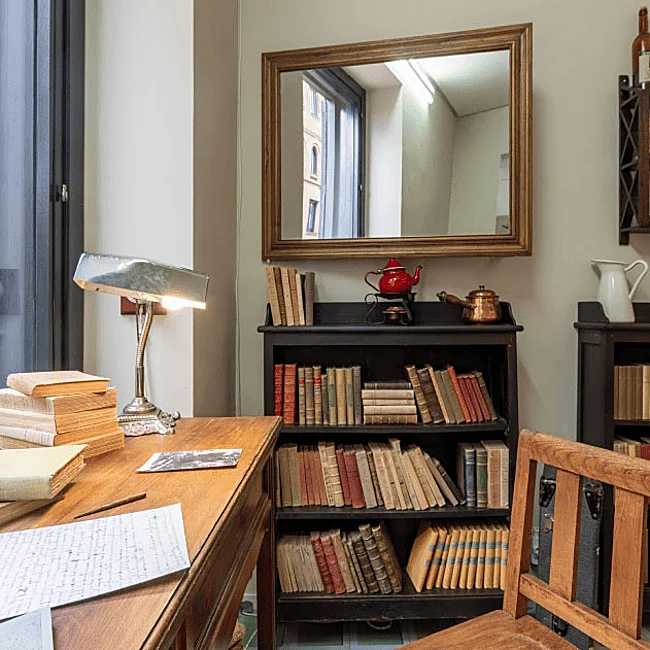
In the midst of the twin buildings, whose walls witnessed so much daring, lies the Garden of Oleanders, the idea of Juan Ramón Jiménez (JRJ), according to all indications, and designed by Javier de Winthuysen in 1915. The curious thing is that the poet from Moguer himself oversaw the planting of trees and shrubs together with the gardener Marcelino, oleanders included, giving rise to what today is known as the Garden of the Poets.
It could not be otherwise, given how inspiring the place was, considered the house of poetry. There, Juan Ramón or Lorca could hear Paul Valéry or Louis Aragon, or witness the publication of Antonio Machado’s Complete Poems on the presses of the Residence, which continues with its publishing work. Since then, Seamus Heaney, Nobel Prize in Literature in 1995, or Adam Zagajewski, Prince of Asturias Award in 2017, have passed through here.
Putrefacts and Anaglyphs
The verses were joined by drawings. Or rather, the putrefacts, which marked the era. According to Rafael Alberti, who attributed the invention to Pepín Bello, they referred to “the caducity, the dead and the anachronistic that many beings and things represented.” Dalí jumped on the bandwagon and began to shape the concept in drawings that he would later collect in a book with a Lorca prologue, but it never reached publication. The putrefacts were not alone, but accompanied by other mischiefs, such as the annual representation of The Profanation of Tenorio, a parody of Zorrilla’s work, or the anaglyphs, four-line poems with two repeated nouns, a third that must be “hen,” and the last, as outrageous as possible. A famous example: “The tea/ the tea/ the hen/ and the Teotocópuli.”
The Twin Pavilions overlook the Hill of the Poplars complex.
With all this in mind, and perhaps beyond, there is no denying how therapeutic a walk on the Hill of the Poplars, JRJ’s nickname, is at every level, after climbing up the Pinar slope along a path flanked by lavender, lilacs and rosemary. It includes the Gardener’s Hut, i.e., Marcelino, which anticipates the architecture of the rest; and the Canalillo, a small irrigation ditch that runs along one boundary of the garden, parallel to the wall of the Natural Sciences Museum. It gave the residents no small joys.
Oxford in Madrid
The Residence of Students, created by Francisco Giner de los Ríos in 1910, with the complicity of Alberto Jiménez Fraud, its first director, in the manner of those in Oxford and Cambridge, was “one of the most fertile experiences of creation and exchange of science and art in Europe in the first third of the twentieth century,” the institution recalls. Here passed Miguel de Unamuno, Emilia Pardo Bazán, Einstein, Gropius, Marie Curie, or Stravinsky. A culture of friendship, creative leisure, and love of nature was cultivated.
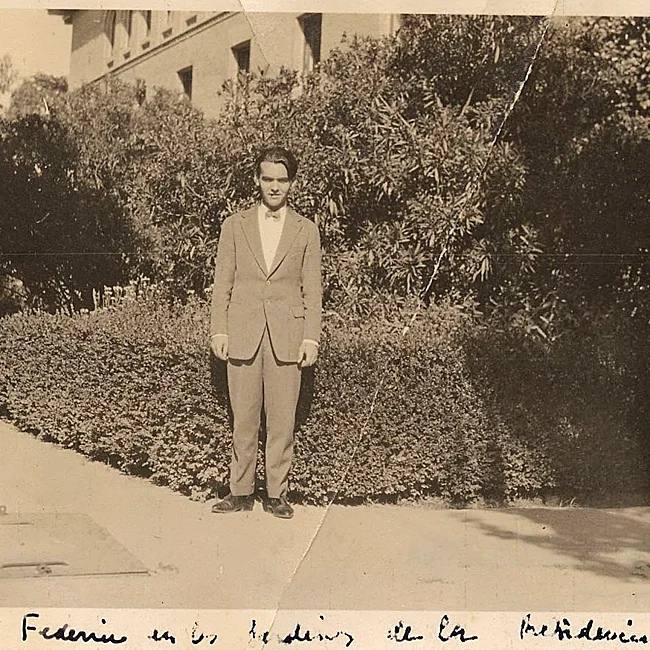
Federico García Lorca in the residence gardens, where he stayed between 1919 and 1928.
Not to forget that its women’s group, the Residence for Ladies, directed by María de Maeztu, has gone down in history as “the first official center created in Spain to promote higher education for women.” It had Victoria Kent as a student and María Zambrano as a professor. Its headquarters? The little hotel at Fortuny Street number 14, where it all began. They settled there when “the Resi” moved to Pinar, 21.
The Silver Age and the War
The dream faded — this one too — with the Spanish Civil War. Its director had to exile and the last residents were evacuated. In 1937 it became the Carabineros Hospital. Later it became a residence for researchers of the newly created Consejo Superior de Investigaciones Científicas (CSIC), and the Auditorium, which had debuted in 1933 with a concert by La Argentinita with Federico at the piano, was consecrated as the Church of the Holy Spirit. In 1986 the miracle happened: it became the Residence of Students again, a place of memory, but also a place to continue cultivating the arts, science, and the humanities, with significant cultural activity and a group of young fellows. Reliving that Silver Age.