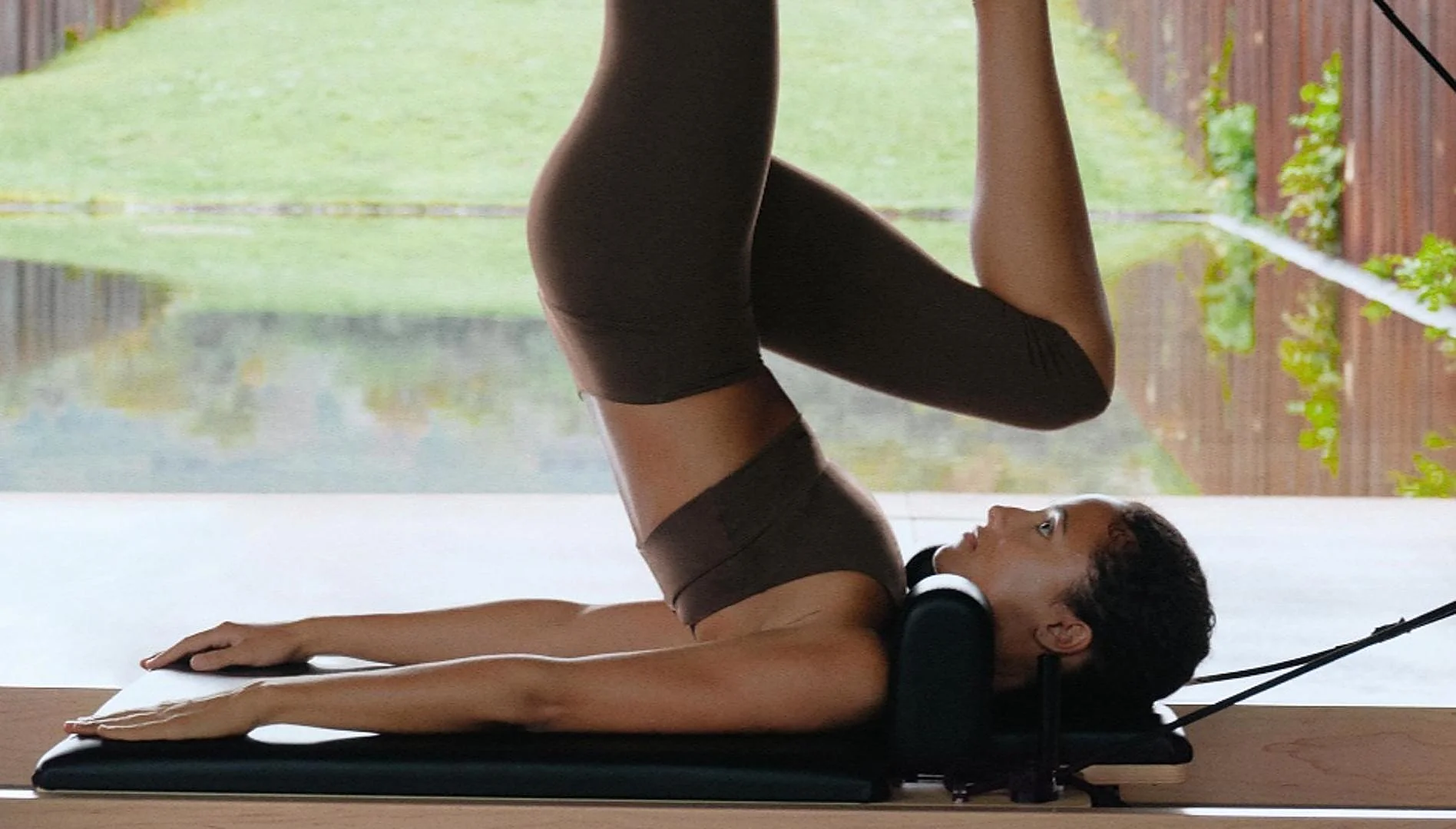
The roll down may seem like a simple forward-bending movement. In reality, it is much more complex. Laura Cabral, a Pilates teacher at Corpora Pilates, explains what happens in the body during its execution: “The lumbar, thoracic joints mobilize and there is cervical elongation. When returning to the initial position, the core is activated and, to finish, there is an extension and elongation of the entire spine from the lumbar region, strengthening the extensor musculature that keeps the spine upright.” Flexion, activation and extension, in a single exercise.
Doing it on the reformer changes the quality of the work compared to the floor entirely. “The resistance offered by the springs certainly changes the exercise because they assist the muscular work: the abdominals and the arms, and the person can focus better to achieve the precision that is the key to the exercises as we teach them,” Cabral explains. On the floor, the work depends solely on the student’s strength. On the reformer, that assistance frees attention for what really matters: the control of each vertebral segment.
That precision does not appear by chance. The Dr. Juan Bosco of Corpora Pilates recommends a preliminary step: “It is advisable to have done beforehand, for example, the bridge on the floor, since the person must have proprioception of their lumbar area and how to articulate it.” From there, breathing comes into play, the instructor’s tactile assists on the areas to move at each moment, and the concentration seeking precision, always guided by the instructor.
When it is advisable and when it should be avoided
As with any Pilates exercise, progression is key. “Start with less demanding movements until the fitness adapts to the more advanced version”, says Cabral. If there is dorsal stiffness, it is preferable to work first with mobilizing exercises in both flexion and extension. With hyperkyphosis, that preparatory phase is even more important.
In chronic lumbar tension, the roll down is not the first option. “It is not advisable to do it until there is good strengthening of the core without flexing the lumbar spine,” warns Dr. Juan Bosco. There are cases where it must be avoided outright: “It should be avoided if there is a herniation or protrusions.”
Is it really the most complete exercise for the spine?
Within the Pilates method, the answer is not so simple. “There are several more complete exercises”: do not forget that Joseph Pilates designed other apparatuses that provide movements that on the reformer are more demanding or are not done the same, notes Cabral. The reformer has its own variants that complement the needs of each person to achieve a healthy spine for sure.
“The roll down is a great exercise, but not the only one,” summarizes Cabral. Its value lies in integrating mobility, core activation, and strengthening of the extensor musculature in a single movement, working several abilities at once efficiently. Precisely that combination, together with the improvement of body awareness and postural control, is what makes it such an interesting tool.
Performed with good technique, it trains the spine vertebra by vertebra, a type of work rarely practiced outside Pilates. And that learning doesn’t stay on the mat: it shows in everyday gestures such as bending to pick up something from the floor or turning to look behind, movements that are almost always done in a block and without any awareness of which part of the back is working. For someone starting Pilates or returning after a break, the roll down is usually one of the first exercises where a real difference is noticed: less stiffness when bending, a greater sense of a long and free back. A small change in appearance, but with a lot of mileage behind it.