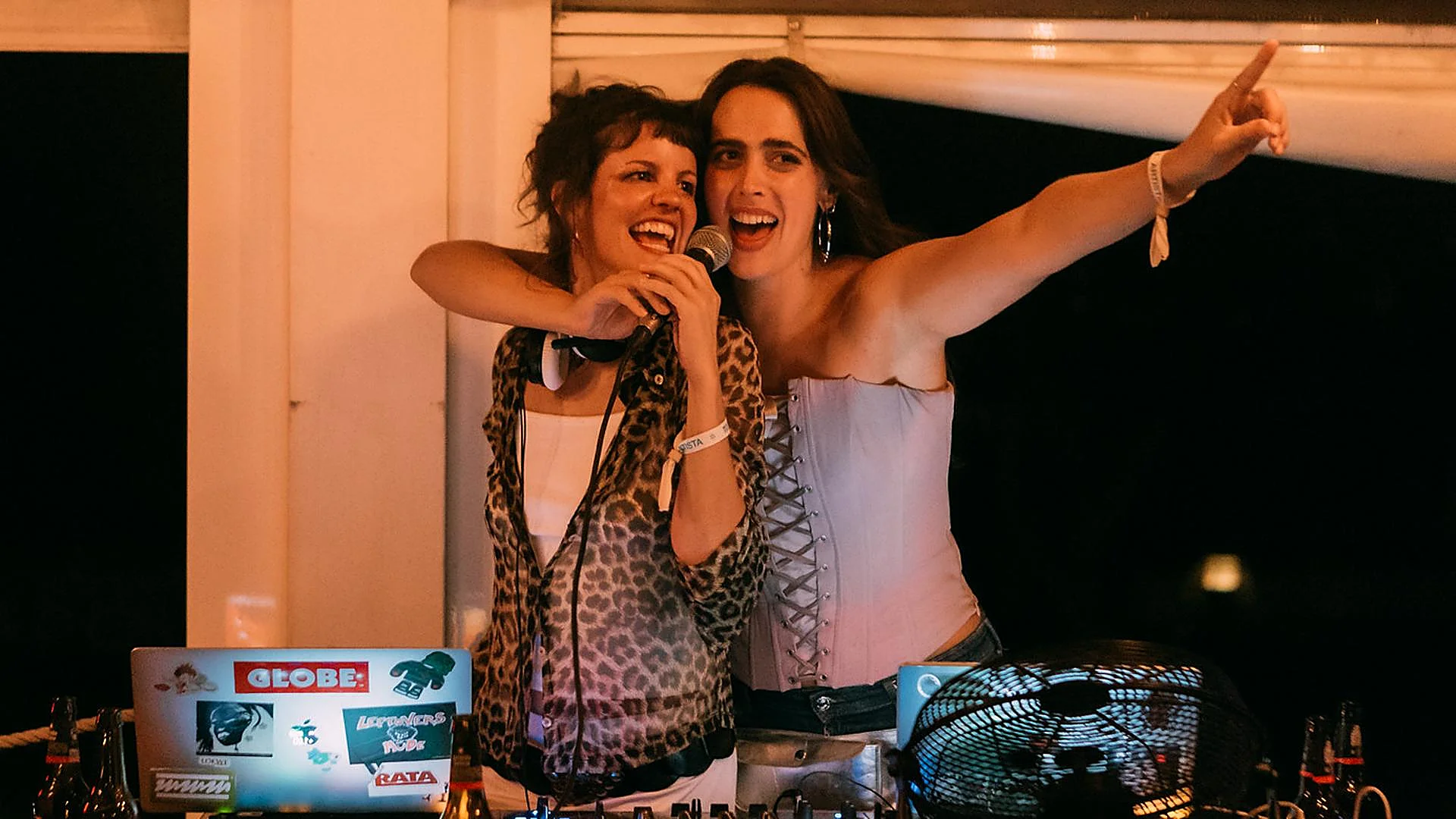
When Hinds began playing in Madrid in 2011, there weren’t many bands like them. Ana Perrote and Carlotta Cosials formed part of a new generation of female groups that broke with a scene still very male-dominated and carried the Spanish garage rock far beyond our borders. They did so, moreover, in their own way, not conforming to the expectations that for years had surrounded women in rock: they built their own identity and ended up becoming one of the Spanish bands with the greatest international reach.
Since then, their track record speaks for itself: they have toured all over the world, they have played at some of the most important festivals on the planet — they were the first Spanish band to perform at Coachella and also to perform on one of the main stages at Glastonbury— and they have shared bills and stages with names such as The Strokes, The Black Lips, or The Libertines. In 2016 they also became the first Spanish group to perform on The Late Show with Stephen Colbert, one of the most important late-night programs on American television.
From that first international leap to today they have released four records, have weathered a pandemic and several lineup changes. Viva Hinds, released in 2024, marked the start of a new chapter for Ana and Carlotta, who now continue the project as a duo. We meet them in Formentera, where they have been part of the lineup of the tenth anniversary of SON Estrella Galicia Posidonia, to talk about these years, how the band has changed, and what they have in store now.
Hinds has existed for more than a decade. If you could sit down right now with the Hinds who started, what would you tell them?
Ana: That everything is going to be alright. We enjoy it a lot, but there were moments when I let some criticisms sink me too much, even the envy of people close to us. We did very well and very fast, we were very lucky, and that sometimes made us feel a bit bad. It was as if we had to celebrate something in a room, in private, and then think about how to tell certain people. With time you realize it isn’t worth living like that. Besides, those people are no longer in our lives.
Carlotta: I would tell them not to make any decision out of fear. I think at the beginning we did very well and, if I could talk to the Hinds after the first album, I would say: “Ignore everyone. Trust your instincts. Trust Ana. You are the core of all this.” Sometimes you doubt because you think others will be right, but making a decision out of fear is never a good decision.
In all these years you have experienced successes, travels, changes and also difficult moments. What have you learned from each other?
Carlotta: The sense of humor. In the face of the greatest misfortune, humor is an incredible survival tool. It makes everything a game and allows you to downplay things even when you’ve messed up. It happened to us with something as silly as getting a merch order wrong: you know you’re going to mess it up anyway, so you make a joke and everything becomes much more bearable.
Ana: And learning to not care so much. In this job it’s very easy to obsess and take everything too seriously. Humor helps to take the edge off and to keep our feet on the ground.
In your work, uncertainty seems to go hand in hand. You don’t know what will happen with a song, a tour, or even with your own life. How have you learned to live with it?
Ana: I rely a lot on Carlotta because she has a completely different personality from mine: she thinks everything will turn out fine and I tend to think the opposite. So, in moments of uncertainty, I try to borrow a little of that way of seeing things. It also helps having gone through so many situations: even if things don’t turn out as you hoped, you know that somehow they will work out. We adapt fairly well.
Carlotta: Also, when you decide to be an artist, uncertainty comes with the territory. It is very hard to ask the art world for financial or future security. Times change, the audience changes, and everything is in motion. You have to learn to live with that.
How does a Hinds song come to life? Does a melody, a phrase, a guitar, a story appear first…?
Carlotta: There are a thousand ways to write. Sometimes you try to recover something that worked for you in another song, but suddenly it won’t work and you have to find a new way. We tend to rely on chords or on some musical idea; writing from scratch has rarely worked for us. In reality, our process is very varied.
Ana: With the lyrics we like to work when something has just happened to us. We practically see each other every day, so we know what is happening in our lives, what we are feeling, what book we have read, what movie we have seen, or what conversation we have had. When something moves us, we talk about it and, if we are very excited, angry, or even crying, it is a very good moment to write.
Carlotta: That’s why it’s so important not to let a song slip away. Everything in life passes and, if you don’t write something within three days, you can stop remembering exactly what you felt. You can try to recreate it later, but it won’t be the same. To put your guts into a song you have to capture it in that moment.
Is there a Viva Hinds song that you now understand differently than when you wrote it?
Carlotta: Yes. In fact, I would change a part of the lyrics of Coffee, the part that says There’s nothing as sweet as living in Madrid. It’s a line we wrote in a moment completely different from the present. If we played it today, I would have liked to change it.
If you had to choose one Viva Hinds song to explain who Hinds were at that moment, which would it be?
Ana: Superstar. Although there’s something important: those songs were written between 2022 and 2024 and quite a bit of time has passed. They represent a lot of what we were during those two years, but we aren’t exactly those people anymore.
Carlotta: There’s always the need to move forward. Even if what’s new hasn’t come out yet, for us Viva Hinds already represents an earlier version of Hinds.
Hinds was one of the bands that opened the path in this new wave of female bands in Spain. Do you think today a girl who wants to form a band faces a world different from the one you faced?
Ana: It’s a different world and I’m very glad, but it’s far from perfect, fair, or egalitarian. No one should have gone through what we’ve gone through. If we had been a boys’ band, we would probably have enjoyed that era a lot more because we wouldn’t have been criticized in the same way.
I also believe there is now a very beautiful network of support among girl groups, at least in Madrid, which is the scene we know best. We help each other, we talk among ourselves and there isn’t as much pose. But that doesn’t mean everything is solved. I’m sure we still get paid half. At the end, the audience remains Spanish society, and society doesn’t change that fast.
Carlotta: The world has changed, but we’re still not at the finish line. So yes, there are still reasons to be angry.
What continues to bother you about questions asked of women musicians that would never be asked of a group of men?
Carlotta: They don’t have to talk constantly about how they feel or answer questions about feminism again and again. And I think we should turn the tables. Feminist questions should be asked of men: “What are you doing to make the world more feminist?”.
Ana: It drives me crazy to see, for example, lists of the best concerts or favorite bands in which not a single woman appears. We’re not talking about having 50% representation. I’m talking about, among five bands you admire, having at least one woman who inspires you enough to be there. I can’t understand that they don’t even notice.
Carlotta: We need to shift the focus. Feminist questions have to affect them. It can’t be that they look the other way as if the feminist struggle has nothing to do with them. If we’re talking about genuine feminist struggle, the problem is also with them. They are the ones who have to become aware, learn, study and change.
After all you have lived through, what continues to excite you and what scares you?
Ana: Right now we’re at a very exciting moment. Viva Hinds has worked very well and has placed us in a position where we can regain excitement without being completely overwhelmed, taking each decision by every single cent.
We’re thinking about a new album and, above all, about a new live show. We want to put on a bigger show, devote more time and care to it, and have it bear no resemblance to what has been seen of Hinds so far. We’ve been doing this for many years and we feel like giving it a radical turn.
That fills us with a lot of excitement, but also quite a bit of fear because it means stepping out of our comfort zone. Right now I’m more comfortable on stage than in my own home. Breaking that comfort and betting on something completely different gives me a little fear but also a lot of excitement. It’s about allowing yourself to play.
If we sit down again to talk ten years from now, what would you like to be able to tell me has happened between today and that day?
Ana: I would like to be able to tell you that there has been a housing decree in Madrid and across Spain that prohibits vulture funds, limits Airbnb and tourist apartments and imposes taxes for those who own more than two units.
Carlotta: That would make Spain economically phenomenal: salaries would rise and the country would become a much more attractive place. And, in the meantime, Hinds would have made a really weird record that nobody trusted at first: “This is going to be too strange.” And suddenly everyone would say: “No, no, no. This is amazing.”