After strolling through Agua Amarga, the white village with maritime charm at Cape Gata (Almería) and watching the most prodigious sunset in Barbate, a fishing town in Cádiz, we set our course northwest with the clear intention of soaking in the Galician sea. And there is nothing better than doing it in a typical Galician coast village like O Barqueiro, in A Coruña. Just hearing its name puts us in the mood, reminding us of Maqroll el Gaviero, Álvaro Mutis’s old sea wolf who spoke every language on earth. O Barqueiro gets its name from the ferryman who carried people and goods from one side of the estuary to the other until a bridge was built in 1901, at the initiative of Juan Fernández Latorre, founder of La Voz de Galicia and republican deputy for Ortigueira at that time. A century and a quarter has passed already.
The ferryman, like Konchalovski’s The Postman of the White Nights (a 2014 film), came and went in a single endless voyage, along an estuary, in this Galician case one of the smallest in Galicia and perhaps for that reason one of the most beautiful. Its geography is also remarkable for its beauty at the edge of the land and beyond, as it is the meeting point between the Atlantic and the Cantabrian seas, whose waters mingle at Cape Estaca de Bares, in the municipality of Mañón, the northernmost point of Spain and of the Iberian Peninsula. From Estaca de Bares and Cape Ortegal, in Cariño, what is essentially the Ortigueira estuary, and up to the border with Portugal at the mouth of the Minho, extends the most rugged coast of the Spanish littoral. In Europe, only the Breton coasts compare.
These landscapes are also a true bird sanctuary after summer, when the migratory passage from Iceland, Greenland and northern Europe toward warm Africa arrives, and they soar over these seas in an unparalleled choreography, seeking shelter in the ruins of the old Benedictine monastery – ruined by Norman incursions – on the island of Coelleira, the largest of the Cantabrian islands of Galicia, now in Lugo, facing the tip of Vicedo. The island, where a evocative lighthouse stands, has an irregular trapezoid shape and today is covered with grass, but in times past it hosted fields of wheat.
What to see in O Barqueiro and the surrounding area
In nearby Loiba, to top things off, lies what they call the most beautiful bench in the world, at the O Coitelo viewpoint, and we wouldn’t dare to disagree. Its impressive cliffs, the Picóns de Loiba, which form furnas “where the sea beats and sings its night full of fish”, as Lorca put it, were the setting for Bad Education, by Pedro Almodóvar, and above all we want them to be ours. The hiking route that runs along it, within the Cantabrian Route Natural Path (Camino Natural de la Ruta del Cantábrico), is frankly mind-blowing.
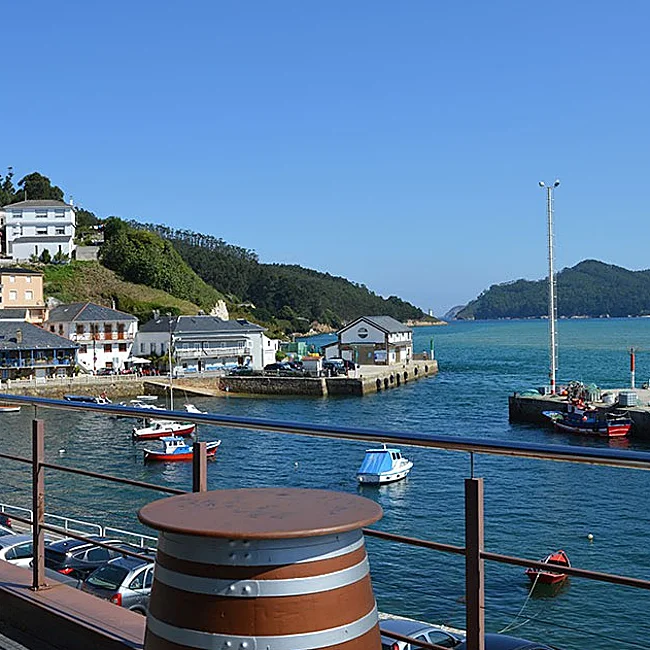
O Barqueiro is a very authentic fishing village in the Rías Altas.
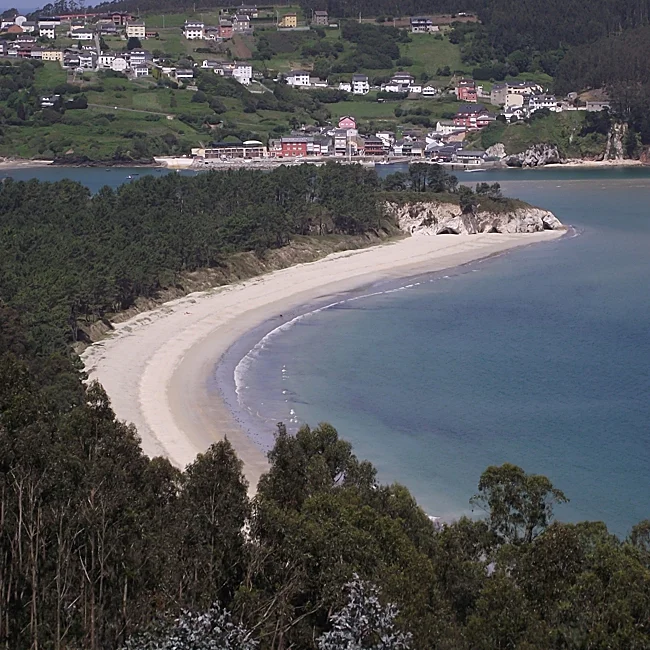
O Barqueiro, which we had left behind, sits right at the mouth of the Sor, a salmon river that traces upstream the natural boundary between the provinces of A Coruña and Lugo, and forms here its estuary, between the sandbank of the Arealonga beach in Lugo’s Vicedo, shaped like a shell, and the Punta de Barra lighthouse.
Beyond its geographic location, south of the Bares peninsula, which already makes it very special, what surprises about this small
An estuary and three bridges
There was a time, back in the eighteenth century, when this harbor was as bustling as Bares, with small boats engaged mainly in sardine fishing. According to the Madoz dictionary, in 1847 the Mogor parish counted 1,015 inhabitants and maintained active three salt-curing factories, six linen and burlap weavers, four flour mills, a grocery shop, and two taverns. The iron bridge, inaugurated at the same time as the twentieth century, marked the end of the ferryman and, at the same time, the improvement of communications between the districts of Viviro and Ortigueira. O Barqueiro became the administrative and service center of Mañón, eventually housing two schools, one for boys and one for girls.
The Arealonga Beach is now in Lugo.
The salt-curing tradition continued and so did coastal navigation of ships that unloaded salt and coal and loaded kaolin and timber. Now what predominates is fishing and shellfishing, to which tourism has increasingly joined. Who wouldn’t want to visit a village like O Barqueiro, with the three bridges over the estuary that allow crossing the Sor estuary: the old one (1901), pedestrian only; the rail bridge (1960), and the new one for vehicle traffic (1980).
Where to eat in O Barqueiro
The fruits of the sea can be tasted at the A Sobreposta restaurant, in the area of the same name, named after the two large rocks that preside it, stacked one on top of the other. It opened its doors in 2011 with the aim of combining “fresh produce and quality with the wonderful views of this port,” they say.
The maritime feast includes cockles, razor clams, vieriñas, clams, crab claws, or langoustines grilled, which share the menu with croquettes of lacón infused in cocido broth, a mushroom risotto with fried squid, the day’s fish, or the seafood rice and lobster dishes. The desserts are equally tempting: rice pudding with chestnut ice cream; coffee semifreddo with orujo cream and a crumble of nuts, cookies and salted chocolate, or a simple artisanal yogurt.