The success in comedy ofThe Curse of Widow’s Bay was more or less clear from the moment, episode after episode, it became the series that everyone had to watch. In drama, the fight between The Pitt and Pluribus was expected to be tighter, perhaps because of the nominations haul of the first. In the end each went home with seven awards. What no one suspected was that in the miniseries category, Emmy night would crown a winner that had made little noise and had to overcome fictions like Love Story or Bronca. But that is how it happened.
Everything began to take shape last weekend, the date on which the television awards organization relegates the technical awards and the minor acting honors. This year the Best Supporting Actor and Best Supporting Actress in a Miniseries categories sneaked in there for the first time, perhaps because they themselves were aware that the nominees did not have the solidity and charm of the nominees in previous editions. Perhaps simply because there isn’t time for everything and someone had to be sacrificed.
The case is that Linda Cardellini and David Harbour, who competed in the category with his fellow cast member Jason Bateman, arrived on Monday night, the night of the Emmys’ biggest night, with a pair of recognitions as best supporting actors in miniseries. And the creator, Steven Conrad, had already picked up Best Director and Best Script. So, let’s face it, when Oscar Isaac went home without the Emmy for Best Actor in a Miniseries for Bronca, (because Matthew Rhys had gone for what they’d invited him for, all of it), the die was cast: DTF St. Louis was going to be proclaimed the Best Miniseries. And it was.
The Sad Midlife Crisis
But what is this miniseries with such a peculiar title about, that few have talked about until today? According to Conrad, a screenwriter among others of The Secret Life of Walter Mitty, the series is inspired by his married friends and their use of dating apps (because the show’s name comes from there). But in reality, HBO’s initial idea (which Conrad eventually discarded) sprang from the case of a New York dentist accused of murdering his friend because he maintained a romantic relationship with the deceased’s wife.
David Harbour and Jason Bateman in an image from DTF St. Louis.

Conrad had already created a fictional world when the platform approached him with the proposal, and together with David Harbour, who also worked on the creation of the series, they continued with their ideas. And they turned DTF St. Louis into a black comedy in which two men start to work together, become friends and then, once again, life lets one of them down. The existential void of midlife, sex in long-term relationships, the inability to connect with new generations and the aforementioned apps as a place to find a new vital spark are some of the central themes of the seven-episode production.
Harbour and Cardellini are Floyd Smernitch and Carol Love-Smernitch, a couple with many bills and few plans in which communication is not abundant but affection is. But of course, that may sustain a couple, to whom is added her child from a previous relationship who is now a teenager, but it does not fill their intimate lives. Fortunately, Floyd begins working as a sign-language interpreter in the weather segment of a local network, and there he meets Clark.
Friends Forever
In a short time Clark and Floyd become friends and the former goes with his family to a modest party that the latter throws in his garden. There, the weather man meets Carol and falls in love. Or perhaps she falls for him. Whatever the case, both do a lot to meet again, first in public and then in a motel. And while Clark beds her, he becomes the best friend of him. Until Floyd turns up dead at a municipal facility and the personal stories of the protagonists join with the mystery of who killed Harbour’s character.
Richard Jenkins and Joy Sunday in an image from the miniseries DTF St. Louis,
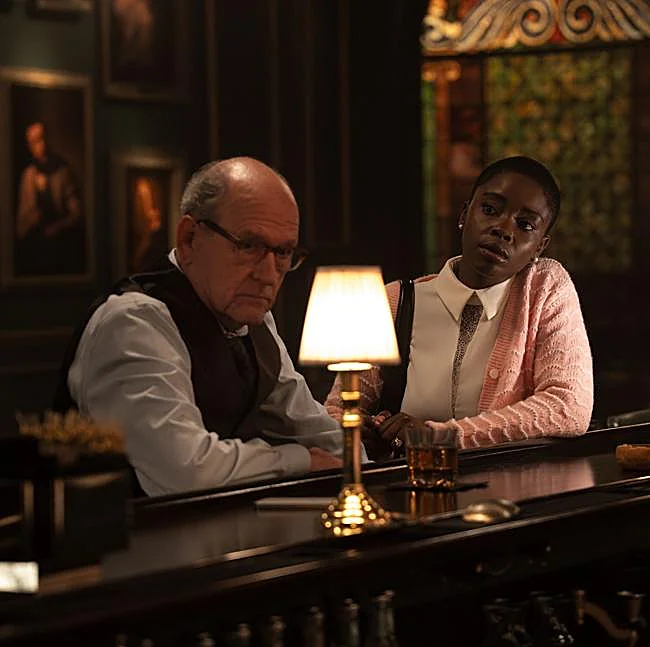
The conflict of DFT St. Louis is not about infidelity or betrayal, but about the existential sadness of the Smernitch lives, Floyd’s depressive tendency, the string of misfortunes that happened to him at a moment in his life and have marked him forever. In fact, the detectives Homer and Plumb’s investigation (with Richard Jenkins and Joy Sunday bringing to life the best of the series) serves to reveal this love triangle and reflect on lost illusions, loneliness, lack of intimacy and whether sex can solve it all.
The existential sadness of the characters permeates every minute of the production and no matter how funny the surrounding events, or their circumstances or their clumsiness, it is sometimes difficult for DFT St Louis to feel like the comedy it aims to be. And for me, who could not empathize with the trio of leads and their circumstances, their seven Emmys are the one-eyed man in the land of the blind. Those were the days when the Emmy Miniseries category recognized productions like Chernobyl, and chose The Queen’s Gambit over Mare of Easttown or My Plush Reindeer, instead of Ripley.