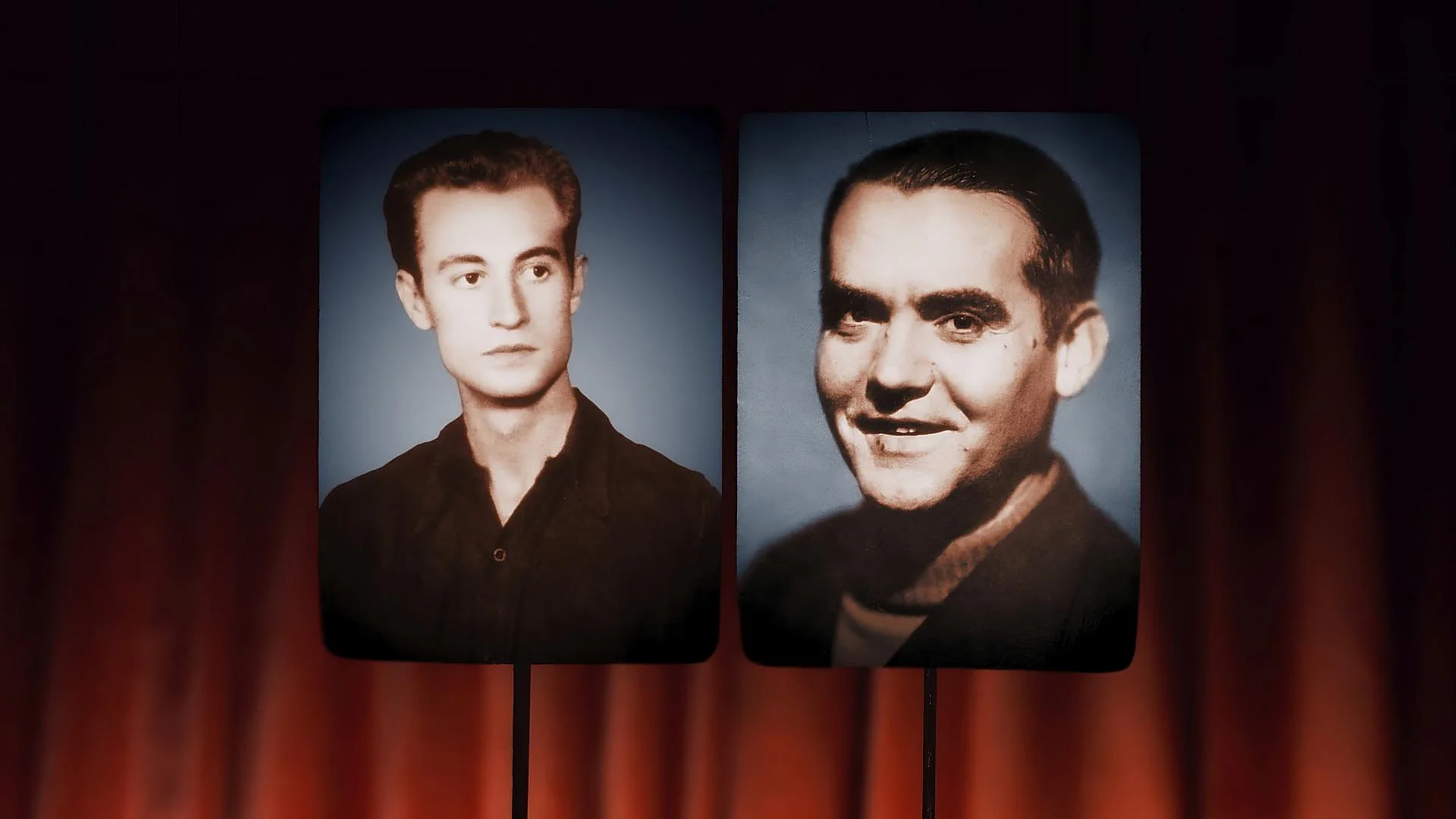
The phenomenon of La bola negra, Javier Calvo and Javier Ambrossi’s film, has once again awakened interest in Federico García Lorca. His life, his relationships, and everything that for decades was concealed around his figure continue to arouse interest almost a century after his murder. For those who have been left wanting to know more about the Granada-born poet, La voz quebrada is one of the films worth discovering. Manuel Menchón’s documentary delves into a part of his history that remained secret for decades: his relationship with Juan Ramírez de Lucas, considered his last love.
Premiered in cinemas on October 16, the film draws on the documents and memories that Ramírez de Lucas kept throughout his life and that only came to light after his death, in 2010. Letters, diaries, photographs and other materials allow reconstructing a relationship that was marked by the circumstances of Spain in 1936. Lorca and Juan wanted to go together to Mexico to start a new life away from a society in which their relationship could not be lived freely. That journey never took place: weeks later, the poet was killed in Granada.
Federico García Lorca’s Last Love
The relationship between Lorca and Ramírez de Lucas is one of the documentary’s central points, but Menchón does not limit himself to reconstructing a romance. The film also shows the weight that silence had in Juan’s life, who kept his story with the poet secret for more than seven decades. The fear of rejection and the political and social circumstances of the time help to understand why such an important part of both of their lives remained outside the public narrative for so long.
The film also allows approaching Lorca from a different angle than the writer we study in school. Here appears the man who wrote love letters, made plans for the future, and had a personal life that did not always fit the public image that was built of him. It is precisely this perspective that connects with the interest awakened by La bola negra: both works recover the relationships and desires that had to remain hidden in a society that did not accept homosexuality.
Unpublished Images and Real Documents
One of the film’s greatest attractions is in the materials it uses to tell the story. In addition to letters and diaries, the documentary recovers unpublished moving images of Federico García Lorca, including recordings related to La Barraca, the university theatre company with which he toured Spain. They are documents that allow us to see him beyond his most well-known photographs and to approach a less common facet of his life.
Manuel Menchón combines these materials with the voices of several actors who interpret the protagonists’ texts and memories. Álvaro Morte provides the voice for Lorca, while Francesco Carril takes part in recreating Juan’s story. The film thus alternates historical investigation with a more cinematic narration, aided by archival footage, readings, and music. The result is not a conventional documentary based solely on interviews, but a reconstruction that uses the documents themselves to shape the narrative.
La voz quebrada has a particular appeal because it does not focus solely on Lorca’s death, but also on the life he could have had. The plan to depart for Mexico with Juan allows imagining another ending to a story that was interrupted by the coup and the poet’s murder. The film cannot change what happened, but it recovers a part of his life that for a long time was relegated.
The documentary may be especially interesting for those who have enjoyed La bola negra and want to delve into Lorca’s personal dimension, though it also functions as a standalone work. Its main value lies in rescuing documents that help us know the writer better and to understand the price paid by those who could not live their identity freely. Ninety years later, the story of Federico García Lorca still has much to tell, and this documentary demonstrates that there are still aspects of his life to be discovered.