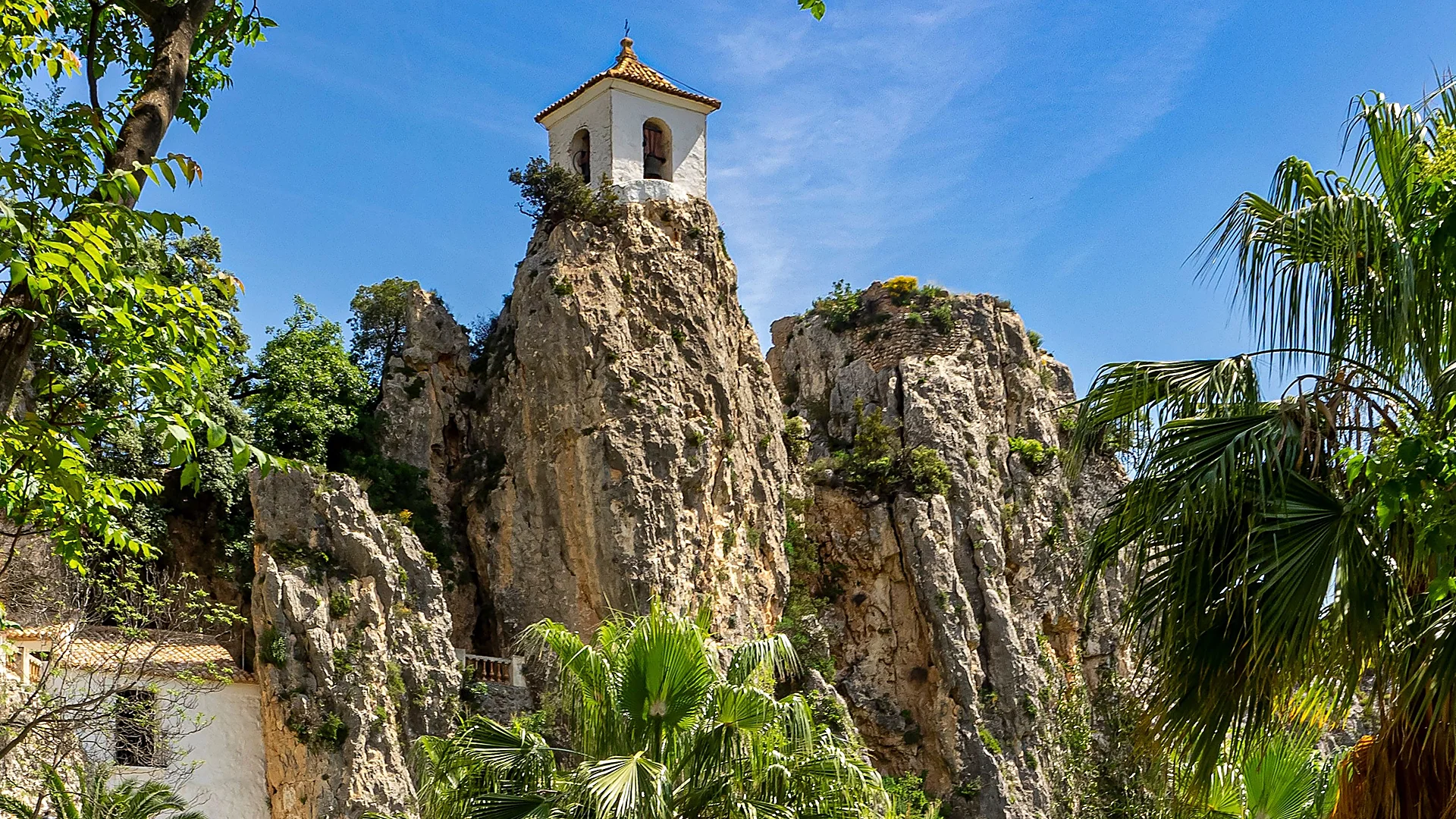
We could say that Guadalest, officially El Castell de Guadalest, is the prettiest town in Alicante, with the permission of Altea and its iconic blue domes. But that designation falls short. It does not do justice to this municipality that knows nothing of vertigo, perched on the jagged heights frequented by birds and hikers, and that rises in the midst of a verdant garden with oasis-like features, between citrus groves and palm trees. It even has a turquoise waters reservoir at its feet. Perhaps it should be likened to Frías, the town in Burgos with hanging houses, or Castellfollit de la Roca, nearly a miracle in Garrotxa (Girona), in order to fully capture its unchanging beauty.
Guadalest, from the Muslim era and conquered by Christians in the mid-13th century, has become a top tourist destination because, besides its charms, it lies only twenty kilometers from Benidorm. Although one must conquer it via a winding road, as one would expect from such an exceedingly picturesque destination. Two worlds opposites at a short distance on the Costa Blanca. From the grandeur of skyscrapers competing to rise higher than the quaint cobbled streets that climb to fit a difficult terrain.
This inland municipality of Alicante, belonging to the comarca of la Marina Baja, sits at an altitude of 595 meters, surrounded by the peaks of the Xortà, Serrella and Aitana ranges, forming a monumental mountainous relief. From afar you can clearly see how the houses, with whitewashed walls, cling to the topography. Up close, once you have crossed the portal of San José, a pass carved into the rock, you get the sense of being in a place isolated in space and frozen in time. Rich in craft shops and regional products, that is for sure.
What to See in Guadalest
What gives the ensemble its power, besides the surroundings, is its strategic position, provided by the Castle of San José, a fortress from the XIth century that played a decisive role in the Medieval and Modern eras, and which survived poorly to wars and earthquakes. There is another one, the Castle of Alcozaiba, from the same period and also Muslim, located between the noble house of the Orduña and the parish church, of which only a ruined tower remains.
Guadalest is on the Costa Blanca, just 20 km from Benidorm.

The Orduña House is currently Municipal Museum, where you can better learn the history of Guadalest. Also known as Casa Gran, a large house in a small town, it was built after the 1644 earthquake, which devastated the region and left the castle trembling. Its owners, of Basque origin, had traveled earlier to the Kingdom of Valencia with the infante Fortuna of Navarre and later served the Cardona, who were admirals of Aragon. When Sancho de Cardona was named in 1543 marquis of Guadalest, the Orduñas moved here and served as castellans of the fortress and governors of the marquisate. There is a lot of history between those walls.
A 19th-Century Bourgeois House
The decoration adorning this four-story mansion with a cellar corresponds to the bourgeois taste of the second half of the 19th century. On its walls hang, above all, canvases with religious themes, from the 16th century and later. The kitchen is as it was, with traditional utensils on view, and in the interior courtyard there is a cistern. The dining room houses a notable ceramics collection, in which two Valencian pieces with metallic reflections (16th century) stand out, along with others from French and German origins from the 18th-19th centuries.
The Guadalest reservoir makes the scene even more idyllic.

On the noble floor, there are wall maps printed in Paris in 1706, a collection of photographs of the family members in the 19th century, bargueños with ivory inlays, old Catalan-origin drawings, a set of chairs, armchairs and an Isabeline-era sofa, and other decorative objects, distributed among the various rooms. A substantial library is not missing, housing 1,265 volumes. On the third floor, there is the exhibition room. And, as a curious fact, from its ground floor you can access the Castle of San José.
A Town Straight Out of a Movie
In addition, in the basement of the town hall the 12th-century prison is preserved. In Guadalest it is easy to feel like you’re in a movie and enjoy it as if it were a novel. As for the Church of Our Lady of the Assumption, another of its architectural landmarks, it is a Baroque building from the XVIII century and attributed to the architect José Sierra. It replaced the temple erected after the Christian conquest and was burned and looted during the Spanish Civil War, so it was remodeled in 1962. In 2018 it unveiled a new altarpiece in the main altar.
The Orduña House is one of the must-sees of this Alicante town.

The Municipal Museum is somewhat to be expected. Not so the Museum of Bethlehem and Dollhouses, which gathers dollhouses, an ecological nativity scene, and antique toys. It is also surprising that there is a Museum of Historic Vehicles, though what better place, on the other hand. It is a collection consisting of 140 motorcycles and several mini cars, dating from the 1920s to the 1970s. Certainly, another way to travel through time. Alongside them, old objects such as sewing machines, coffee makers or radios.
Other Surprising Museums
No less remarkable is the Museum of Microminiatures, created by Manuel Ussá, who is renowned as one of the world’s best microminiaturists. He is the mastermind behind the Statue of Liberty inside the eye of a needle or Goya’s The Shootings of May 2 on a grain of rice. And there is another museum among the curiosities: the Museum of Salt and Pepper Shakers, with more than 20,000 specimens. Because the other two remaining museums fall into the conventional category. On the one hand, the Ethnological Museum, in a typical house of El Castell de Guadalest built into the rock. On the other hand, the Medieval Historical Museum, where instruments of torture and capital punishment are exhibited.
A view of this picturesque town on the Costa Blanca.

Hikers can get up early, before the sun exposes its harshness, and set off on the route that climbs to the Xortà summit or to the Castell de Castells. Both share the initial path, from the reservoir, reached via Costeretes Street, opposite Claudio’s Shop, up to the Blocón ridge. Once at this saddle, the path branches. To climb, take the right turn. To go to the neighboring village, the central one. At destination, you can visit the rock paintings of Pla de Petracos, the Cova del Somo, and the Fuente de los Tejos.