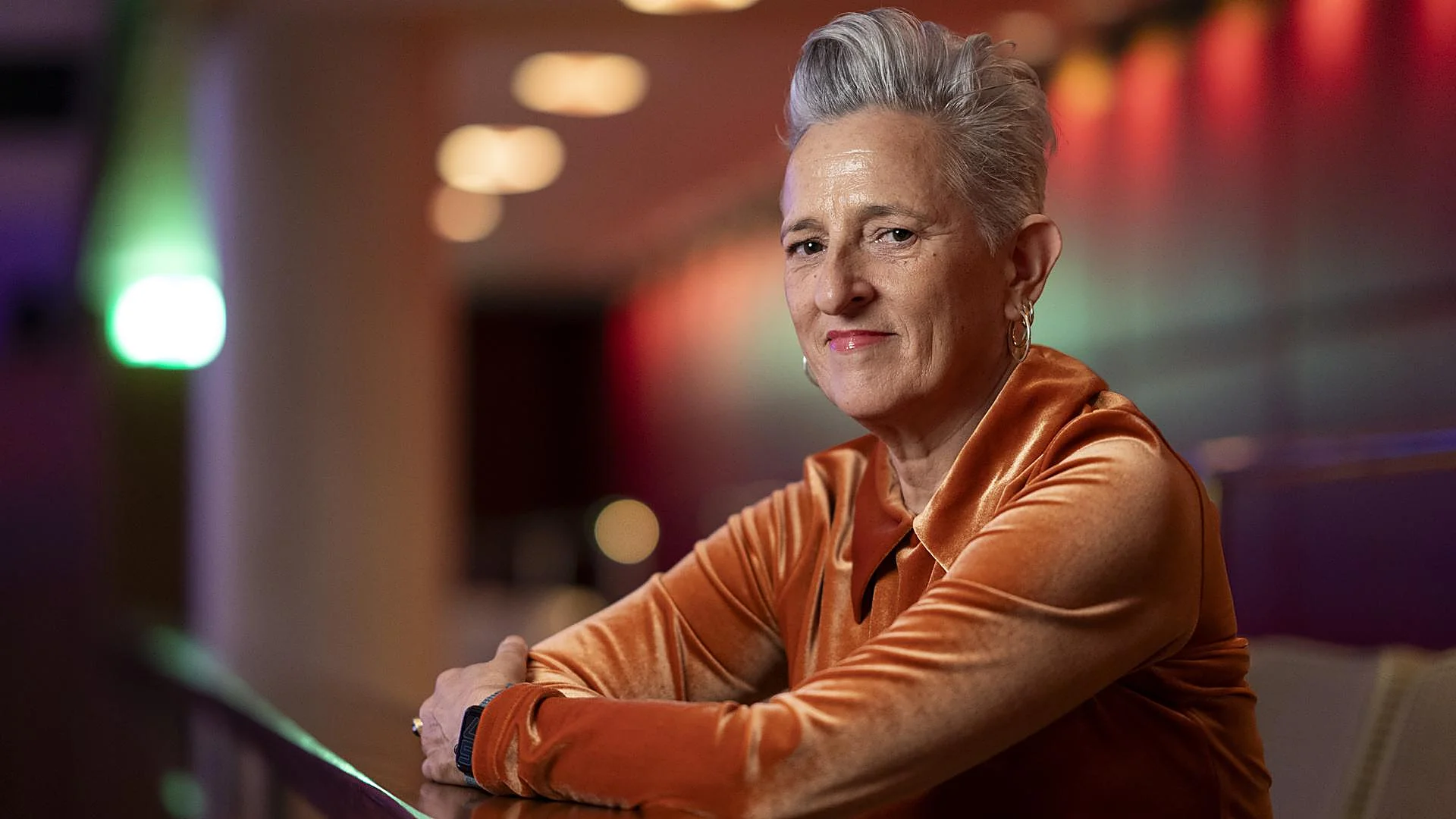
Charlotte Wood became a Booker Prize finalist with Stone Yard Devotional, now published in Spain as The Retreat (Libros del Asteroide). The novel follows a woman who, exhausted by her work and in the midst of a personal crisis, leaves Sydney and temporarily settles in a small religious community in rural Australia. She is not a believer and does not seek spiritual answers, but there she discovers a way of life grounded in silence, routines and distance from external noise that gradually begins to transform the way she looks at the world.
Wood, born in Cooma in 1965, is one of the contemporary Australian writers most recognized. She has published seven novels and three books of non-fiction and among her works stand out The Natural Way of Things, winner of the Stella Prize, and The Weekend, which received wide international attention. In The Retreat, however, she guides her writing toward a more intimate territory: memory, guilt, forgiveness, illness and the need to find a place from which to observe a world that is increasingly difficult to understand.
The novel was born during the lockdowns and after a serious illness that, as Wood explains, made her rethink her way of writing. “I felt an urgent need to shed everything that was superfluous in my work,” she explains. In Mujer Hoy we spoke with the writer about isolation, guilt, forgiveness, her female characters and the role of literature in a world that is growing ever faster.
In The Retreat, a woman decides to leave behind the life she knows and take refuge in a religious community. How did the idea of writing this story arise?
The first thing I wanted to write about was religion, about Catholic nuns. I grew up in a very religious town, and although I left religion a long time ago I have always wondered what could lead a contemporary woman to want to become a nun. Historically I could understand it, but I found it hard to imagine it in the present world. Then came COVID, the lockdowns and everything we experienced during that period. In one of those moments I returned to my hometown, where I grew up and which, to a large extent, is the setting of the book. I thought I wanted to write about that arid landscape, about the town, my childhood, my mother…
That’s how books work for me: I put two things together that, at first, have nothing to do with each other. In this case, I thought of someone like me becoming a nun. I couldn’t understand it until the idea of withdrawal from the contemporary world appeared. Then I thought: “Ah, now I understand.” I understand the impulse to distance oneself from the overwhelming chaos of the world. And little by little all those things began to fit together as I wrote the book.
Why a religious community? What possibilities did that space offer you that perhaps you wouldn’t have found in another type of community?
I think it was the contrast. At first, the protagonist thinks those women are a little ridiculous. She is delighted to find herself in a quiet place, far from the world, but she wonders what they are doing there. She thinks they are not contributing to the world. Her life, on the other hand, has been marked by action and activism. Gradually, however, she realizes that her activism has failed. All that drive to act has not brought any benefit to her or to her work as an environmental activist.
She begins to think that perhaps those women, simply by staying still and quiet, without imposing themselves on the world, are doing more for it than she has achieved with her constant need to take the reins. She also begins to understand that part of her work there involves confronting her own ego, learning to contain that need to impose on the world. It’s a struggle that, in truth, I also have in my own inner life: how much we should be in the world and how much we should withdraw, and what the most ethical place in that spectrum is.
There is a constant tension between isolation and community in the novel. How much do we need others even when we think we want to be alone?
That is precisely part of the tension I spoke about earlier: to be in the world or outside of it. As a novelist, my instinct is to distance myself from the world, but I live in the middle of a city. And I also need the world. If I were really going to live in a completely isolated place, I would have nothing to write about. I need to go out and witness what is happening so that it feeds my work.

The cover of ‘The Retreat’
At the same time, I think artists need to step away from others to have a certain distance from which to observe and transform what we see into art. So for me it is a constant tension: to be with people or to withdraw from them. Also, I grew up in a large family. There are five brothers and sisters, so perhaps that also forms part of my sensitivity to the idea of community.
Has said that The Retreat contains elements of your own life and childhood. How do you decide which personal experiences can become literary material?
That is difficult. I hadn’t done it before in such a direct way. This is my tenth book and I had already used elements of my life before, but I had always disguised, transformed or changed them. In this case there is transformation as well, but many of the things related to the protagonist’s mother come from my memories of my own mother. In that sense, it is a portrait of my mother and of the city where I grew up, but it isn’t completely faithful, because it is built from my memory.
I have four brothers, and yet the book’s woman is an only child. So it isn’t an exact representation of my life. Many things about the town and about her childhood, however, are memories that I feel I keep in a very vivid way. And, yet, often I would go to check a public event and there was no record. Then I wondered: “Did I invent it? Or did it really happen?” It mostly happened with things from when I was very young or very young.
At the beginning of the book there is an epigraph by Elizabeth Hardwick that speaks of that working memory of distorted memory. I think all our memories are distorted. They are our perception of something and they will never precisely match what happened. In this case, enough time had passed since those events for me to feel ready to write about them. I allowed myself to do it in a way that, when I was a younger writer, I wouldn’t have allowed myself.
Was it painful to write about such precise moments of your childhood?
It wasn’t a painful process, but it was challenging to find the right tone. It was hard to decide how much truth and how much invention I could mix without it feeling strange. Although, in truth, the whole book is a blend of truth and invention. I did have a very clear rule with things related to my mother: I would only write about moments in which it was just her and me.
I didn’t want to take my sister’s experience with our mother and put it into my book. I needed to be clear that everything I wrote about my mother came from my own experiences with her. Some of those things were difficult because my mother died when I was in my twenties and my father had already died. But I wouldn’t say it was painful to write about it. On the contrary, it was beautiful. It allowed me to think about what kind of person my mother was.
Did you write the novel during the COVID lockdowns while you were going through a serious illness yourself? How did these two experiences affect the writing of the book?
When I started writing the book the lockdowns had not yet arrived. But earlier, in 2019, Australia suffered terrible wildfires, the worst we had experienced. I know Spain has suffered terrible fires this summer. We have followed what was happening with a mix of horror and recognition, because that sense of catastrophe, of an intensity and destruction we had not seen before, is something we know.
I was writing something perhaps lighter and then that happened. And just as the fires were starting to subside here, the pandemic arrived. It was another catastrophe for which we had no answers. We had never lived through anything like that. I think, from that moment, the book took on a much more serious emotional tone. Everything felt very disorienting. We didn’t know what would happen and I think it was a huge shock for everyone. And then something else happened: my sisters and I were diagnosed with breast cancer at the same time. There are three sisters. Now we are all well, but there was a year of treatments and all that entails. I kept writing the book and it was another blow, another overwhelming experience to face.
You’ve said that, after all that, you felt an urgent need to remove the superfluous from your work. How did that translate into the writing of this novel?
It translated into there not being many explanations in the novel. The language is fairly bare. I didn’t want to explain too much about why she had ended up there, what had happened to her marriage, what had happened to her work, how she had left… I didn’t want to fill the book with backstory or explanations. I wanted to do it this way from an artistic standpoint, but I think everything that happened also had something to do with it. And after all of that, especially after my sisters’ and my own cancer, I thought: “I’m going to write the book I want to write and it doesn’t matter if anyone likes it.” I didn’t want to try to please everyone.
When you write books you think: “Perhaps readers won’t understand exactly what I mean, so I’ll explain it more.” And what I discovered writing this book is that, in fact, readers like the opposite. They like to do their own work: imagine, interpret and engage with the book. I think that, especially in the publishing world, we sometimes try to please readers too much in a rather boring way. But they want to be an equal partner in reading. So I followed my instincts a lot: no explanations, nothing that didn’t need to be in the book would be there.
One of the most present emotions in the novel is guilt, alongside forgiveness, but you do not offer easy solutions for either. What interests you about guilt as a literary emotion?
I’m more interested in forgiveness than guilt, though they are probably related. We speak of forgiveness as if it were something very simple, but I think it is much more complex. There is a part near the end where the narrator speaks of something called forgiveness therapy. It is a kind of structured process for someone who has suffered something terrible and must decide whether they want to forgive the person who did it. It is a rigorous moral work.
Charlotte Wood

It’s not simply a trade. Sometimes we speak of forgiveness and apologies as if they work like this: if I do something terrible that hurts you a lot and then I say “I’m sorry,” then you have to forgive me because I have apologised. But I don’t think it works that way. Sometimes we seek forgiveness to feel better about ourselves. That doesn’t necessarily mean we are repairing the damage we have caused.
There is a scene in which the narrator apologizes to Helen Perry, the other nun, for cruelty related to her childhood. Helen simply replies “okay.” She does not say “you forgive me” nor “I don’t forgive you.” She leaves the matter unresolved and leaves the narrator with the sense that nothing is settled. I think there are things that cannot be forgiven. I grew up Catholic learning that God forgives everything and I always found that difficult to understand. I used to think: if you commit a brutal murder and then say “I’m sorry,” why should that cancel what you’ve done? It always struck me as a too-simple idea. I think we talk about forgiveness and apologies as if they were a transaction, and I don’t think they are.
You’ve said you don’t want your fiction to be hopeless, even though hopelessness can be tempting. What can literature do in the face of a world that seems to be deteriorating?
Sometimes it seems utterly useless to write fiction in this world, because it doesn’t have the power to change things. But I think it can make us think in a more careful and deeper way and, in some sense, reassure us. We live in a world permanently connected, where everything is turning all the time and we receive ten-second fragments of anything. I think that literally makes us go crazy.
One of the things literature can do is quiet the mind and give us space to think and feel. And I think that, even if it did nothing more than that, it would be very important, because human beings need an inner life that has nothing to do with money. I also like that literature is freely available through libraries or the old classics we can find on the internet. Anyone who has access to a library can access some of the world’s best works of art, and that does not happen with any other art form in the same way.
I believe human connection, from person to person, will become increasingly important. Some of the people in charge of artificial intelligence think we can get robots to write novels and that’s wonderful. I don’t see it that way. People who read my books will never read a book written by AI because they seek a human connection. They want to enter the mind and the heart of another human being. And that is what literature is. I don’t know what the future of literature holds, but I believe we need that connection deeply, as human beings.
Your female characters are never built to be exemplary: they are contradictory, uncomfortable, and at times hard to love. Are you interested in writing women who do not need to be pleasing?
Yes. I hate the idea that women have to be pleasant. I think, in a sense, it is a feminist project to write women who are as complex, imperfect and contradictory as men. I am 61 years old and when I grew up I was taught that girls had to be good, well-behaved and pleasant, and, from my point of view, fairly boring.
That wasn’t taught by my family but by the culture. And also Catholicism, because girls had a completely different role from boys. Everything revolved around being modest, quiet, pleasant and boring. I’m not interested in that. And I don’t think it is interesting for fiction to create one-dimensional characters. The interest of life and drama comes from people who are not completely good nor completely bad, nor completely intelligent nor completely stupid. When I look around me I don’t know anyone who is one single thing. I’m interested in creating characters who have many different faces.
What does The Retreat achieve that you hadn’t achieved in your previous novels?
I think now I have more confidence in not explaining everything. Going back to what we discussed earlier: I could have explained more things, but I had the confidence to write a quiet book. In the publishing world people sometimes talk about “quiet books” as something negative, as if a book had to have a lot of action or a lot of drama. But, as a reader, that kind of writing doesn’t interest me much.
I’m interested in exploring relationships between people that don’t necessarily have to do with abuse or with obvious displays of power. I also enjoyed playing with the structure, which is fairly loose, and with the diary-like form. The timelines are more complex. There are several things that make me think this is a more mature book. I’m not ashamed of my other books, but I feel I have reached a place of greater authority with my writing.
After writing a novel so focused on what is worth preserving, has anything changed in your own life? What have you learned from writing this book?
I don’t know exactly what I have learned, because my lessons change constantly. But I think one of the things the protagonist learns is a kind of life rhythm: doing the same thing every day, in the same place. I aspire to that simplicity.
It is quite difficult to achieve in the contemporary world, living in a city and being connected all the time. Also, I travel constantly and all that, but I know that when I manage to enter a rhythm of very simple daily routines — cooking, staying at home — that is when I feel most rooted and I have more space, more mental breadth. I don’t always manage to maintain it, but that is what I aim for.