In the poetic-theatrical realm, there is no stage more Lorquian than the Cortijo del Fraile, located in the already evocative Cabo de Gata. There occurred on July 22, 1928 the “Níjar crime,” which Federico García Lorca rendered in Bodas de sangre (1931). An 18th‑century building constructed by the Dominicans that offered a desolate image until now, on the path to becoming a Center of Arts and Territory. To this literary geography is added the map drawn by Javier Ambrossi and Javier Calvo for cinema. The sets where La bola negra has been shot in its three timelines, 1932, 1937 and 2017. More Lorca in the air.
In the landscape cast, Granada had to be present, the Granada of Rafael Alberti’s ballad, of “the blood fallen from the best brother,” in memory of Federico. The Andalusian city, once again the protagonist. Starting with the Casa-Museo Huerta de San Vicente, the García Lorca family summer home, where his piano and the original furniture can be seen. Here the poet stayed before seeking refuge at the residence of the Rosales, where he was detained. To that also refers the family home of Carlos, the protagonist of La bola negra in that Spain of the thirties, a finca among olive trees very similar to the poet’s.
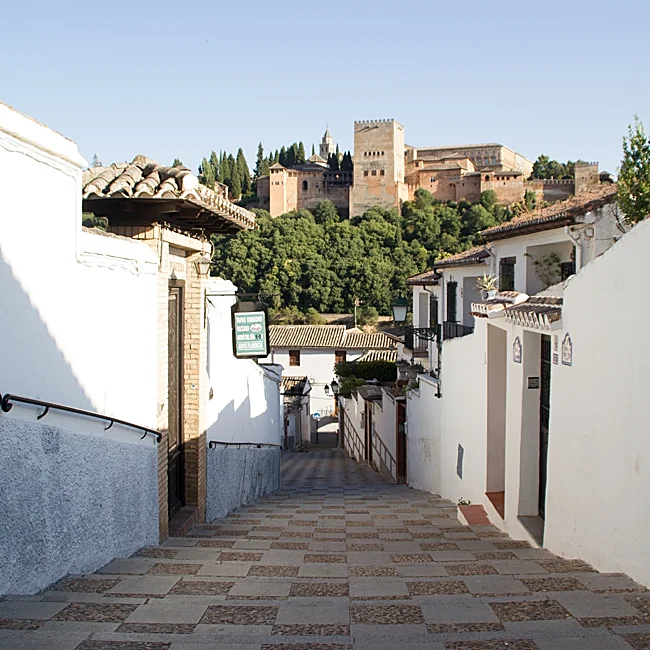
We see Carlos descending the slopes of the Albaicín and losing himself through its labyrinths in search of companionship. The neighborhood is so old and genuine, with its typical houses and cármenes—small alquerías with orchards, fruit trees and a piercing scent of jasmine—that there was hardly a need to reconstruct it. One could venture through the narrowness of the picturesque Calle del Beso and Calle Guinea, which filled with stalls of flowers, fruits and vegetables. Everything unfolds from the San Miguel Alto viewpoint, the highest, at 850 meters. The church, the views, the leisure. And all is cinema.
La Granada de Lorca
The character played by Milo Quifes travels with his friends, of course, along the Paseo de los Tristes, beside the Darro and in the shadow of the Alhambra, unlike anything on the Sabika hill. A 16th‑century cobbled promenade whose name comes from the funeral processions that trudged toward the cemetery. For the exterior of the casino, crucial in the film, the Carmen de los Mártires was chosen, on the Mauror hill, south of the Nasrid monumental complex.
The Carmen of the Martyrs shines splendidly among romantic gardens.
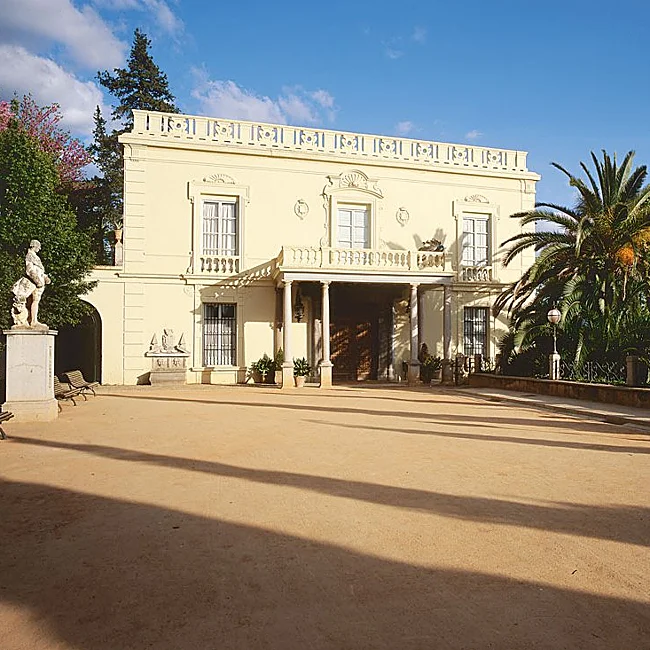
This Carmen, owned by the City Council of Granada, was a Carmelites’ convent and had San Juan de la Cruz as prior between 1582 and 1588, and José Zorrilla as resident, author of Don Juan Tenorio, in 1889. It is named thus because it was for the Muslims the Corral de los Cautivos; the captives were the Christians. It is hard to imagine it when standing before such a palatial mansion, a 19th‑century building set in more than seven hectares, or walking the Poets’ Route, the poets of old and of today, surrounded by romantic, French and English gardens.
Un cortijo abandonado
Besides the Carmen, the Javis chose another typical construction in the area, a cortijo, to transform it into a luxurious mansion. It took its toll. The Cortijo de los Prados, in Deifontes, 27 kilometers from Granada, was in a state of abandonment. But the furniture, the paintings and other paraphernalia of the era worked the miracle. And it served as a location for some of the key sequences in which the young man who cannot enter the Granada social club because of La Bola Negra is involved. For being homosexual, to put it plainly.
Los ecos de Mariana Pineda
We are still in Granada. In the Santa Ana square, where the Darro’s mythical run begins and the imposing Mudéjar church tower rises, built in the 16th century on a community mosque, street protests erupt with tricolour flags, vehicles burning and citizens crying out for freedom with shouts of “long live the republic,” in the moments before the Sanjurjada, the failed coup led by General Sanjurjo against the Second Republic.
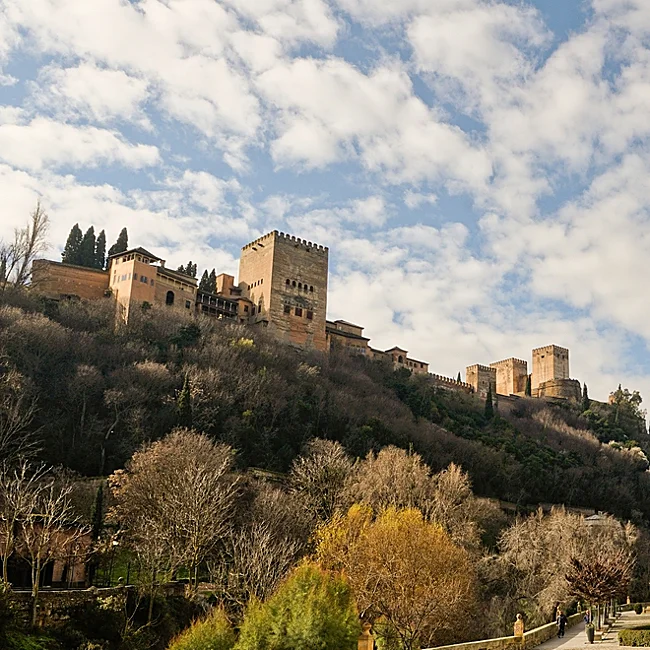
The Alhambra from the Paseo de los Tristes, beside the Darro.
This carmen, owned by the City Council of Granada, was a convent of the Carmelites and had San Juan de la Cruz as prior between 1582 and 1588, and José Zorrilla, author of Don Juan Tenorio, as resident in 1889. It is named thus because it was for the Muslims the Corral de los Cautivos; the captives were the Christians. It is hard to imagine it when you stand before such a palatial mansion, a 19th‑century building planted on more than seven hectares, or you stroll the Poets’ Route, the poets of yesteryear and today, surrounded by romantic, French and English gardens.
Cantabria, lights and shadows
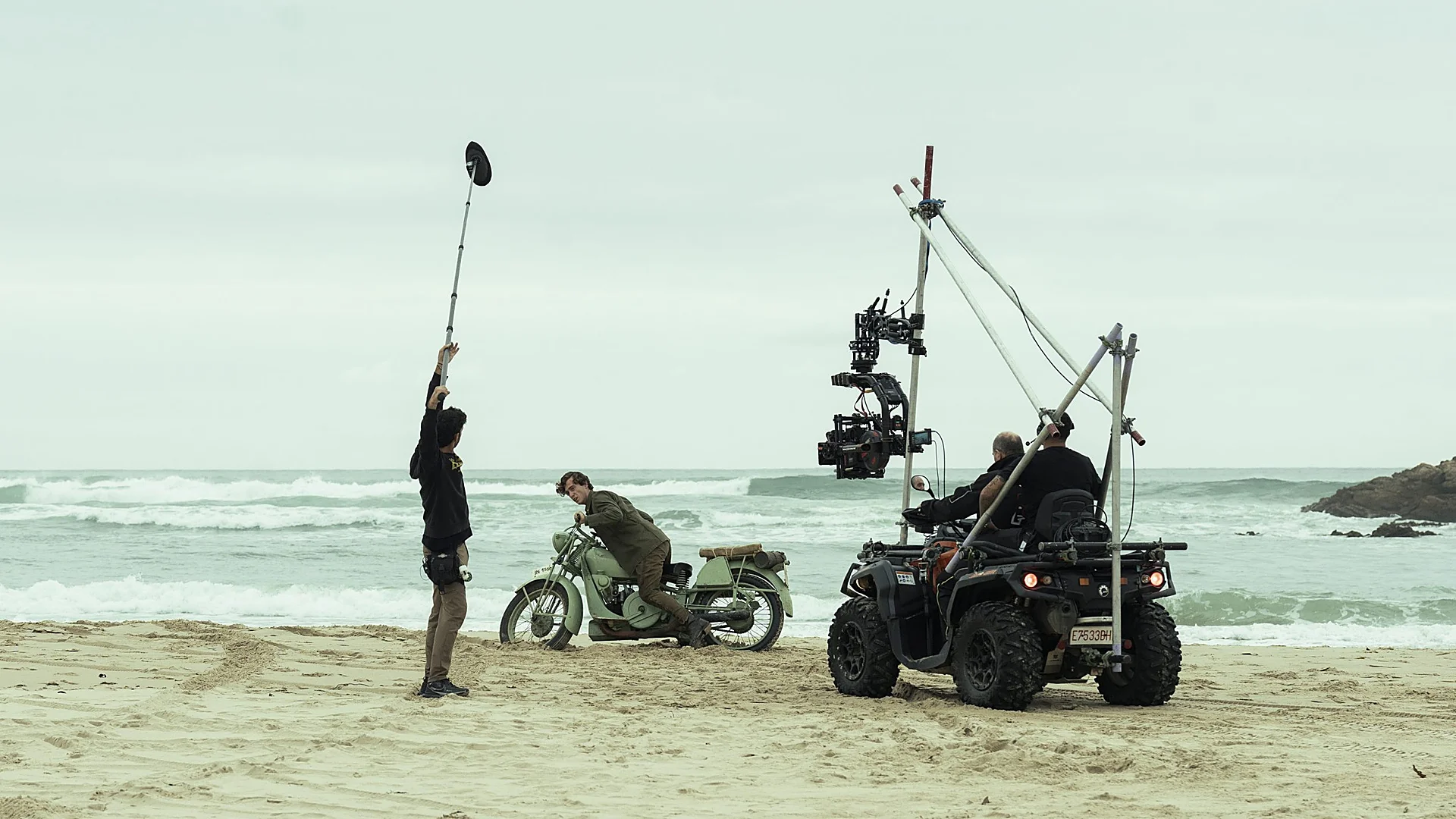
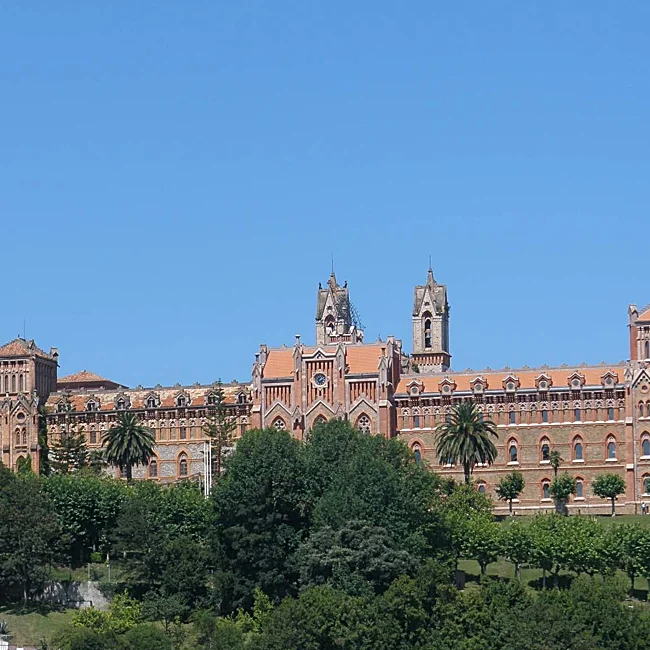
In this darkness, the light of Cantabria’s landscapes dominates, where Rapún ends up. In particular, the light of the wild Arnía beach, famous for its rock formations and cliffs, and Oyambre, which is a natural park, where the soldiers bathe and sing. In addition to the nearby towns of Valdáliga and Herrerías, where a bombardment during the war and a shooting were staged. The field hospital where the republican and his guard meet, that is to say, Miguel Ángel Bernardeau and Guitarricadelafuente, is actually the Major Seminary of the Pontifical University of Comillas. A majestic building with influences from Gothic, Moorish (Mudéjar) and Modernist styles.
The Major Seminary of the Pontifical University of Comillas.
There is still another Cantabrian setting, the village of Lafuente, where Alberto’s character (Conejero’s alter ego), played by Carlos González, already in 2017, is obsessed with reconstructing the past. This place as secluded as idyllic, belonging to the municipality of Lamasón and with barely 17 inhabitants, is surrounded by mountains—the colossal foothills of the Picos de Europa—, valleys and forests. It is land of Romanesque churches and houses with a sun porch or a running balcony. From here a path leads to Santo Toribio de Liébana, 32 kilometers away. This researcher and playwright, whom we see with the foreign Hispanist Isabelle Durand (Glenn Close) at the Madrid Ateneo, will also travel to Athens. On the big screen, Monastiraki square, at the foot of the Acropolis.
From Sigüenza to Sierra Nevada
In medieval Sigüenza (Guadalajara), as if time had stood still, the Javis found an abandoned theater perfect for the cuplé singer Nené Romero (Penélope Cruz), inspired by Olga Ramos, the queen of cuplé, to cheer the soldiers. It was customary at the time to keep the combatants’ morale high. Moreover, its stone streets, the cathedral and the castle served to set the scenes for various sequences.
The Albaicín is one of the Granada settings for La bola negra.
All ends in Sierra Nevada, in the white snow of the pleonasm, a reflection of the Albaicín’s whiteness, in stark contrast with the bola negra, as a group of period skiers, performed by professionals from the Telemark Rikitaum club, carve their way through the fog. In the notes of La bola negra by Federico García Lorca appear the skiers and the snow in the dramatis personae, the list of characters of a play, along with Carlos, his friends, the family and the casino’s partners. As he wrote, “a drama of contemporary customs.”