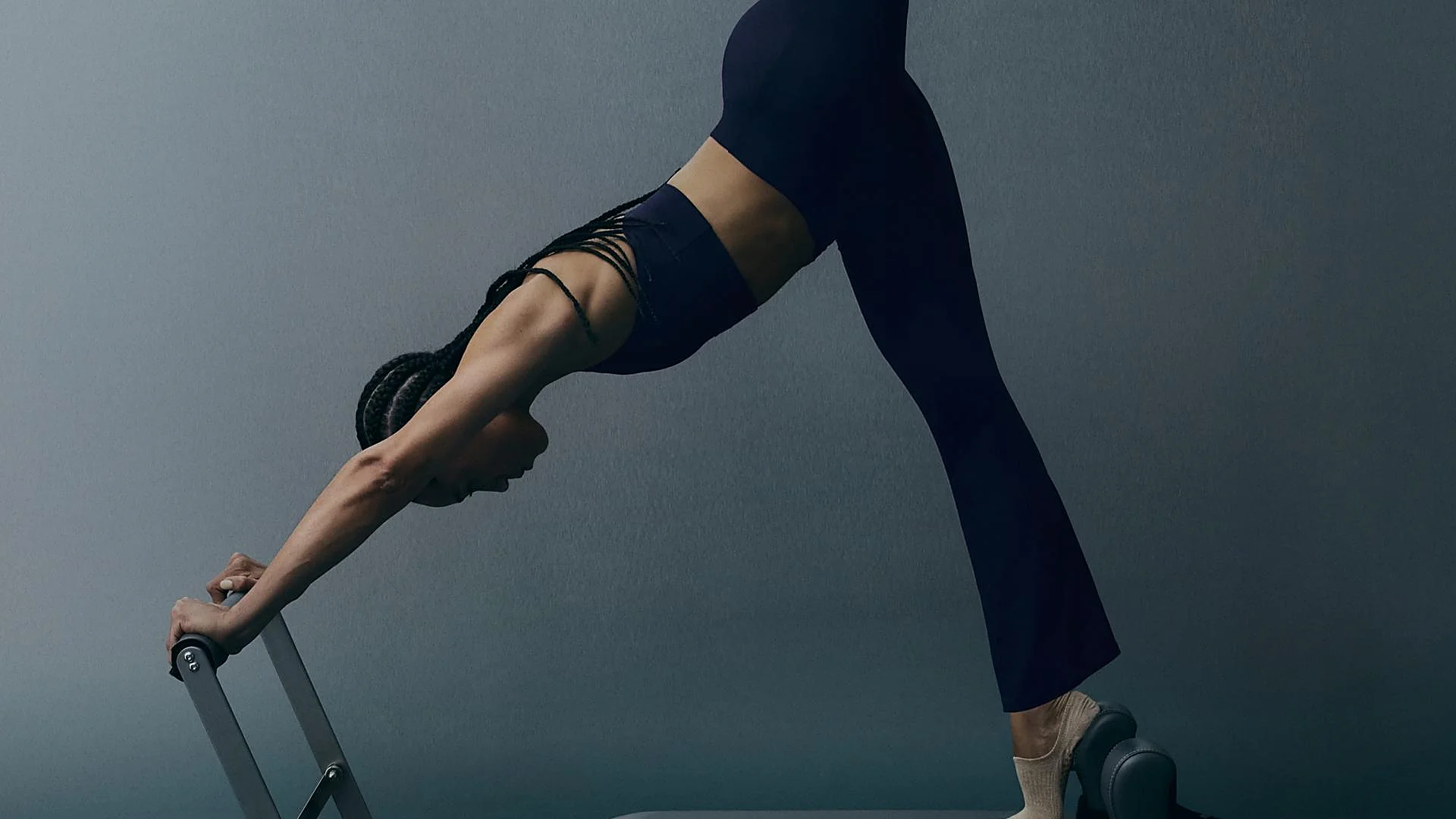
Shoulder bridge, footwork with emphasis on the alignment between the knee and the foot, lunges, bottom lift, lateral hip abduction work. Teresa Vázquez de Castro, head of Education and Product at Club Pilates Spain, points to these reformer exercises as the most useful for activating the glute after the summer: «All of them share that they combine hip extension and/or abduction with pelvic stabilization, promoting the involvement of the gluteus maximus and medius». They are common exercises within the method’s classical repertoire, adapted with springs to demand more control.
There is no automatic superiority of the reformer over the floor. «It has not been demonstrated that the reformer is universally superior to floor work for this objective, as it depends on each case», clarifies Vázquez de Castro. Its real advantage lies in the springs: they allow graded resistance and precise control of the movement’s range, something on the floor depends solely on body weight and the technique of the person performing it. Small modifications in hip position, moreover, substantially change how much the glute participates.
A session of between 30 and 40 minutes, two or three times per week, follows a concrete order. «Activation, shoulder bridge, footwork with emphasis on the glute, unilateral work or lunges, hip extension, lateral abduction and cool-down», details Vázquez de Castro. Two or three sets of eight to ten repetitions, with a resistance that allows maintaining pelvic and spinal stability, set the pace of the routine. It is a structure similar to what is usually followed in any Pilates session aimed at a specific muscle group, with activation at the start and cooldown at the end.
There is no fixed spring load established as optimal for everyone. «It must be individualized based on the reformer, the person’s level and their technique», explains Vázquez de Castro. What is constant are the mistakes that tend to recur in this routine, regardless of the center or the student’s level: they almost always relate to losing pelvic stability to gain more range.
The most frequent mistakes
Arching the lumbar area to gain more range is the most common fault. «The main mistakes are arching the lumbar area to gain more range, jutting the ribs forward, losing the knee-to-foot alignment, rotating the pelvis or pushing mainly with the hamstrings», enumerates Vázquez de Castro. Keeping the pelvis stable and generating the extension from the hip, rather than compensating with the back, is what truly increases the glute’s prominence. In some exercises such as the bridge, certain modifications allow maintaining a high glute activation while reducing the hamstring participation at the same time.
For someone starting from a not very active glute, progression begins outside the reformer. «I would begin with glute bridges, hip abductions with a band, clamshells and hip extensions with low resistance. In a first phase, the goal is that the person identifies the contraction without compensating with the lumbar region or the hamstrings», explains Vázquez de Castro. The initial priority is not to add more resistance through the springs, but to recover motor control and movement quality.
Can the tone lost over the summer be recovered, and when does it start to show? «Yes, although it is worth talking about psychomotor control, strength recovery, muscle mass and appearance,and not about recovering tone as a phenomenon specific to autumn», clarifies Vázquez de Castro. «With consistent training and a sufficient load, the first changes in strength and control can appear roughly between four and eight weeks», she notes.
The visual changes usually take longer and also depend on diet, physical activity, genetics and each person’s starting point of each person. Constancy, technique and patience are, according to Vázquez de Castro, los tres factores que realmente marcan la diferencia. There are no shortcuts on the reformer that substitute for that combination, no matter how well the springs are graduated.