Each body reacts differently to the summer break. Inés Jiménez, founder of Arde Barre and physiotherapist, explains it honestly: “Genetically we are all very different and do not react the same to the stimulus of stopping training. What happens to the body when you stop training Pilates is like stopping training another sport: it loses tone, swells more, loses strength and endurance.” There is good news in all this: the body has memory.
“Sport is also very grateful in terms of body memory to recover what you used to have. It’s no longer so hard to reach the point we were at because the body has memory,” explains Jiménez. But that doesn’t mean you can suddenly return to the previous level. “If before you stopped practicing it you were doing X, don’t try to reach that level immediately, as it can generate frustration, injury and a lot of muscular fatigue,” she warns.
That fatigue creates a cycle that is hard to break. “Fatigue leads to poorer post-exercise recovery, which will generate tiredness that traps you in a vicious circle, because, in turn, due to the fatigue, you’ll train poorly and remain tired,” explains Jiménez. Listening to the body and knowing how far you can go in each session is, for her, the most important thing when resuming. Fatigue is always present when returning. The key is to distinguish the normal from the warning that today’s pace should be reduced.
The exercise to start with
When returning, the priority is breathing, mobility and core activation. “One of the exercises I would recommend is the Pelvic Curl or shoulder bridge, as it activates the core, mobilizes the spine vertebra by vertebra, activates breathing, strengthens the entire posterior chain (glutes, hamstrings and back) and is also of very low load,” explains Jiménez. She also recommends the cat-cow, lying leg rotations to work spinal twists, and the glute bridge.
The most common mistake is training at the same intensity as before summer. “When intensity is prioritized without the prior preparation, you lose breathing, you lose technique, alignment, and movement control,” warns Jiménez. Not listening to the body, again, is the second major mistake she sees among her students when resuming practice in September.
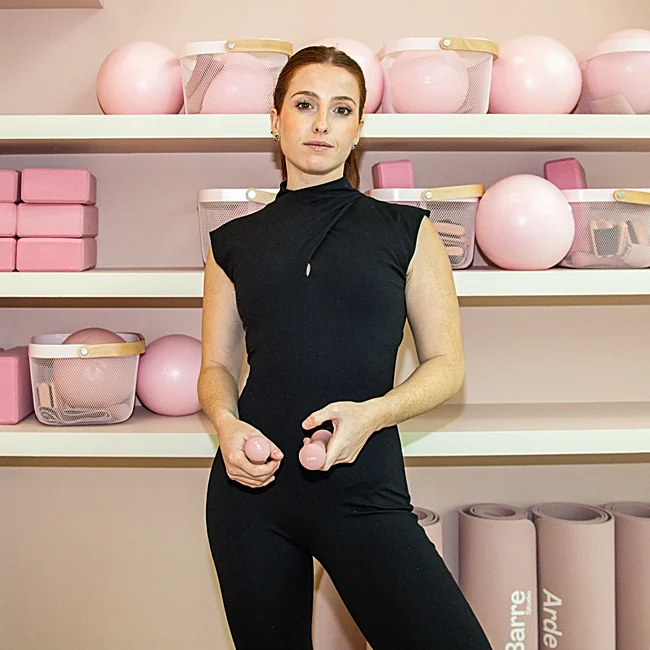
Inés Jiménez, founder of Arde Barre and physiotherapist.
How long it takes to recover the level
There is no exact number of sessions that applies to everyone. “It depends on many factors, such as the length of the break, the physical activity undertaken during holidays, age and the recovery capacity, what physical condition they come with, if they have eaten and drunk poorly or, on the contrary, have taken care of themselves,” explains Jiménez. As a rough guide, two weeks are usually enough, equivalent to between six and eight sessions.
Is there an exercise capable of resetting the body completely? “Starting from the premise that no exercise makes a complete reset of the body, Pelvic Curl is very good,” clarifies Jiménez. More than a fitness exercise, it serves to reorganize the body before returning to training with intensity.
“That combination of mobility, stability, strength and control is what drives many professionals to carry it out in the return,” summarizes Jiménez. It is the most common starting point among Pilates instructors precisely for that reason: it works on several fronts at once.
The body, freshly out of vacation, does not need a spectacular exercise but one that restores the lost connection. Pelvic Curl fulfills that function before the moment comes to demand more.