That José Luis Cuerda chose Albacete as the setting for Amanece, que no es poco (1989) says a lot about this province. Not for being surreal, but for being surprising. Although magical realism, as Davis Uclés has made clear with his The Peninsula of the Empty Houses, exists everywhere. And also on the Iberian Peninsula. Or in Iberia, as the writer would say. The filmmaker chose Aýna, Liétor and Molinicos. And if we find these places leaning more toward Murcia and Jaén, Jorquera, toward which we are headed, we already have it practically in Valencia. Or in Cuenca, depending. That is, to the northeast. 50 kilometers from the city of Albacete.
The first thing to say about this Castilian-Manchego village, from La Manchuela to be precise, is that it has Alcalá del Júcar as a neighbor, with houses carved into the mountain. And not only do they share a river, but they are twins in the sense that when it comes to picturesque, no one beats them, or almost no one. In the vein of the Valencian Bocairent, a fairy-tale place you can walk through via a magical route. Or Morella, in Castellón, which, if it had sea, would be a Mont Saint-Michel.
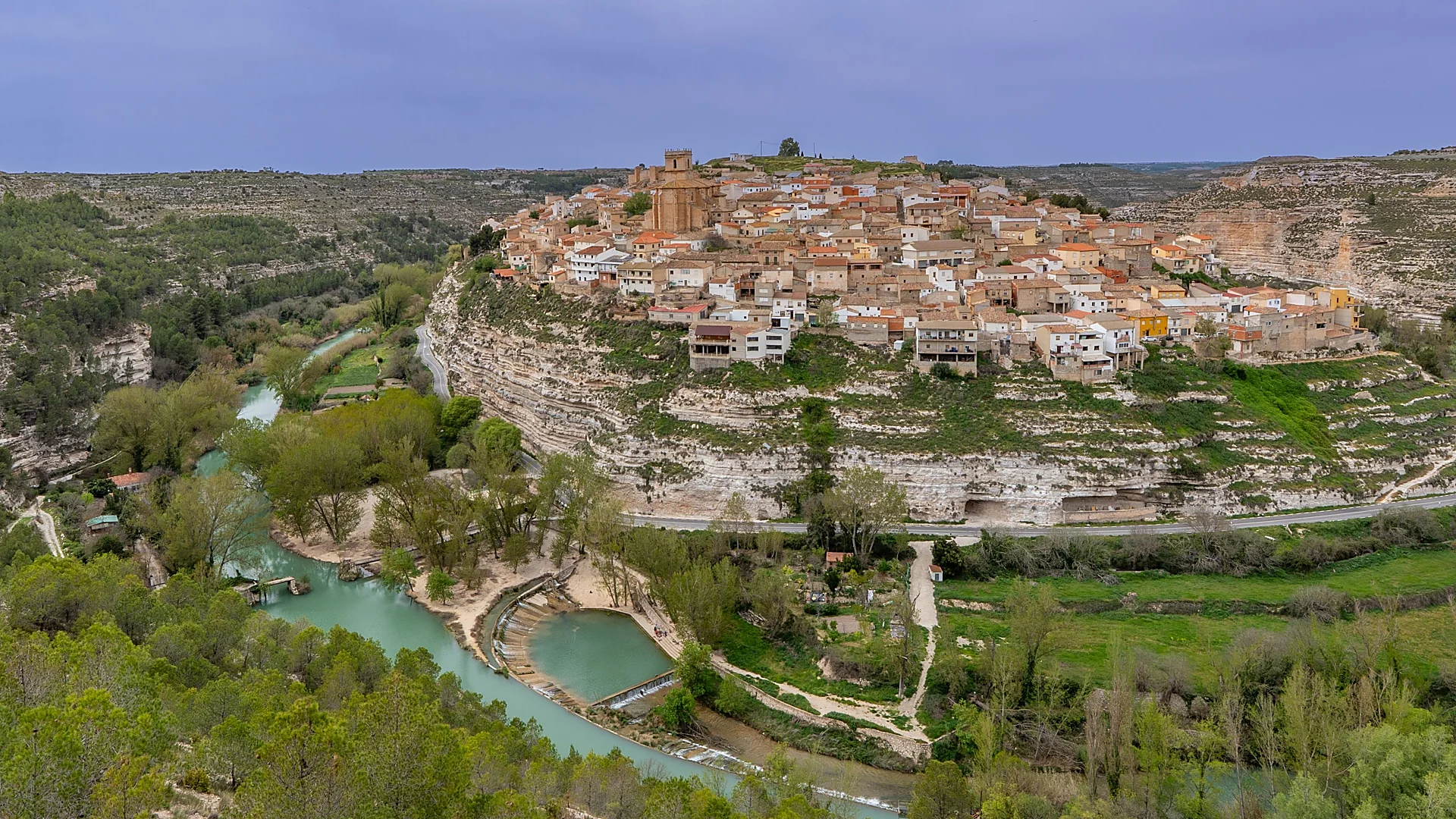
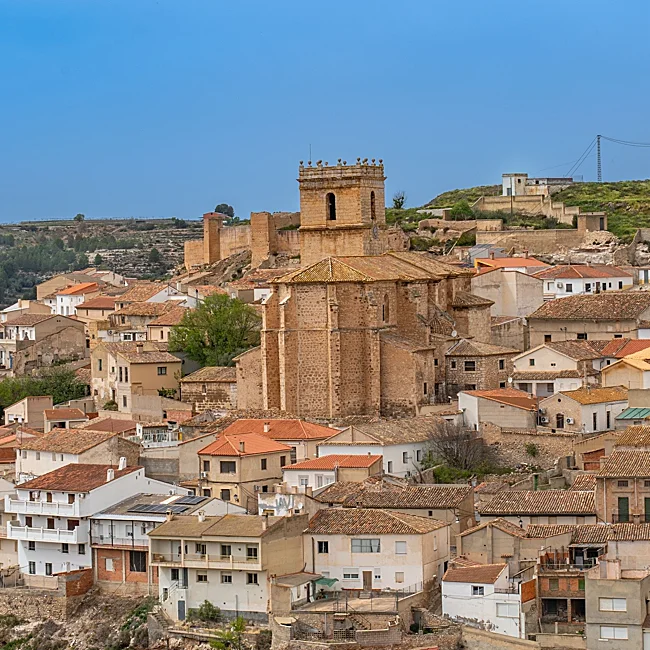
It follows to imagine that Jorquera is perched on a hill, embraced by el Júcar, which traces an impressive meander along its course, as a counterpoint to the surrounding plain that monopolizes the rest of the landscape. To see it or, better said, to admire it, one must look out from the panoramic viewpoint located at the entrance of the town. In this privileged balcony is where one truly becomes aware of how capricious the topography is and of the way in which the houses have virtuously stacked themselves one above the other to save the depths of the cliff.
What to See in Jorquera
It is hard to imagine a better watchtower or bastion. And it was so, as proven by what remains of the castle, to where El Cid Campeador pursued the ‘very armed Moor’, according to the first General Chronicle of Spain, promoted by Alfonso X the Wise. And as proven by the Almohad walls, built in the 13th century, and the White Tower, where, according to legend, the lady who gives it its name was kept captive. This tower was erected in the mid-15th century to defend one of the town’s gates, the Puerta de la Villa, just as the Torre Armez, now vanished, protected Puerta Nueva. The White Tower, restored, currently serves as an exhibition hall.
Jorquera está en lo alto de un cerro sobre el meandro que traza el Júcar.
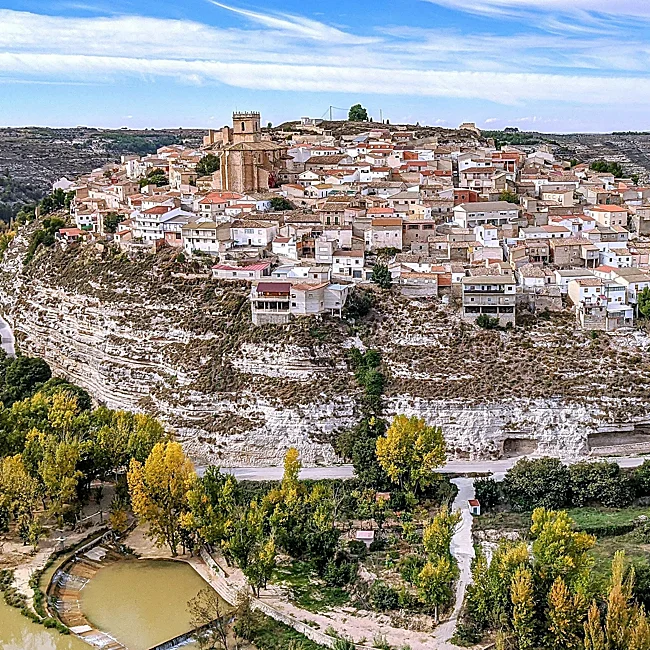
Before Jorquera, the Visigoths and the Romans had passed, but it was the Muslims who left the greatest mark, especially in the irrigation and canalization system, which made the agriculture of the era flourish and continues to be used today. A walk through its cobbled streets will lead us to the church of Santa María de la Asunción, from the 16th century, conceived as Gothic, but ultimately imbued with Renaissance spirit. On this walk we will also discover a set of patrician, heraldic houses, as in León Felipe’s poem.
A stroll through the old town
These are the Casa del Corregidor (18th century), next to the town hall, with the shield of the Marquis of Villena and the shield of the town; the Casa de los Ortega, on Calle Mayor, from the same period; the Casa de los Tomás-Alarcón, on Calle Rosario, from that century or the next, since the shield shows the arms of the person who was mayor and corregidor in the 19th century; and another house on Calle Mayor, probably from the 17th century, with a coat of arms of unknown lineage.
La iglesia de Santa María de la Asunción preside la estampa de Jorquera.
Outside the town walls lies the Hermitage of Our Lady of Cubas, in the small hamlet of the same name, where the patron saint of Jorquera is venerated. Once outside the urban core, everything invites approaching the banks of the Júcar, a natural setting of great landscape and ecological value. Along the river’s gorges and escarpments carved by the river, century after century, there is also lush vegetation, turning it into an oasis.
Hiking and Swimming
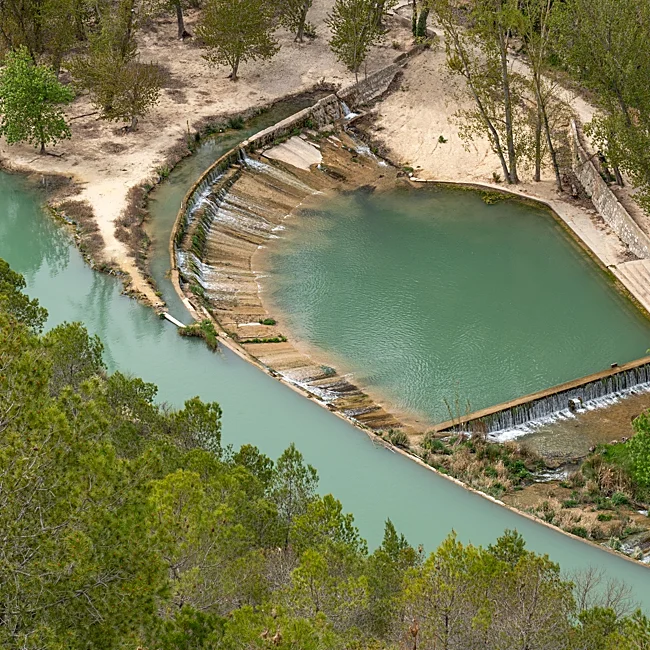
A riverscape where one can enjoy its enormous biodiversity. And during the summer months—already—an area for swimming next to the dam, which will come in handy if we embark on the hiking adventure. For example, along the route that goes along the left bank of the river to the hamlet of La Recueja, about five kilometers away, passing in some stretches between the enormous canyon walls.
The Júcar also offers hiking trails and swimming areas.
Afterwards, you can recharge at one of the town’s restaurants. At El Mirador, besides excellent views from its terrace, they offer typical tapas such as fried tail of white pork or huevos rotos, in addition to a festival of meats and seafood. At La Playa, by the river, they serve a wide range of arroz dishes: lobster rice, a banda, meloso, campestre, or ribs marinated and tender garlic from the Jorquera orchard. In addition to classics such as gazpacho manchego, the lomo de orza volcano, or the atascaburras, handmade in Grandma Leo’s mortar (literally).