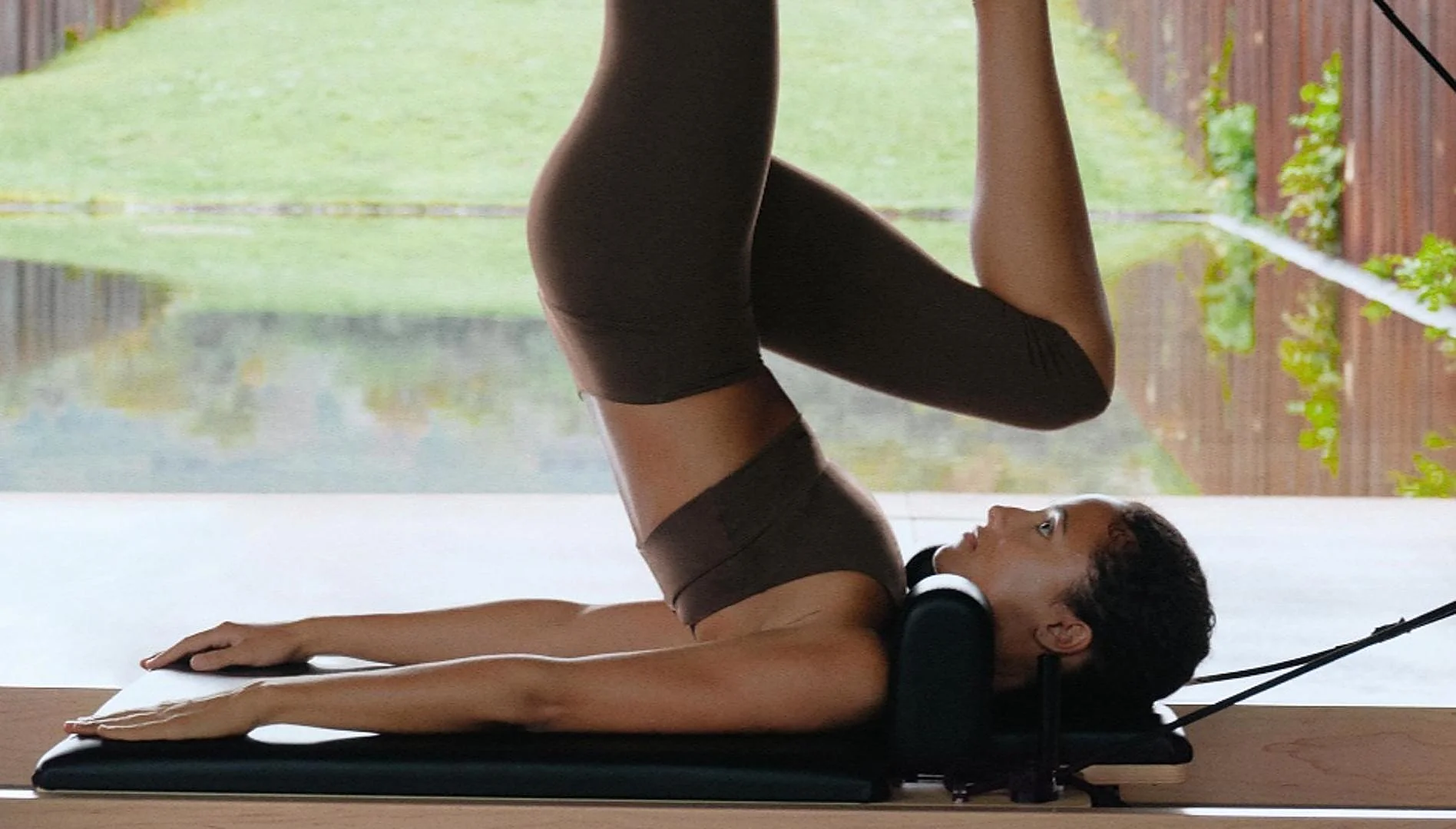
The spine is not a rigid structure. It is formed by vertebrae that should be able to move independently and progressively, and this capacity is one of the first things lost with a sedentary lifestyle and aging. The roll over is the Pilates exercise that works exactly that. Juanita Cardona, Pilates instructor at Piko Studios, explains it plainly: “It works the segmental joints of the spine, i.e., the ability to move the vertebrae in a controlled and progressive manner. During the movement the entire posterior chain is mobilized and the deep muscles responsible for stabilizing the trunk are activated.”
What the roll over produces is not a structural correction, but an improvement in the quality of movement. “It does not reposition the vertebrae nor modify the discs’ structure,” Cardona clarifies. Its benefits come from keeping the spine active and functional, improving body awareness and movement control. That distinction matters because many people come to Pilates seeking that an exercise will “solve” their back, when in reality the goal is deeper and more valuable: learning to move better.
After 50, the most important technical precaution is to avoid loading weight on the neck. “The support should be distributed on the upper back and the movement should be performed slowly and controlled, vertebra by vertebra,” explains Cardona. It is not an exercise suitable for everyone. People with advanced osteoporosis, certain cervical pathologies, symptomatic hernias or a recent history of spinal injuries should consult with a professional before incorporating it. “In Pilates we always assess whether an exercise is appropriate for the person, not the other way around,” she notes.
The most frequent execution errors occur when one tries to go too far using momentum rather than control. It is also common to lose alignment, place too much weight on the cervical area, or perform the descent abruptly. “These compensations increase tension on the neck and can cause discomfort in both the neck and the lower back,” warns Cardona. The quality of the movement is far more important than the amplitude or appearance of the exercise, and this is especially true after 50.
How to introduce it if you start from zero
Before working on the full roll over, Cardona recommends developing spinal mobility and core control through simpler exercises such as the pelvic curl, the half roll back or different variants of spinal articulation. Once the person demonstrates control, abdominal strength and sufficient mobility, partial versions of the movement can be introduced. “The progression should be gradual and always respect individual capabilities,” she explains. There is no standard timeline: every body advances at its own pace.
That gradual process is not only a safety issue but also a matter of effectiveness. A roll over done with compensations does not produce the benefits it promises and can cause discomfort that discourages continuing practice. On the other hand, when you reach the exercise with a real base of control and mobility, the movement flows naturally and the body responds clearly. The progression is not the path to exercise: it is part of the exercise itself.
What changes with constant practice
Mobility improves when you train consistently, but it does not depend on a single exercise. “The roll over can be part of that process as long as it is appropriate for the person and performed correctly,” says Cardona. What they usually observe over time is greater body awareness, a better ability to move the spine with control, and a general sense of greater mobility and fluidity in daily movements. These changes are not always spectacular, but they are real and noticeable in very concrete things in day-to-day life.
After 50, however, the roll over should not be the only work for the spine. “The combination of strength, mobility and stability is what really helps to keep a functional spine and a body capable of moving autonomously for more years,” summarizes Cardona. Strength training complements and enhances everything mobility work produces. Without that strength base, the mobility gained is more fragile and less transferable to real life.
The roll over is not a show exercise nor a measure of flexibility. It is a working tool that, practiced regularly and with good technique, helps to keep the spine active, mobile and conscious. After 50, that has a value that goes far beyond Pilates: it is an investment in the quality of movement for the years to come.