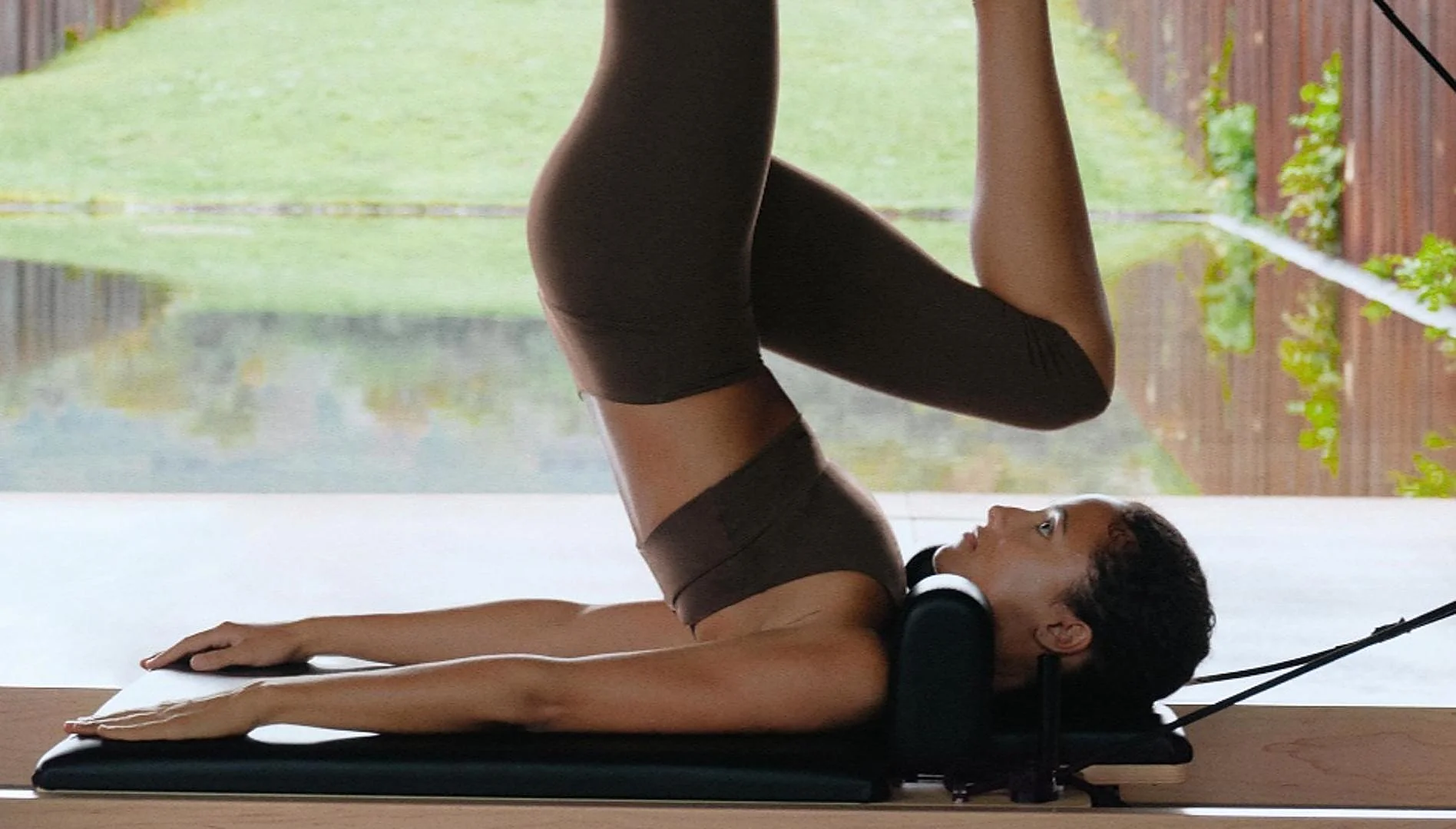
Eight hours in front of the computer, shoulders forward, the chest closed and the head pitched forward. This is the posture adopted by most people who work seated, and it has concrete consequences on the musculature, posture, and even mood. Becca Alonso, Pilates Reformer coach at Floor Studio, a boutique reformer and barre center in Getafe, explains it from the start: “Working at a computer overloads the musculature, and an exercise like the Swan allows us to activate, strengthen, and elongate the musculature in equal measures, reducing tension in both the upper back and the lumbar area.” The Swan is not just a stretching exercise: it is the direct response to what sedentary work does to the body.
The problem of spending hours sitting in front of the computer is twofold. On one hand, the musculature hunches and atrophies due to the lack of movement. On the other, maintaining those positions compresses the blood vessels and reduces tissue perfusion. “Spending hours in front of the computer makes our musculature disconnect, atrophying from the lack of movement and even from reduced blood perfusion,” says Alonso. The most common result is neck pain, tension in the trapezius and shoulders, and a chronic feeling of stiffness in the upper back that many people normalize without knowing there is a solution.
The Swan acts directly on those imbalances. It works the trapezius, the pectorals, and the latissimus dorsi, which are the muscles that keep posture correctly. “With the Swan we counteract that position by opening the chest, mobilizing the spine, and activating our anterior and posterior muscular chain,” explains Alonso. Not only does it open what the computer closes: it also strengthens what sedentary life weakens. It is one of the few exercises that simultaneously trains strength and mobility in the same direction.
The correct execution of the Swan is what determines whether the work reaches the upper back or becomes a lumbar or cervical compression. “We accompany the chest opening with a deep inhalation, without throwing the head back, bringing the crown toward the ceiling and activating the abdomen,” explains Alonso. The control of spinal extension is fundamental: it is not about going as far back as possible, but about creating length and opening from the center, with the core active at all times.
The mistakes that turn the Swan into an injurious exercise
The most frequent mistakes are the lumbar or cervical hyperextension with excessive lordosis, which causes pressure on the intervertebral discs, and the elevation of the shoulder blades, which tightens the shoulder and trapezius area. “They are the main problems you can encounter in the Swan,” says Alonso. When these errors accumulate, the exercise stops counteracting the effects of sedentary life and worsens them. The difference between a well-executed Swan and a poorly done one is not always visible from the outside, but it is clearly noticeable in how the body responds.
Another common mistake is not activating the abdomen before starting the movement. Without that activation, the spinal extension falls onto the lumbar area instead of distributing progressively through the entire back. The Swan requires the core to be active as support from the start, because it is what allows the chest opening to be real and not a lumbar compensation. Without that base, the exercise loses much of its effectiveness and can cause discomfort instead of relieving it.
Why it also improves anxiety and mood
The Swan has a benefit that goes beyond posture. “It has been observed that in people with anxiety, symptoms improve thanks to chest opening, diaphragmatic and respiratory control,” says Alonso. The closed posture produced by office work not only affects the muscles: it also influences breathing and the nervous state. Opening the chest and breathing deeply has a direct effect on the nervous system that many students notice from the first sessions.
The changes that students notice with regular Swan practice are concrete and progressive. Less tension in the neck and shoulders by the end of the day, greater mobility in the upper back, better posture, and a sensation of more space in the chest are the most frequent. “It can improve and reverse postural effects with regular work in which we mobilize the spine well without unnecessarily tensing the back,” sums up Alonso. It is not an immediate change, but it is sustained when the exercise is incorporated regularly.
The Swan is not a flashy exercise nor does it require equipment. But for those who spend many hours in front of the computer, it is one of the most necessary and one of the most complete: it strengthens, mobilizes, opens, and breathes at the same time. Incorporating it regularly into the Pilates routine is one of the smartest decisions to counteract what sedentary work does to the body week after week.