
To sharpen as much as possible the focus on symptoms in order to diagnose ovarian cancer as early as possible: that is the obsession of gynecologists and oncologists regarding a disease that lacks satisfactory detection tools. In fact, three out of four cases of ovarian cancer are diagnosed when the disease has already spread. It is a type of tumor that grows in the abdomen, a wide cavity in which it can develop without evident symptoms or with discomfort easily ascribed to other causes.
Let us situate the incidence of ovarian cancer to get an idea of the importance of knowing more about the symptoms of this ailment. We are facing the second most frequent gynecological tumor after endometrial cancer, accounting for 33% of cases. It is the deadliest gynecological cancer and, overall, the second deadliest after breast cancer. The incidence is seven cases per 100,000 inhabitants.
Despite its high incidence, diagnosis remains low: for every case of ovarian cancer, nearly ten breast cancers are diagnosed. In fact, it is the most lethal of gynecological tumors because in three out of four cases the disease is diagnosed late. In fact, when detected in its early stages, survival exceeds 90%. About 20% of cases have an hereditary origin and are mainly associated with mutations in the BRCA1 and BRCA2 genes.
We spoke with the Dr. José Luis Sánchez Iglesias, a gynecologic-oncologist at Vall D’Hebron University Hospital in Barcelona, to learn which factors are worth considering to shorten as much as possible a hypothetical diagnosis of ovarian cancer. Dr. Sánchez Iglesias is the current president of ONCOSEGO, the oncology section within the Spanish Society of Gynecology and Obstetrics. He also belongs to the Medical Advisory Committee of ASACO, the Association of Women Affected by Gynecologic Ovarian Cancer, which informs, supports and gives visibility to this condition and to the women who suffer from it.
WOMEN TODAY: What difficulty does diagnosing ovarian cancer present and what symptoms should alert us?
DOCTOR SÁNCHEZ IGLESIAS: The difficulty of diagnosing ovarian cancer is that it is a tumor that in early stages is asymptomatic: it does not produce any symptoms. In fact, on occasion the diagnosis is made incidentally, for example in a check-up for which an ultrasound has been performed. In advanced ovarian cancer the symptomatology is very nonspecific: it can be digestive, with gastroesophageal reflux, abdominal discomfort, genitourinary discomfort, sometimes with repeated infections…
Generally, we are faced with a symptomatology for which people go to their family doctor, sometimes to emergency, and the diagnosis is not completed. Treatments for reflux or for a urinary infection, for example, are started. This leads to diagnosis with significant delays, which can range from six to nine months, when the tumor has already spread in the abdomen. The big problem with this tumor is that there is no screening test or early diagnosis that can detect it.
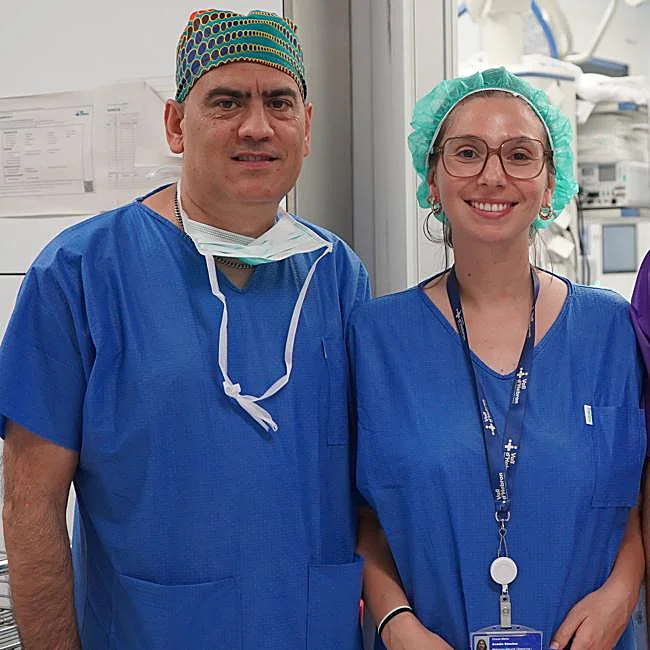
Dr. Sánchez Iglesias and Dr. Acosta Sánchez.
Is there any preventive surgery? In which types of ovarian cancer can it be recommended?
In 90% of cases we are talking about epithelial ovarian cancer. The epithelium is what surrounds the ovaries and fallopian tubes. In 2010, a pathologist, Dr. Kurman, determined two types of tumors: type 1 or low-grade and type 2, high-grade serous tumors. He also determined that these type 2 tumors did not originate in the ovary, but in the fallopian tubes, only that by continuity they ended up affecting the ovary. He detected that there were precursor lesions in the tubes, premalignant lesions that, over time, can trigger ovarian cancer.
This finding allows those women who carry mutations that increase the risk of ovarian cancer to resort to a surgery called risk-reducing cytoreduction. It consists of removing the ovaries and fallopian tubes. Even so, the risk of illness will never be zero, because it comes from the epithelium that lines all the organs of the area: the ovary, the fallopian tubes, and the peritoneum.
What criteria must women meet to access that genetic test that confirms the mutations? If I am not mistaken, in private healthcare the cost of that test ranges between €2,000-€3,000.
All women with ovarian cancer undergo a genetic test. We know that 20% of ovarian cancer patients have one of the mutations mentioned above (BRCA1, BRCA2). It is a significant percentage. The genetic test also allows detecting other mutations called HRD that indicate the benefit of inhibitor drugs. In this case, the percentage of women with this mutation reaches 50%.
The genetic test is not indicated for the general population due to the low probability of finding a mutation. However, the relatives of ovarian cancer patients in whom the mutation has indeed been detected can access the test in public healthcare and decide on undergoing any risk-reducing cytoreductive surgery.
What options exist to access any risk-reducing surgery for ovarian cancer in women who do not have any genetic mutation?
In patients undergoing benign gynecological procedures such as hysterectomy, the removal of the uterus, the removal of a fibroid, an ovarian cyst, etc., and who do not wish to become pregnant, there is the possibility of performing bilateral salpingectomy: the removal of the fallopian tubes. In fact, we are performing this systematically. It could be considered in other patients who have to undergo digestive or urological surgery, something that at present is not being done although it would be recommended.