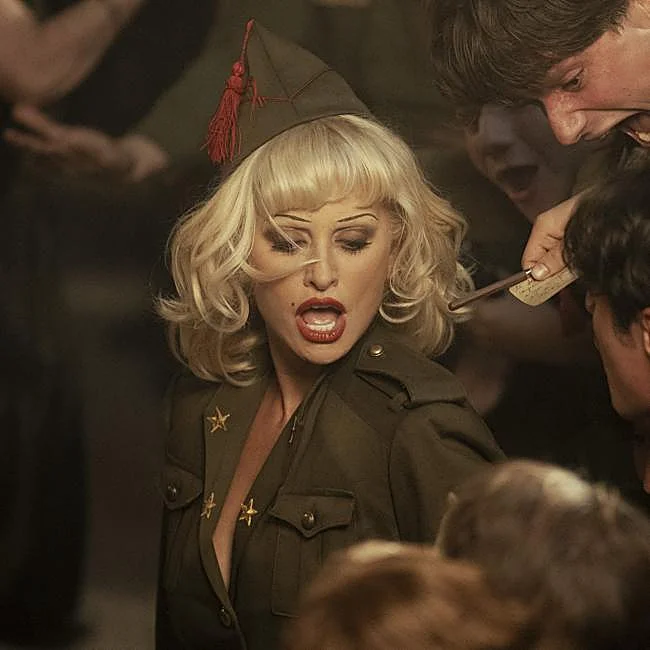
If you have already had the luck to see La bola negra, you may have also been captivated by the scene in which Penélope Cruz embodies Nené Romero, an artist who goes to the barracks to entertain the soldiers of the Nationalist side. With this scene Los Javis resurrect the figure of the cuplé artists, women dedicated to singing and dancing in variety shows who enjoyed a special prominence in the era in which the film is set, the Civil War.
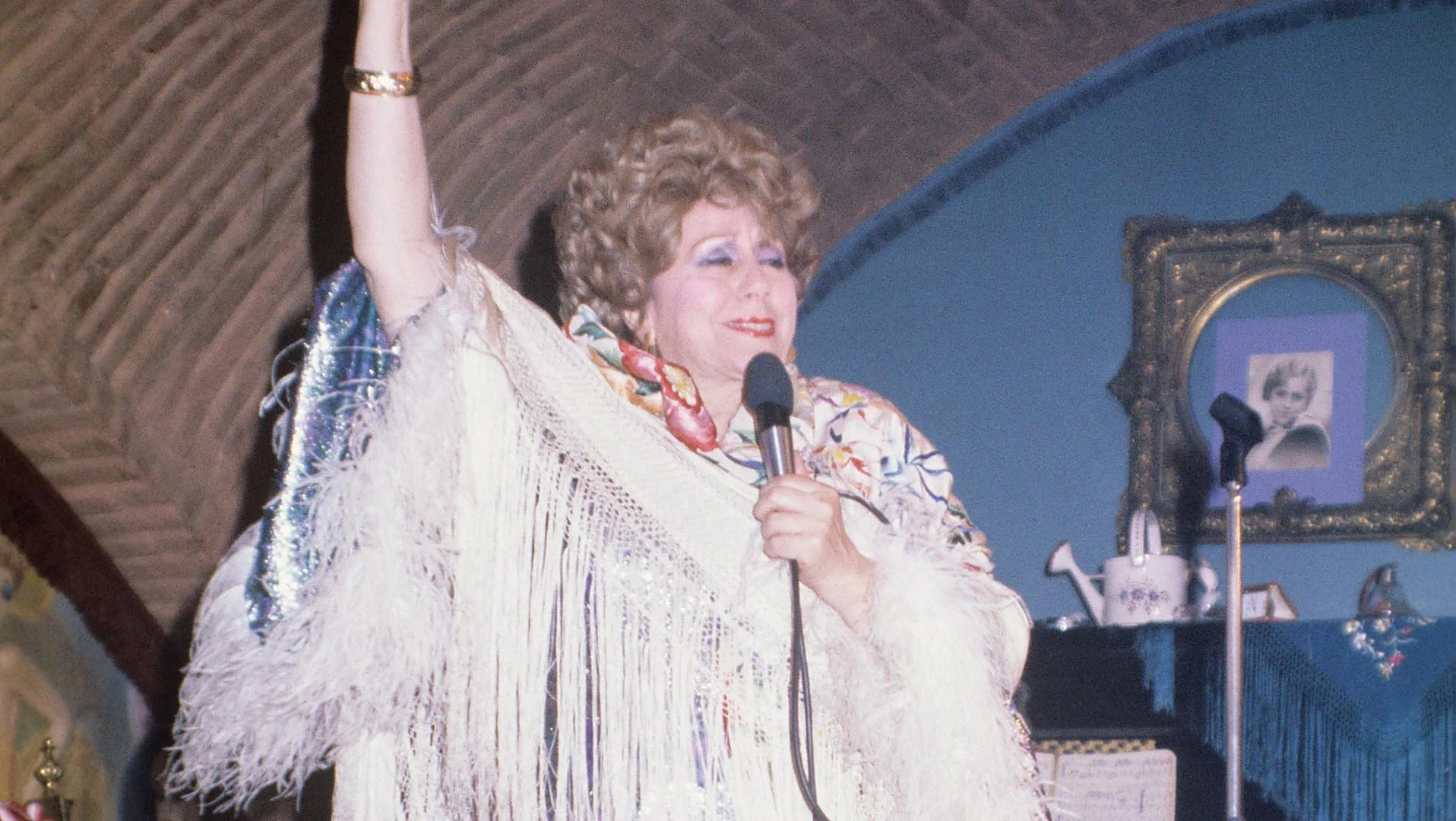
The origin of these artists dates back to the 19th century, and from that moment until well into the Franco dictatorship (an era in which the freedom of cuplé lyrics ceased to be so welcome) there were many names that were written on the cuplé’s Walk of Fame and that have gone down in history as stars of the variety. But if there is one that stands out above all and that still today is remembered as an icon of the genre, that is Olga Ramos, the woman whom Los Javis looked to when conceiving Nené Romero for the film.
This star was born on July 20, 1918, in Badajoz under the name Trinidad Olga Ramos Sanguino, although she would go down in history by her stage name, Olga Ramos. She rose to fame as a regular singer in Madrid’s cafés-concerts, where she also played the violin, for she had training in this instrument which she first pursued at the Conservatorio de Badajoz and later at the Royal Superior Conservatory of Music in Madrid.
Her story with the violin began, precisely, as a blunt attempt to avoid what came later. Her father, an infantry captain, feared that the fame that performers enjoyed at the time would be harmful to his daughter, so he encouraged her to study violin at the conservatory, in order to change his mind. Although, as is evident, he did not manage to erase this idea from her head, Olga went on to win the first prize of chamber music at the Royal Conservatory of Madrid.
During the Civil War, her career as a cupletista saved her and her family from falling into poverty, as she earned a living with her performances to survive the conflict. And Olga’s charm wasn’t limited to her musical talents. The artist knew, through the cuplé, how to evade censorship increasingly present in the world of show business, and she did so by using humor as a resource. The impish nature of the cuplé and the character she embodied in her performances gave her the perfect platform to address controversial issues of the time, such as women’s freedom or sexual desire, but it also required aplomb and personality—qualities Olga brought to the table—giving her the courage, for example, to sing the lyrics in their original version rather than as the censors proposed.
Penélope Cruz portraying the cupletist Nené Romero in La bola negra
With the end of the conflict, Olga continued her training but did not abandon the stages, where she remained steadfast well into her years, or as she herself put it, ‘her joyful autumn.’ She triumphed in Madrid’s legendary venues such as Café Universal, also known as Café de los Espejos, located at Puerta del Sol, or El último cuplé, at 51 Calle de la Palma, which, after the death of its owner, came to be known as La noche del cuplé.
In the 1980s she expanded her artistic horizons to television. She appeared on programs such as Un, dos, tres…responda otra vez or the documentary series Los años vividos, by Mercedes Odina, which reviewed Spain’s recent years through famous figures of the national scene. Olga Ramos knew how to bring to the small screen the humor and rebelliousness inherent in the cuplé that marked her career and her personality and that are largely responsible for why she is still remembered today as a star of the genre.
Her daughter, entrusted with keeping her legacy alive
Olga Ramos passed away in 2005, and the last years of her life, in addition to television, were spent performing with her daughter, Olga María Ramos, entrusted with carrying on her mother’s legacy. Resulting from her relationship with the musician and composer Enrique Ramírez de Gamboa, Olga María wished to follow in her predecessor’s footsteps and also devote herself to cuplé, fascinated by what she had been seeing since she was small, and Olga Ramos wanted to accompany her in her early steps.
More than two decades after the artist’s death, Olga María Ramos remains devoted to the legendary genre that gave so much to her family, not only interpreting cuplés on stages but also as a researcher and disseminator of everything that cuplé entails. It was she who helped Penélope Cruz prepare for the role of Nené Romero in La bola negra (in fact, she even has a small cameo in the film dressed as one of the era’s cupletistas).
Olga María rehearsed the musical numbers with the actress and, especially, spoke to her about the strength of the cuplé that Penélope Cruz managed to carry to the big screen with such mastery. And what Olga feels for the genre that crowned her mother is absolute passion, as demonstrated in the House Museum where she preserves objects as special as Olga Ramos’s violin or in her outreach work on social networks where she defends cuplé as part of Spain’s history and teaches how to wear the Manila shawl with the artistry and ceremony that such a complement, so closely associated with cuplé, deserves.