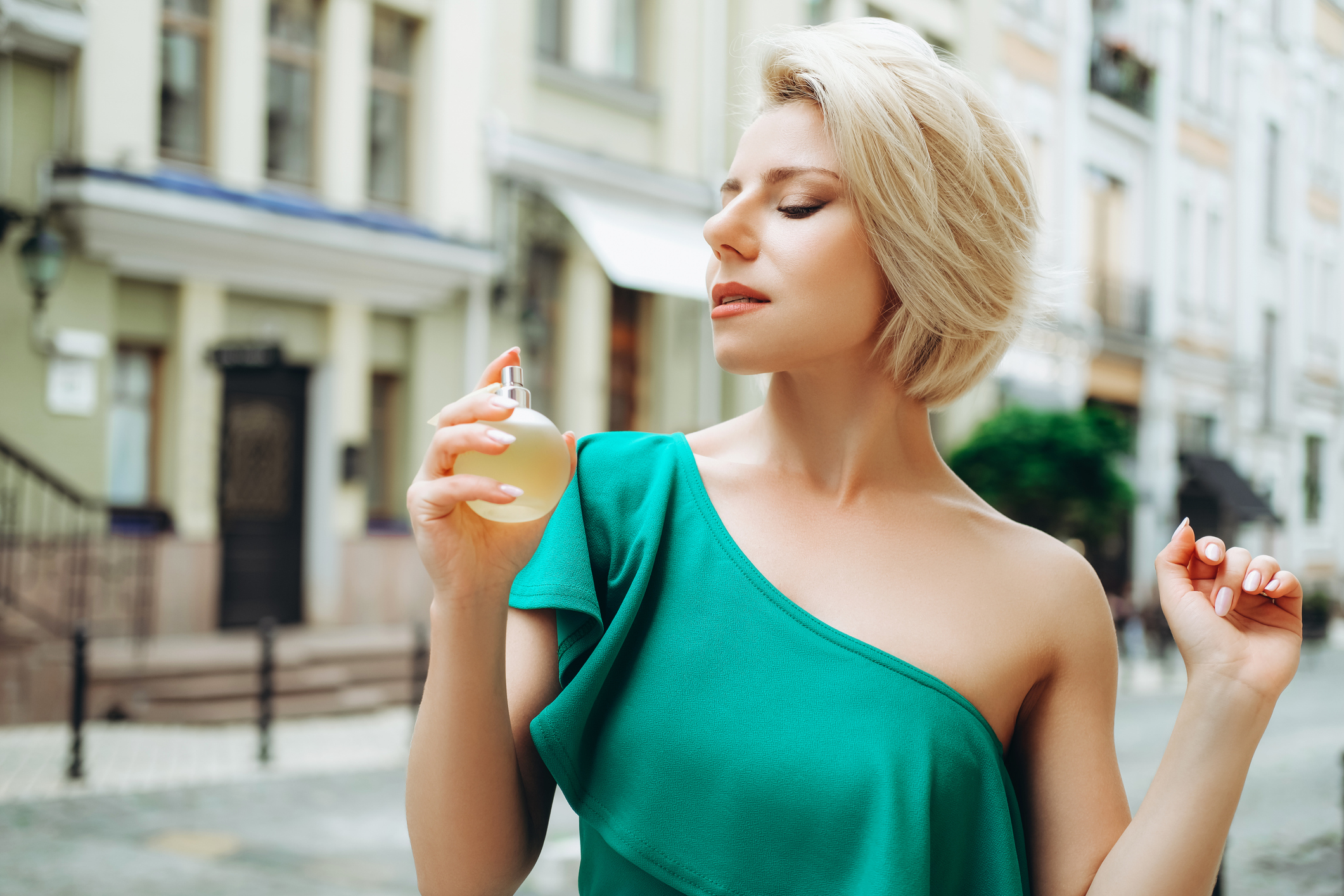
The arrival of Generation Z to perfumery has been a breath of fresh air. “I am fascinated by their audacity to use accords that until now seemed excessive to us, such as coffee, tobacco or oud,” proclaimed perfumer Ramón Monegal in a small circle during the inauguration of the The Scentuary boutique. They have also popularized layering, that curious gesture of applying two perfumes at once.
Aside from asking two experts in the art of perfumery whether this is a sacrilege or a gesture of personality, we have asked two dermatologists about the possible impact on the skin of doubling the amount of alcohol and the amount of fragrance particles.
Double Serving of Perfume
Perfumes, like any cosmetic, are tested in the laboratory for single-use application. Mixing two perfumes takes it to another level. At first glance, it usually means doubling the amount of product that ends up on the skin. The dermatologist Cristina Corredera, of the Ricart Medical Institute, points out that layering does not necessarily imply doubling the risk of irritation. What it does increase is simultaneous exposure to a greater number of ingredients from the two formulations.
There are no two perfumes alike, nor two skins alike. The key lies in the total amount of product we apply, its composition and the characteristics of the skin on which it is applied. “One person may apply several spritzes of the same perfume and be perfectly tolerable, while another may experience irritation with a smaller amount. Especially if their skin is especially sensitive or if any component of the fragrance triggers a reaction.”
Is so much alcohol dangerous?
The dermatologist clears up doubts about a possible adverse reaction to so much alcohol. “Although alcohol can contribute to dryness or irritation, especially in sensitive skin, with the skin barrier compromised or freshly waxed, we cannot assume that combining two perfumes will double the risk of irritation.”
In similar terms, Carlos Morales Raya, a dermatologist expert in laser, acne and aesthetics, and medical director of the Madrid clinic that bears his name, responds. “Alcohol evaporates quickly. On healthy skin, normal amounts of perfume are usually well tolerated. Applying two perfumes does not automatically imply double the problem from the alcohol.”
Be careful with oil-based perfumes
Dr. Morales Raya notes his caveats when layering is done with highly concentrated perfumes, essences, or oil-based perfumes. “One must separate concentration from alcohol. A more concentrated perfume does not necessarily carry more alcohol. In fact, it is usually the opposite: it carries a higher proportion of aromatic compounds, which from a dermatological standpoint weigh more than the alcohol itself.”
Regarding oil-based perfumes, which are often seen as safer because they do not contain alcohol, he points out that it is quite the opposite. “They stay on the skin longer and extend contact with the aromatic substances. If among them there is any irritant or something to which the person is sensitized, contact dermatitis may arise.”
Something similar happens with essential oils and fragrance components that react with subsequent sun exposure. “The classic example are some compounds in citrus oils, which can produce phototoxic reactions,” he adds.
The perfume as a work of art
Knowing that layering, which has captivated the younger crowd, is safe on healthy skin, the question remains: is it a sacrilege to mix, and what rules should we follow to avoid spoiling the result? Before we start mixing, Jorge Martín, director of 5Th Essence Square, one of the most established niche perfume distributors in Spain, suggests thinking twice about what we have in hand. “A perfume is a complete creation, conceived by a perfumer with its own balance, evolution and discourse,”
Placing each perfume as a work of art, beautiful and complete in itself. It is a Picasso, a Beethoven symphony, or a Ferran Adrià culinary creation. “Before thinking about mixing it, I always recommend getting to know it and wearing it solo,” he adds.
Endowing it with a new personality
Just as Picasso revisited Velázquez’s Las Meninas with his own style, perfumes can be combined, elevated or reimagined with common sense and olfactory sensitivity. Once we have grown intimate with our fragrance, “the perfume also becomes part of our identity. Here, layering can be a legitimate form of personal expression.”
The problem is not mixing, “but doing it without discernment. If we superimpose two very complex, intense and leading perfumes, it is easy to destroy the architecture of both. Layering should bring a personal signature, not erase the identity of the fragrances used,” warns. “Thus we understand it both at Boutique Montale Barcelona and at Fisence: it’s not about mixing for the sake of mixing, but about discovering what each person wants to enhance, soften or transform, and building from there a coherent combination.“
Hands on the mix
Perfumery is a practical art, like cooking or enology. Only here we do not mix ingredients, but complete compositions, and that cannot be done blindly. “More than focusing on whether it is an eau de parfum or an eau de toilette, we should observe its structure, intensity, evolution and olfactory families.”
The simplest starting point is to look for a unifying element: a shared note or families that dialogue well together. “For example, citrus with aromatic notes; white florals with musks; vanilla with amber, woods or spices; or an intense fragrance paired with a cleaner and brighter one,” explains the expert.
The first combination, always in-store
Having overcome the reluctance to mix, one must do it well, test it and seek advice. At the Boutique Montale Barcelona, clients are advised on which perfumes could ‘marry’ best with each other. “We always start from a fragrance the client already knows or has liked. Then we identify what they want to enhance or transform, consult the combinations recommended by the brand, and present the perfumes first separately and then together. Only then do we test them on the skin, because that is where it is really confirmed whether the combination works.”
Reiterates the word ‘dialogue,’ hinting that the mix can add up or end in an impossible quarrel between two fragrances. “My rule is very clear: start with two perfumes and a concrete objective. Do I want to bring freshness, depth, warmth or sensuality? When there is a purpose, layering can create something truly personal. Mixing blindly rarely works.“
Unfortunate combinations and good friendships
When it comes to mixing, everyone is sovereign with the alchemy they apply to layering. “You can mix a niche perfume and a mass-market one, but you shouldn’t.” It is not comparable to mix a richly worked gray amber with nuance with a flat or overly synthetic amber chord used in a mass-market fragrance,” warns Jorge Martín.
To illustrate, he uses an easy-to-visualize analogy. “It’s like mixing a Monini Monocultivar Coratina Bio, recognized as the world’s best extra virgin olive oil, with a mild Hacendado olive oil priced at €3.95 per liter. Both are olive oils, but neither the raw material nor the production process nor their complexity are comparable. When mixed, the second does not elevate the first; it dilutes and blurs precisely what makes the first exceptional,” he adds.
The order of factors does matter
When applying them, I would apply first the more intense, dense or persistent fragrance. Then, the lighter or brighter one, leaving a few moments between the two to observe how the first begins to evolve,” explains.
At Boutique Montale Barcelona we work with three distinct techniques. “Apply both fragrances on the same area; create a cloud to achieve a more diffuse fusion; or distribute them on different areas of the body. The latter allows the fragrances to coexist and build a joint trail without fully losing their identity.”
Balance, restraint and respect are essential to achieving a harmonious result. “The perfect combination should not smell like two perfumes competing with each other. We should seek a third creation that becomes the personal signature of the wearer,” concludes Martín.
We are not as modern as we think
The journalist and expert in olfactory culture, Clara Buedo, is more definitive in stating that layering “several very intense or discordant perfumes is like a war of Titans. The olfactory trail could be lethal.” Buedo is one of the best-informed connoisseurs of the perfume universe in our country. She shares knowledge and passion about perfumes from her Beauty Matters website and in her books ‘Historia del Perfume’ and ‘El perfume en España’ (both published by Catarata). From her small vantage point of authority in the olfactory arts, she has a small warning for Generation Z and their zeal for layering.
“They may think they have discovered gunpowder, but they haven’t. In ancient Mesopotamia the technique of blending was already practiced, and for Arab culture it became an expert ritual. Layering was the “art of superimposing fragrances,” and I emphasize ‘art.’ It is not mixing haphazardly; it is enjoying the multiple facets emanated by each ingredient and how it evolves in layers,” she explains.
In that oriental art and ritual, it was carried out with order and by playing with perfumes in different textures. “First, attar or perfumed oil. It has an oily texture that blends well with the skin and the heat makes the aroma evaporate slowly. They also applied scented powders to different parts of the body and finally sealed it with incense smoke (in Arab cultures bhakoor, with oud chips or agar wood and perfumed substances; in Indian culture, for example, sandalwood was more common),” declares this expert.