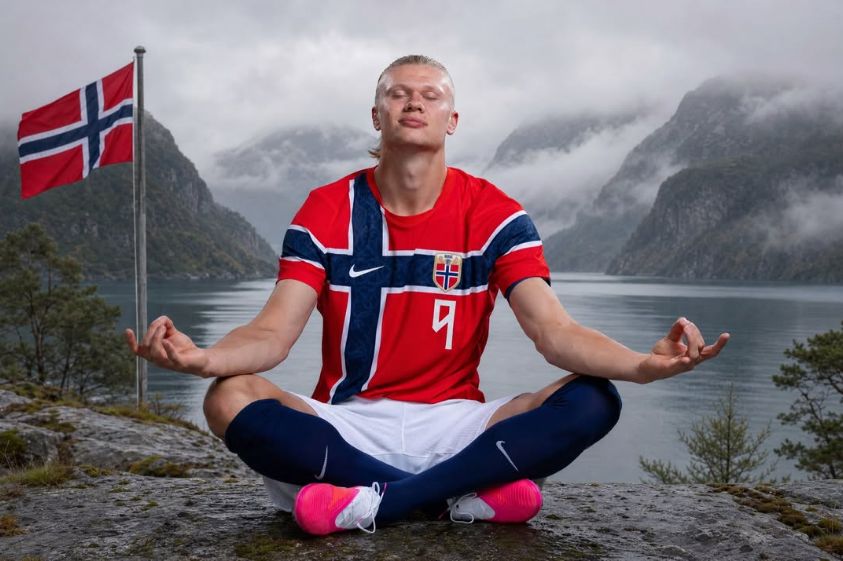
For years, meditation has been seen as something for mystics or yogis. However, this summer, on the occasion of the Football World Cup, many discovered that the Norwegian Erling Haaland practices meditation regularly as a way to manage stress before a match. His seated-in-lotus meditations went around the world and even became the subject of some humorous sequences in a Nike advertisement. The natural ease with which public figures incorporate meditation into their lives is causing many people to try this form of present-mocus? No, present-moment concentration. But, how does one actually meditate?
That is the starting point of Petit BamBou, an app designed ‘to meditate, breathe, and take care of yourself.’ We talk with psychologist Belén Colomina, a contributor to Petit BamBou, about how to start meditating and learn to practice conscious breathing anywhere.
Meditating is not about disconnecting from the world
WeLife. The presenter Oprah Winfrey, the tennis player Novak Djokovic or the footballer Erling Haaland are some of the celebrities who have openly spoken about their passion for dedicating a few minutes each day to meditation. Does it help remove that stigma of ‘hippy’ or mystical?
Belén Colomina. Certainly. When a public figure like Haaland speaks openly about meditation, it helps break some of the prejudices that still exist around this practice. For a long time we have associated meditation with something mystical, spiritual, or reserved for people who lead a very particular lifestyle. However, meditating is, above all, training our ability to pay attention, observe what happens in our minds, and learn to relate to our thoughts and emotions in a more conscious way.
WeLife. Precisely Haaland has been seen meditating on the very field, surrounded by the noise of a stadium. Does that mean you don’t have to isolate yourself to practice meditation?
Belén Colomina. Exactly. That an elite athlete incorporates this practice into their routine reminds us of something important: meditation is not about disconnecting from the world, but about learning to be more present in it. And that is useful for someone facing the pressure of a full stadium just as much as for someone who has to manage a complicated workday, a difficult conversation, or the worries of daily life.
Sitting, walking…
WeLife. Continuing with Haaland, he usually does it in the lotus pose. Is it necessary to do it that way every time?
Belén Colomina. Not at all. This is one of the great myths of meditation: thinking that we need to sit on the floor, cross our legs, or adopt a specific posture. We can meditate perfectly while sitting in a chair, with our feet on the ground and our back in a comfortable and stable position. We can even practice lying down or walking.
WeLife. Let’s put ourselves in the shoes of someone who has never practiced meditation. What would be the most favorable posture?
Belén Colomina. The posture should help us stay present, not become a source of discomfort. The important thing is not how we place our legs, but how we place our attention. We can be seated in the lotus posture with the mind completely distracted, or be in a chair and perform a very deep mindfulness practice.
Day 1 of Your Meditation
WeLife. For those who have never meditated, how can one start?
Belén Colomina. My recommendation is to start in a very simple way, without big expectations and without insisting on doing it perfectly. Just find a quiet place, sit comfortably, and dedicate a few minutes to observing the breath. We don’t need to breathe in a special way; simply notice how the air goes in and out. After a short time, thoughts, memories, worries or plans will appear.
WeLife. Do you have to keep the mind blank?
Belén Colomina. No. Our mind is designed to think. The practice consists of noticing when we have become distracted and gently returning to the present moment, as often as necessary. Each time we recognize a distraction and return to the breath, we are training our attention.
WeLife. How long should our first session last?
Belén Colomina. To begin with, a guided meditation of three or five minutes can be an excellent help. In this sense, a meditation app like Petit BamBou makes the first steps much easier, as it offers simple and structured practices that accompany us, teach us to manage distractions, and help us incorporate meditation into our routine gradually and without demands.
‘Es que yo no tengo tiempo’
WeLife. A question that many people may ask themselves is ‘oh, I have no time for anything. Where am I going to find time for this meditation? How much time should I devote to it per day?
Belén Colomina. One of the most common mistakes is thinking that if we don’t have half an hour available, it’s not worth meditating. We live with very demanding schedules, but precisely for that reason we need to learn to insert small spaces of pause. It is better to meditate seven minutes a day with some regularity than to try to do it for an hour once a month. We can start with five or ten minutes and gradually increase if we feel comfortable. There is no universal duration that works for everyone. Moreover, we can cultivate mindful attention in everyday moments: while walking, having a coffee, or pausing between tasks. It’s not always about finding more time, but about learning to inhabit the time we already have in a different way.
First Guided Steps
WeLife. What does guided meditation with an app bring?
Belén Colomina. A meditation app can be a very valuable tool because it makes access to the practice easier and helps create a habit. When a person starts meditating, it is common not to know what to do, how to manage distractions, or how much time to devote. A guided meditation offers structure and a voice that accompanies, guides, and helps return to the present. It also allows adapting the practice to the needs of each moment: managing stress, preparing for sleep, working on attention, cultivating self-compassion, or learning to relate to emotions. Applications like Petit BamBou also have the advantage of bringing these resources to people who might never have considered attending an in-person course. For me, their greatest contribution is that they make meditation seem less distant or complicated and become a practical, everyday practice.
WeLife. Is it as effective as having a guide by our side?
Belén Colomina. Both options can be useful, though they offer different experiences. Guided meditation through an app allows practice autonomously, adapting schedules and maintaining consistency. For many people it is an excellent entry point and a way to sustain the practice in the long term. Meanwhile, an in-person instructor can observe how each person experiences the practice, resolve doubts, adapt the practices, and offer more personalized guidance. I would not say that one modality is necessarily better than the other. Usefulness depends on the person, their needs, the quality of the practices, and their continuity. In fact, they can complement each other very well. A person can start with an app, deepen through courses or in-person meetings, and continue using guided meditations in daily life. What matters is not so much the format as the quality of learning and the relationship we build with our own mind.
Before the first coffee
WeLife. According to Petit BamBou user metrics, what times do Spaniards prefer to meditate?
Belén Colomina. Petit BamBou’s data show something very interesting: more and more spaces are found to incorporate meditation into our daily life, although there are moments when we turn to it more frequently. Users meditate every day of the week, but activity is slightly higher on Mondays, Tuesdays, and Wednesdays, while Fridays and Saturdays are the days with the least practice. Regarding times, two very specific windows stand out: in the morning, between 7:00 and 8:00, and at night, between 22:00 and 23:00.
WeLife. Are these the most normal hours to do it?
Belén Colomina. From a psychological perspective, it makes a lot of sense. In the morning, meditation can help us start the day with greater calm and mental clarity before slipping into the pace of our obligations. At night, it becomes a space to pause, distance ourselves from worries, and ease the transition to rest.
WeLife. Do we align with the rest of Europe in that timing?
Belén Colomina. The habits of Spanish users are very similar to those of other European countries, both in the days and in the times chosen to meditate. This reminds us that, beyond cultural differences, we share a very human need: to find moments to stop, listen to ourselves, and regain balance amid our routines. In the end, what matters is not so much what time we meditate, but finding that small space we can regularly dedicate to caring for our minds.
Perfect on those days when everything is uphill
WeLife. Haaland uses meditation before matches to visualize plays, tactics, trainings he has done well and to quiet the pre-match noise. Could you give me examples of other moments or situations in our life where it is especially advisable to turn to meditation?
Belén Colomina. Meditation can accompany us in many everyday situations, especially when we feel our minds speeding up or we are operating on autopilot. For example, before an important meeting, a job interview, or a difficult conversation. Stopping for a few minutes can help us recognize our nerves and respond more clearly, rather than letting ourselves be carried away by the moment’s reaction. It can also be useful at the end of a long day, when we arrive home with our heads still full of worries; before sleep, if we have trouble winding down; or when we go through periods of uncertainty and feel our minds constantly anticipating negative scenarios.
WeLife. That sounds like an outlet valve when we’re about to explode…
Belén Colomina. We do not need to wait until we are stressed to meditate. Just as we don’t wait for an injury to start taking care of our body, we can train our attention and our emotional well-being preventively. We often live so focused on what we have to do, what has already happened, or what could happen, that we lose touch with what we are living. Meditation invites us to reclaim that space. Because meditating does not mean stopping to have problems, thoughts, or difficult emotions. It means learning to relate to all of it without losing our own center.