Millions of people discover, each year, the charms of a breathtaking city like Edinburgh; others lean toward Glasgow, and there are even those who, drawn by cinema and television, venture into spectacular places like Skye or the Highlands. However, Scotland has an unexplored territory that houses the elements that have made the British country a must-visit destination for travelers around the world: a history with character, unforgettable landscapes and a creative, distinctive urban life.
Because the east coast of Scotland is a place where nature remains a living treasure and shines with its own light, dotted with some of the country’s most imposing castles, with beautiful coastal towns brushing against the North Sea along its beaches, almost wild. And with a gastronomy inevitably seafood-based, this itinerary is essential to understand authentic Scotland, the Scotland that, sooner or later, conquers.
The bravest and most independent traveler can opt to hire a car to dive into this region where, from north to south, Aberdeen, Dundee and St. Andrews are essential stops. For those seeking greater comfort and for those who want to capture dreamlike scenes in their memory, Scotland’s rail network is the perfect ally to move around without compromising on anything.
Aberdeen: Granite and Silver
With barely an hour and a half between the aforementioned cities, discovering from the rails the beauty of a sunset over a fjord or marveling at the splendid greenery of the interior of the territory is a luxury that those who want to explore eastern Scotland should consider.
Aberdeen Marischal College.
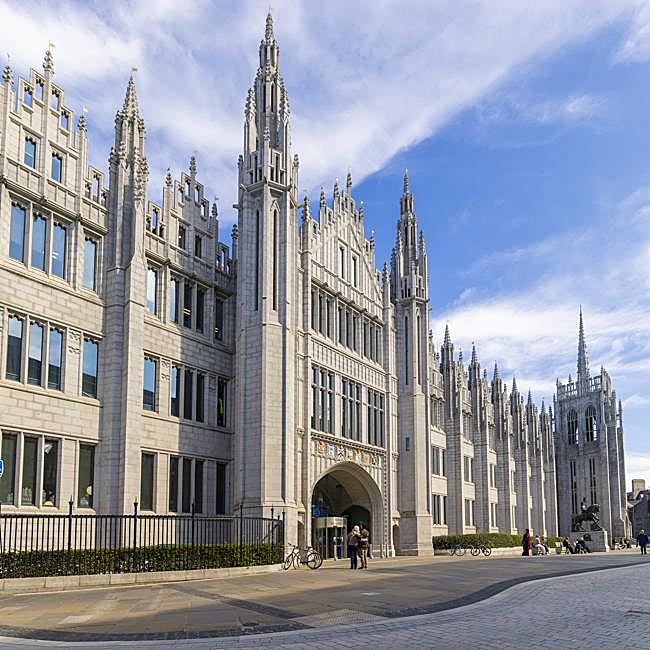
Thanks to its silvery buildings, constructed with stone quarried from local mines, Aberdeen is known as the Granite City and counts, as the principal exemplar of this architecture, with the impressive Marischal College, which is the second-largest building in the world built with this material. Walking, especially at sunset, along Union Street, its main artery, is to yield to the inexhaustible magic of its buildings and its culture.
At the end of the street, on the eastern edge, Castlegate is found, a small square where the local architect John Montgomery placed, four centuries ago, the Mercat Cross crowned by a unicorn, Scotland’s national animal. Legend says that, on full-moon nights, you can still see the ghost of that mythical creature hovering above the square.
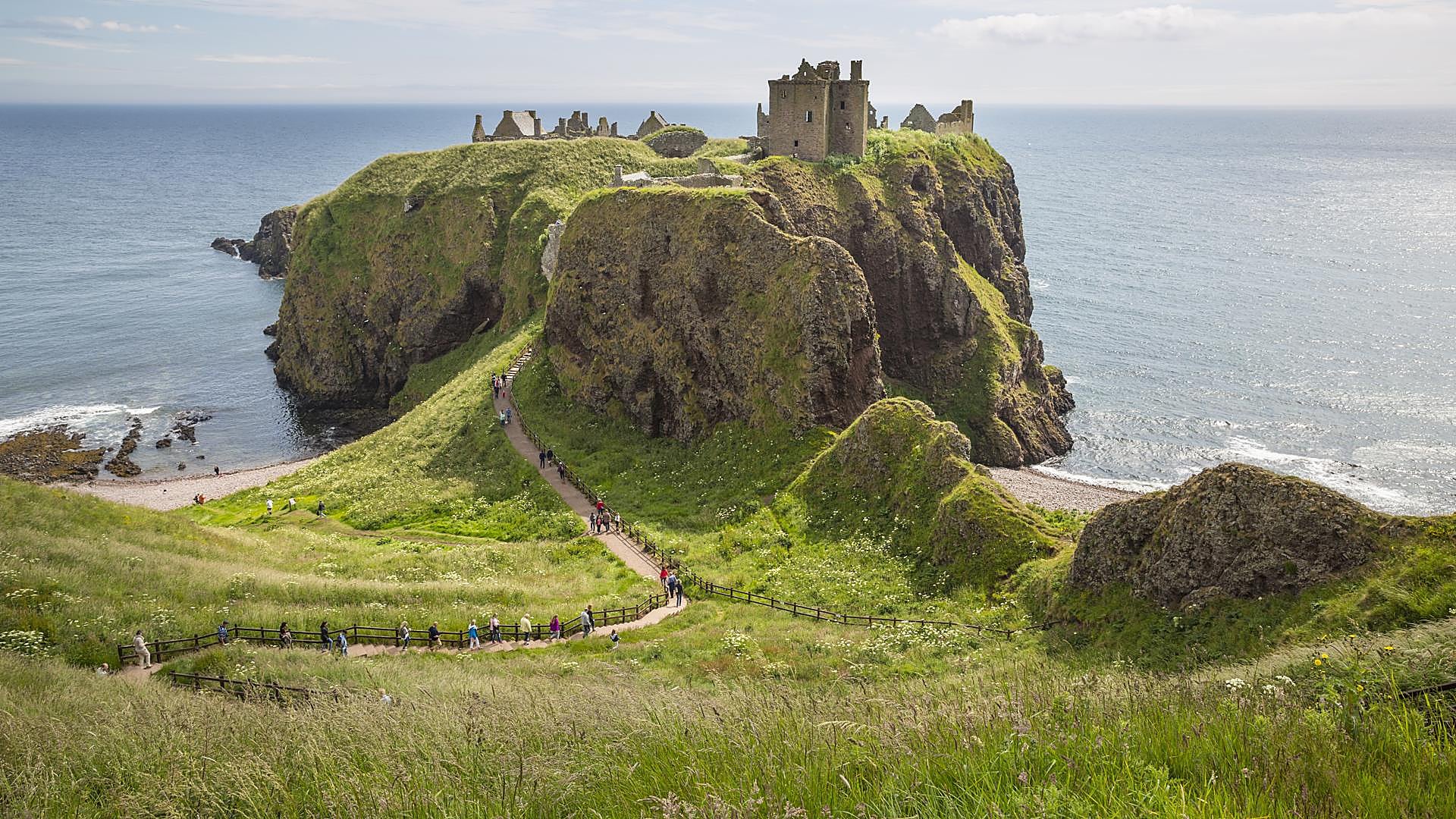
Aberdeen Dunottar
Historically linked to fishing, Aberdeen combines tradition and prosperity with the sea as the protagonist. If the port is a pivotal point of its economy, beaches such as Aberdeen Beach, with their unique landscapes, or viewpoints like Torry Battery, ideal for spotting dolphins, remind us of the power of nature and its relentless appeal.
A fascination that can also be experienced by taking a bus to Dunnottar Castle. Crucial in the country’s history, and with names such as William Wallace or Queen Mary I of Scotland among its most illustrious guests, the ruins of this fortress sit on a spectacular cliff that, as those who know it well say, may be visited only once but then never forgotten.
Dundee: design, art and youth
Arriving by train in Dundee, the country’s fourth-largest city, is an unforgettable experience thanks to the bridge that rises over the Tay Estuary and makes it possible to cross as the urban silhouette becomes visible on the horizon.
V&A Dundee.
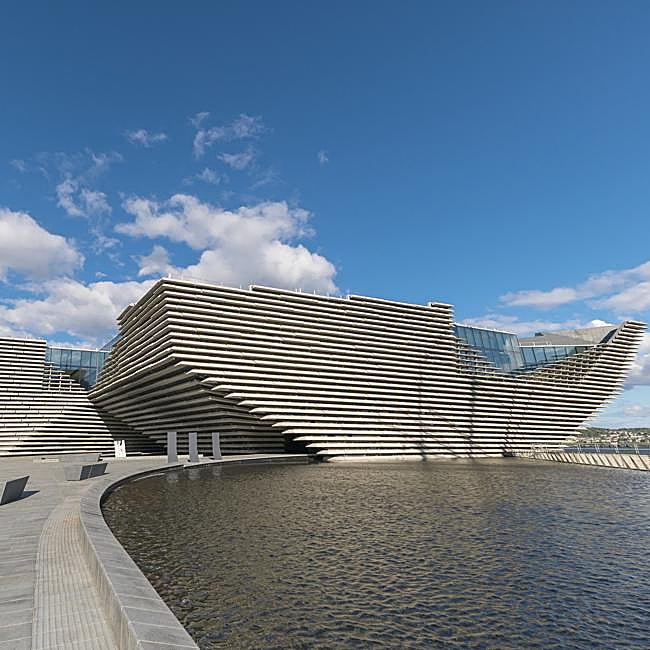
Declared a UNESCO City of Design, Dundee has decided to reinvent itself by betting on culture with the V&A Museum, the only institution of the British cultural entity located outside London, as its main lure. The Japanese architect Kengo Kuma has been responsible for designing this spectacular building with angular lines that seems to emerge from the water and which, in less than a decade, has become a benchmark for travelers and locals.
Alongside the McManus Art Gallery and Museum, housed in a beautiful neo-Gothic building, and the murals that adorn all kinds of properties, Dundee’s transformation extends across the city. And it does so with a vibrant leisure offer for all audiences, driven by the rejuvenating role played by its university population.
St. Andrews: a land bound to its history
Although, if there is a Scottish city tied to the educational entity from which it takes its name, it is St Andrews. There, in the 15th century, the country’s first university was founded and there, six hundred years later, Prince William and his wife, Kate Middleton, met. Because, unlike the cathedral or the castle, whose ruins adorn the cliffs that border the town, the prestige and importance of the cloister have remained intact over time and, today, continue to be essential in the life of St Andrews.
St. Andrews Swilcan.
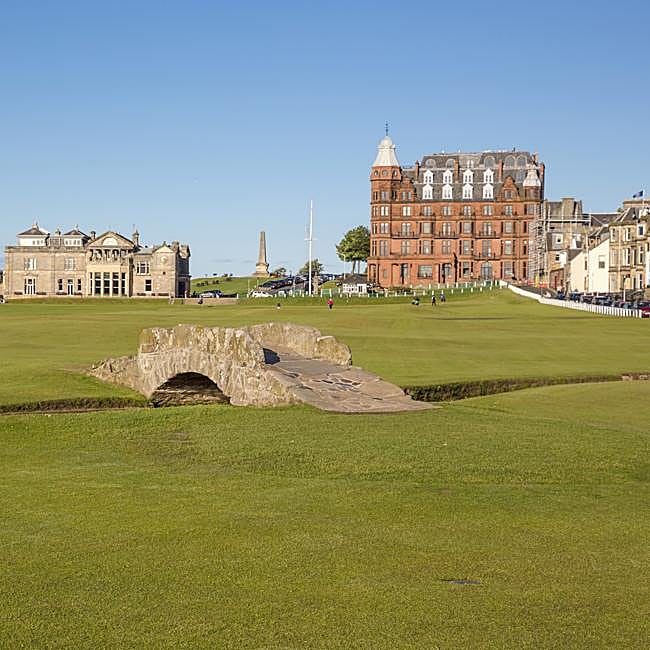
Beyond its delicious seafood-based gastronomy and the timeless charm of its cobbled streets, in this town of fewer than twenty thousand inhabitants, its famous golf course, the Old Course, is also vital. The cradle of this sport in Scotland and a pilgrimage site for golfers from around the world (including Donald Trump), its challenging holes and its privileged location facing West Sands Beach make it something more than a sports venue.
If we are not golf enthusiasts, we can stroll along the sea. Its three uninterrupted kilometers of sand and dunes deserve a visit to this setting that reminds us of the beauty of authenticity. And if weather does not permit, what better excuse than to indulge in oysters and the spectacular view of the beach at the Ondine Oyster & Grill of the Seaton House hotel, a unique place that will make our trip an unforgettable memory.