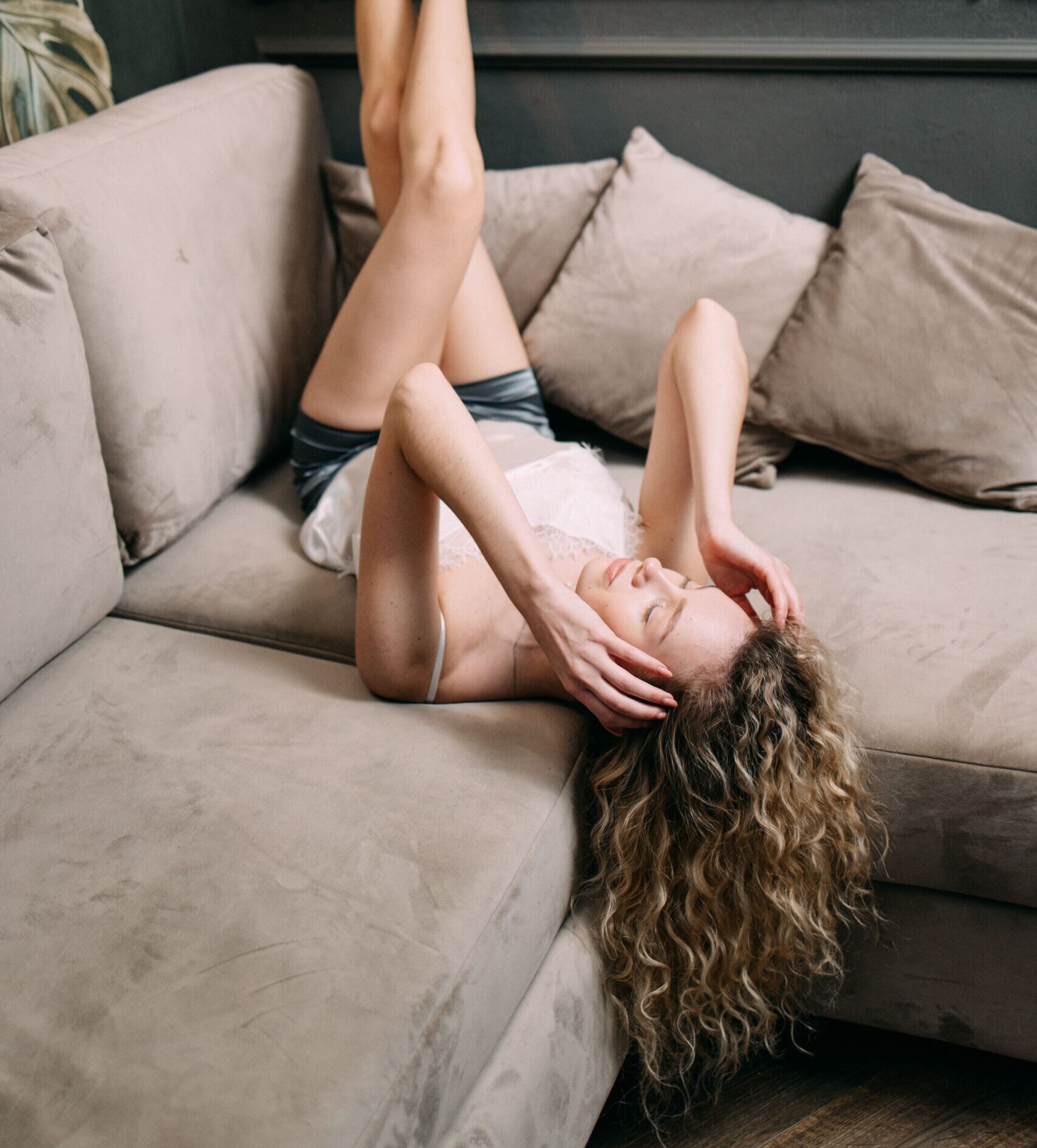
You don’t have to be Halle Berry to feel like Catwoman and free your back. PHOTO: Anastasia Shuraeva (Pexels).
Letting out your feline instinct will give your neck a breather. And even a moment of relaxation.
By Marcos López
AUGUST 27, 2026 / 07:30
Sitting for so many hours glued to a chair or sofa is not doing your spine any favors. On the contrary, it is provoking back pain. To the point of discomfort. But ending this lumbar suffering that affects up to 13% of the Spanish population is very simple. You only have to imitate the walk of the Felis catus. Or, in other words, that of a cat.
Poorly do any animals parade with such majestic ambulation as cats. And the reason for this regal and agile march is basically the flexibility and elasticity of their spine. So it’s time to copy them. To practice the exercise known as the cat walk. Which also will help you get in shape. Javier Giménez, personal trainer and CEO of Healthy Fitness, explains how to do it.
Walking Like a Feline
The cat walk or cat walk is an exercise that “combines the classic ‘cat-camel’ movement with forward displacement. It is performed on all fours, or in other words, on four points of support, alternating between arching the back upwards (scared cat position) and curving it downwards (camel position) while advancing forward”.

The objective of this walk is to exercise the spine and, by extension, all the muscles of the back. And for that, “during the displacement the fluid alternating flexion-extension of the spine is maintained, imitating the undulating movement characteristic of a walking cat”.
No excuses to walk on all fours
It is a very easy exercise to perform and is ideal for all ages and physical conditions. So there is no excuse to start today. Get up from the sofa and become the new Catwoman. Your whole body will thank you. Beginning with your spine, which will gain mobility thanks to an “improvement in flexibility in every single spinal segment”.
But the benefits do not end here, far from it:
- Relief of lumbar tension: it is an excellent exercise to decompress the lower back.
- Core activation: conscious work of the abdominal and lumbar muscles.
- Postural improvement: develops body awareness of the spinal position.
- Coordination: synchronizes the breathing with the body mechanics.
- Effective warm-up: is considered an ideal method to prepare the spine before training.
- Stress reduction: the fluid movement has a relaxing effect.
Mistakes you have to avoid
Simple? Yes. Beneficial? A lot. But little, or nothing, is useful if you do it badly. What will happen if you fall into one of the most common mistakes when performing it:
- Excessive cervical movement: forcing the neck too much instead of moving it naturally.
- Limited range: not performing the full flexion-extension of the spine.
- Inadequate speed: going too fast, losing segmental control. As the name suggests, this is walking, not running.
- Lack of respiratory coordination: not synchronizing inhalation-exhalation with the movement.
- Inadequate hand support: not distributing weight properly on the palms.
- Rigid movement: making abrupt transitions instead of fluid ones.
- Lumbar compensation: hyperextending only the lower area without mobilizing the entire spine.
Ideal for people aged 0 to 100
Let me insist: it is an ideal exercise for you. Just as it is for everyone. From children to very elderly people. Even more so if you lead a sedentary life, because it helps to recover mobility. In fact, along with being accessible, the second best descriptor for this exercise is ‘therapeutic’, frequently recommended in the rehabilitation of people with chronic low back pain.
Need more reasons? Here is a very important one: unlike other animal walks, such as the crocodile walk, no prior experience is required. Regardless of whether you are an Olympic athlete or a complete beginner, you can practice it from the first minute. Even during pregnancy.
Tips to make it even easier
It’s also okay if you have trouble performing it. You can always turn to some simple adaptations to make it (even) easier. For example, use its static version, in which the flexion-extension of the spine is performed, but there is no displacement; or reduce the range of motion. You can also support the weight on the forearms rather than the wrists. Or use a thick mat or another cushioned surface to minimize impact on the knees and prevent pain.
Conversely, if you have recently suffered a vertebral fracture, have an acute disc herniation with intense pain, or have undergone recent spinal surgery and do not have your doctor’s authorization, this exercise is not for you.