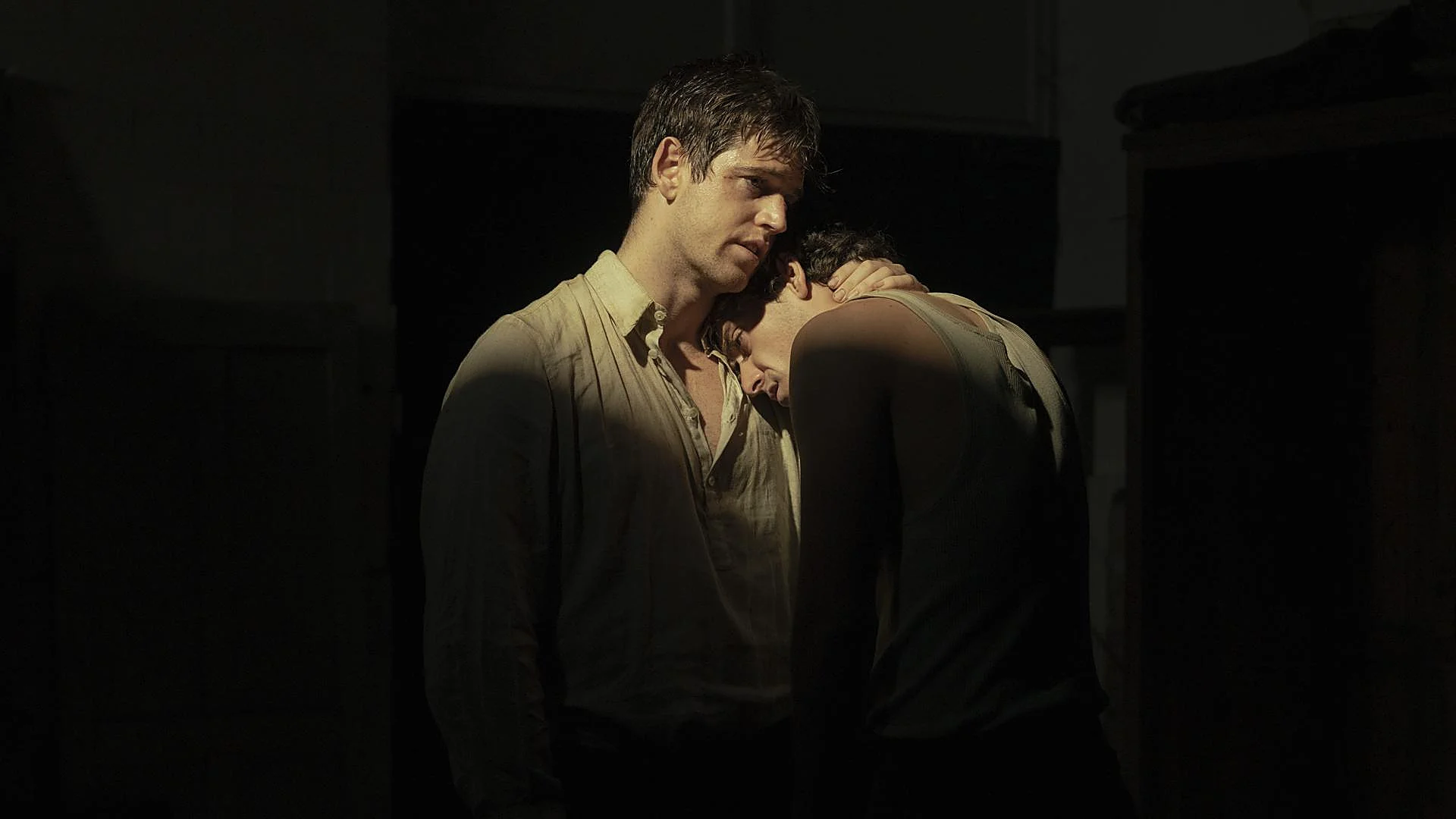
Friday finally arrived at the cinemas, The Black Ball, the film by Javier Calvo and Javier Ambrossi that, among other materials, draws on The Dark Stone, the work by Alberto Conejero. In it, Miguel Bernardeau plays Rafael Rodríguez Rapún, one of the most important men in the late years of Federico García Lorca and, for decades, a figure little known.
But before becoming a character on stage and now on screen, Rapún had his own life. He studied Mining Engineering, was a footballer, an actor, secretary of La Barraca, a socialist, and a republican soldier. He died at 25, in the midst of the Civil War, and his name was forever linked to Lorca. This is the story of the man who for too long seemed doomed to be a footnote in the life of the poet and whom Alberto Conejero decided to rescue from oblivion.
Much more than “Lorca’s Last Love”
When people speak of Rafael Rodríguez Rapún, almost always the name of Federico García Lorca appears first. It’s understandable: his relationship with the poet occupies a fundamental place in Lorca’s and Rapún’s late years, and Rapún has long been considered the main addressee of the so-called The Sonnets of the Dark Love. But reducing his biography to “Lorca’s last love” leaves out a good part of the story.
Rapún was born in Madrid in 1912 and studied Mining Engineering at the Madrid School of Mines. He also played football for Atlético de Madrid and, in 1932, joined the Madrid Socialist Group and the Socialist Youth. The following year he joined La Barraca, the university theater project created by Federico García Lorca and Eduardo Ugarte with the aim of bringing classical theater to towns and cities across Spain. There he began as an actor and ended up serving as the company’s secretary.
His relationship with Lorca was thus also professional and political, as well as romantic. Rapún became the poet’s personal secretary and remained linked to him until 1935. His figure thus appears tied to some of the most important cultural projects of Republican Spain, at a moment when theater and culture were also tools to bring society, which until then had had very limited access to them, closer together.
It was precisely in those years when the relationship between them grew closer. Rapún became one of Lorca’s most trusted confidants and stood by his side in some of the poet’s last years. The poet referred to him as “the three Rs” and, although the romantic relationship between them has been the subject of various investigations and interpretations, Rapún is considered the main addressee of the so-called The Sonnets of the Dark Love, the collection of poems that Lorca wrote in the last years of his life and that remained unpublished for decades.
The sonnets speak of a clandestine love, of desire, of separation, and of the fear of losing what is loved. For a long time, the identity of that recipient remained shrouded in mystery. Rapún’s name began to appear among investigations into Lorca’s private life, but his own story continued to occupy a secondary place compared to the poet’s.
It was precisely the reading of The Sonnets of the Dark Love that led Alberto Conejero to become interested in Rafael Rodríguez Rapún. The playwright, who encountered the poems as a teenager, began to wonder who that man behind them was and what had become of his life. The curiosity eventually became an investigation that led him to Rapún’s family, and in particular to his brother Tomás.
Through him he was able to learn memories and family materials that helped reconstruct the figure of the young man who had been spoken about so much in relation to Lorca. Among them were books that the poet had given Rafael, with dedications and notes. From that investigation arose The Dark Stone, premiered in 2015. The play is based on the real figure of Rapún, but it does not seek to be a biography. Conejero imagines a meeting between Rafael and Sebastián, a young soldier who guards him in a hospital in Santander during the Civil War. The two belong to opposing sides and are forced to share what could be Rapún’s last hours.
The meeting between the two is fictional, but the man at the center of the work is real. His time with La Barraca, his relationship with Lorca, and his political commitment are also real. Conejero’s dramaturgy arises precisely from those gaps left by history, and now it has become cinema in The Black Ball.
A life that ended at 25
Rapún joined the People’s Army of the Republic and rose to become an artillery lieutenant on the northern front. He died during the Civil War in Santander, in August 1937, at only 25, barely a year after Lorca’s murder. That parallel further linked their names in memory, though Rapún’s story would remain for decades in a secondary position. The Dark Stone managed, in some way, to reverse that gaze: placing at the center the young man who until then had been spoken of mainly in relation to the poet.
Now it does so as well in The Black Ball. Miguel Bernardeau takes up the mantle of that character and gives Rapún a face again in the Los Javis’ film, with Alberto Conejero again attached to the project as co-screenwriter. The story that began with a few poems, continued with an investigation, and then arrived at the theatre, now makes the leap to cinema.