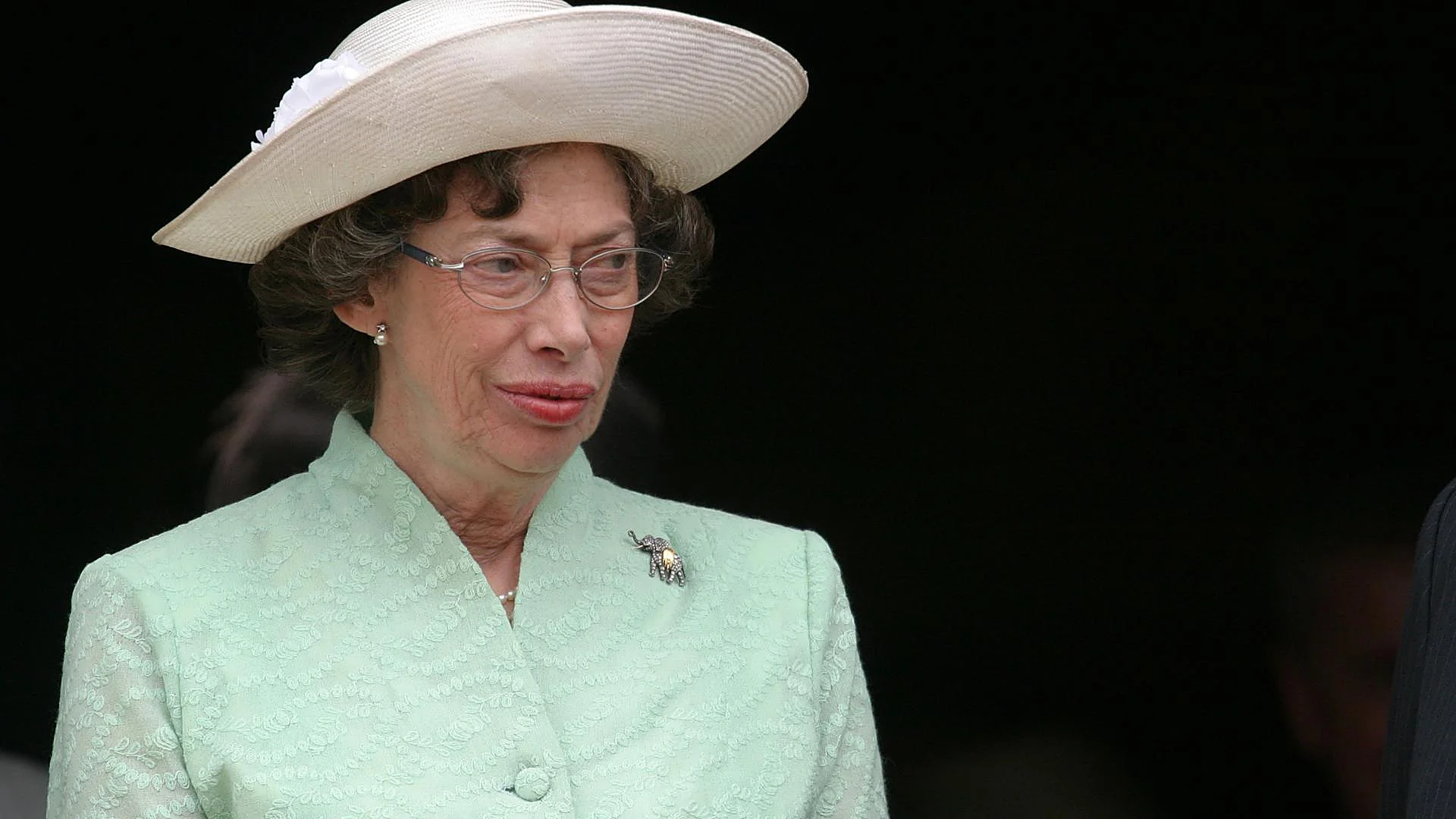
If there is anything that can be said about Princess Elizabeth of Denmark, cousin of Queen Margrethe, Queen Anne-Marie and Princess Benedikte, it is that she was an unconventional member of the royalty and that she lived an independent life both in her diplomatic career, which she combined with her royal duties, and in her love life, in which she lived a long story of love without marrying for more than twenty years.
Elizabeth Caroline-Mathilde Alexandrine Helena Olga Thyra Feodora Estrid Margrethe Désirée, princess of the House of Glücksburg, was born in Copenhagen on May 8, 1935. Her father, Prince Knud, was the younger son of Crown Prince Christian –later King Christian X– and of Princess Alexandrine of Mecklenburg-Schwerin, a grand duchy in the northeast of Prussia. Elizabeth was the eldest granddaughter of King Christian X and Queen Alexandrine.
Elizabeth was one month away from turning five when Hitler invaded Denmark, on April 9, 1940. Her grandfather, the king, decided not to exile and remained at the Amalienborg Palace, in Copenhagen, with his wife and the entire royal family. Elizabeth always recalled that one of the memories she kept from those turbulent years was the king, her grandfather, going out each morning, alone, on horseback, to ride through the streets of the city, where he was greeted as a hero to the citizens.
This memory perhaps shaped, perhaps, her own love for independence. The occupation ended on May 5, 1945, when Elisabeth was ten years old. From that dark era she retained a solid rejection of totalitarianism and antisemitism, and the conviction that diplomacy was the best means to solve the problems of the world.
Fashion and Diplomacy
Elizabeth was educated first at home and then in a secondary school and, later, in an exclusive academic center in Lausanne, Brillantmont. When she approached twenty, Elizabeth broke with tradition and, instead of seeking a husband, enrolled at the pioneering Margrethe Skolen, in Copenhagen, which today is the renowned Scandinavian Academy of Design and Fashion. After that, Elizabeth dedicated herself to her true passion, diplomacy.
She joined the Ministry of Foreign Affairs in 1956 as a trainee, and with the years rose to be head of section. From 1973 to 1976, she was stationed in Washington. Her second stay in the United States was from 1981 to 1985. In that period she greatly enjoyed the social life of the capital. She was also posted at the UN mission in Geneva, though always balancing her career with her duties as a princess.
Elizabeth had two younger brothers, Prince Ingolf and Prince Christian, who renounced their royal titles upon marrying commoners, which caused a great uproar in the royal family. The princess’s father, Prince Knud, had occupied the place of heir to the throne of his brother, King Frederick IX of Denmark, for a time, since the king had only three daughters — Margrethe (1940), Benedikte (1944) and Anne-Marie (1946) —, but no son.
If Knud had become king after Frederick’s death in 1972, Elizabeth, the eldest of his siblings, would have been queen, instead of Margrethe. But Knud found himself relegated in the line of succession when, in 1953, the law that did not allow women to reign in the presence of a male heir was changed and Margrethe II ascended to the throne. Elizabeth then occupied, from then on, the twelfth place in the line of succession.
A long romantic passion
The princess occupied a wing of Sorgenfri Palace, north of Copenhagen, where she had grown up and where she always considered her home. In her private life, she also chose her own path. She never married or had children, but she lived more than twenty years with her partner, the Danish filmmaker Claus Hermansen, 16 years older than her, a relationship in keeping with a more relaxed and modern monarchy, distant from the rigidity of previous generations.
The couple remained united until the death of the filmmaker, in 1977. Hermansen was a director, screenwriter and also an actor and a respected figure in Scandinavian cinema. He was a member of the Resistance during the Nazi occupation and made several short films about German domination. Two of his documentaries were awarded in Venice.
The princess Elizabeth lived with Hermansen in the elegant residential district of Furesø, northwest of Copenhagen. After his death, in 1977, Elizabeth returned to Sorgenfri Palace. Despite her unconventional life, Elizabeth always kept her royal title and maintained a close relationship with the royal family, especially with her cousin Margrethe and her nephews, daughters of her brother Ingolf, who helped her with shopping. In old age, she spent time hosting relatives and friends and recounting episodes of her diplomatic career.
“It is not easy to grow old,” she confessed in an interview. “For me, the worst thing is not that my health fails. The worst is missing my loved ones and the many friends who are no longer there.” In another interview, the princess stated that she had not wished to have children who would “shout.” Elizabeth died on June 19, 2018, at the age of 83, surrounded by those who loved her.
The funeral of Princess Elizabeth took place in Lyngby Church, north of Copenhagen, where she had been baptized and confirmed. She was cremated and buried beside her great love, Claus Hermansen, in the Sorgenfri cemetery. Attending the funeral were Queen Margrethe II, Princess Benedikte and Queen Anne-Marie of Greece. A crown of Queen Margrethe was placed in a prominent place. The venue and date of the funeral were announced on the Royal Household’s website.