
September is synonymous with back to school for everyone, including royalty. In the case of Princess Leonor, this term is one of new beginnings, as after three years of military training, the heir to the Spanish throne begins her university journey. On Monday, September 7, it was her first day at Carlos III University of Madrid, where she will pursue a degree in Political Science. Following in her father’s footsteps, the princess will continue her academic education at a public university in the Community of Madrid where, of course, she will share experiences with the rest of the students who form part of the institution’s student body.
Since not every back-to-school implies the arrival of a princess at your own university, from MUJERHOY we wanted to approach the Getafe Campus to experience the atmosphere of these days up close and learn the students’ opinions about her atypical start. It is 9:30 in the morning when students leave their classrooms to enjoy the first break between classes. It is the third day of the term, but the routine has already fully entered their schedules. The Humanities Campus cafeteria fills with freshmen and veterans in university life. A group of newcomers to the History and Political Science degree acknowledges that the shift from high school to university is significant, but they say that beyond their personal experience, the elephant in the room has royal blood in its veins.
“It’s strange,” they admit, “they want her to go by a normal person, but there’s something in the atmosphere that makes it not the case.” “They stress that she is just another student, but none of us has been greeted by the rector,” says one member of the group. And although none of them are affected by Leonor’s presence at their university, it is impossible to ignore the issue. A brand has taken the opportunity to place an advertisement on bus shelters, they tell us and show a photo: a bench turned into a throne, a giant crown, and a sign that reads “welcome to the uni, princess” right in front of the Faculty of Social and Legal Sciences, the place where, as these students were told during the course introduction, the princess’s movements around the university will be limited, for that is where the subjects of her degree are taught. “That is why it doesn’t affect us at all,” they conclude.
Bus stop in front of the Faculty of Social and Legal Sciences of Carlos III University of Madrid, in Getafe, with the Canva advertisement marking the start of the princess Leonor’s university year

We leave the Humanities cafeteria to move to the main stage of events. Along the way we can see with our own eyes the work of the bus stop, something that surprises us greatly, but which the students seem to be more than used to. From the Building 9 of the Faculty of Social and Legal Sciences, fourth-year students depart who recall a first day unlike anything they had lived before: “There were a lot of people, cameras, media… Never had a first day been so crowded. It coincided with the university associations fair, so the buzz about the princess blended with this event.” They also tell us that that same building from which they depart is the one designated for Leonor to receive all of her classes, hence the windows are covered with vinyls that prevent viewing inside from outside and the façade is full of signs with the university logo.
The fact that her academic experience is confined to a single building—in a university where the norm is not only to change classrooms but to move to different areas depending on the subject—arouses some sadness among her fellow students. “I am very sad because she will miss out on real campus life. We don’t know if it was her own decision or if it was imposed on her, but the fact that she has to stay in the same building all the time and not experience the changes of classes, the usual campus movement, is disheartening,” empathizes one of the young women. “They are giving advertising that isn’t real: what good is putting crowns on a bus stop if she won’t use public transport,” reflects another.
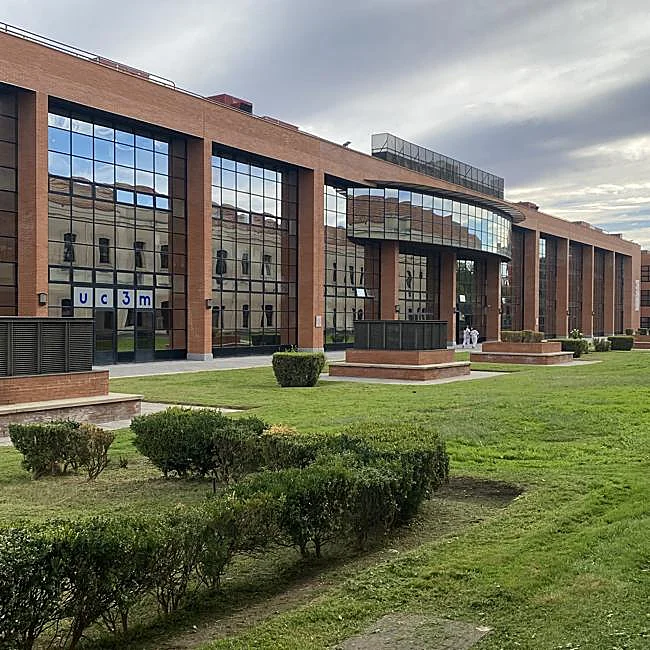
Building 9 of the Faculty of Social and Legal Sciences, at Carlos III University of Madrid, where Princess Leonor will attend her classes
Has the arrival of the princess sparked political debate among the students?
The mood in the corridors of Building 9—which, incidentally, shows no sign of the princess on the day we visit the faculty, as her schedule reportedly requires only two days on site per week—is very calm and all the students agree that day-to-day life remains normal. Beyond the exceptional situation they lived through last Monday, they point out that the most striking thing is the increase in security, mostly dressed in a way to blend in: “They wear street clothes and folders from the local academies, but it doesn’t fool us; we know they are security personnel.” They also add: “Moreover, if you pull out your phone to take pictures of Leonor, they come up to you and force you to delete them.” They also mention that coffee machines have been removed from the buildings, where crowds used to form during class changes, “but it’s not clear if it’s because of the princess.”
What some testimonies do refer to is the debate that has sparked among Carlos III students and which goes beyond mere novelty. Many wonder about her choice, “She is the perfect university for her, because being public allows a privacy that benefits her,” says a female student. They also question why she is pursuing that degree (“she could have chosen Journalism, like her mother”) and wonder whether she will feel comfortable facing certain chapters of Spain’s history or whether she will participate in debates about the legitimacy of her role. “In these circles it is normal to discuss these topics, to express political opinions that are not always aligned with the monarchical institution, and to debate arguments drawing largely on what we see in class. I would love for Leonor to participate in them. It would be very interesting, although I don’t know if I will see them or if she can participate,” admits a student from the Economics degree.
Getafe Campus of the Carlos III University of Madrid

There are those who have not hesitated to publicly share their less favorable opinion of the monarchy with graffiti in spaces such as the sports area of the Campus. According to what they tell us, on the very day the princess arrived someone clearly opposed, vandalizing this facility. Fortunately, the university did not take long to clean it up, as we have seen when we went and found there was nothing left. “They have been careful to ensure there were no offensive messages for Leonor,” they assure us, “although at the associations fair many left their opposition clear with subtle messages you could find at their stands.” These were the most notable acts of activism, which, three days before the event, have not been much further publicized.
After a morning wandering around the Getafe Campus of the Carlos III University of Madrid, we have been able to verify in person that, indeed, there are few differences with a September without royalty at the university. Beyond personal opinions, debates typical of students and a few minor incidents, the start of Leonor’s university phase has not caused any upheaval for her fellow students, who, while recognizing the oddity of sharing a campus with a member of the royalty, intend to live the course with total normality. They only share one majority opinion: Let the cameras not bother us. If they leave us alone, we are all in for the princess being here.