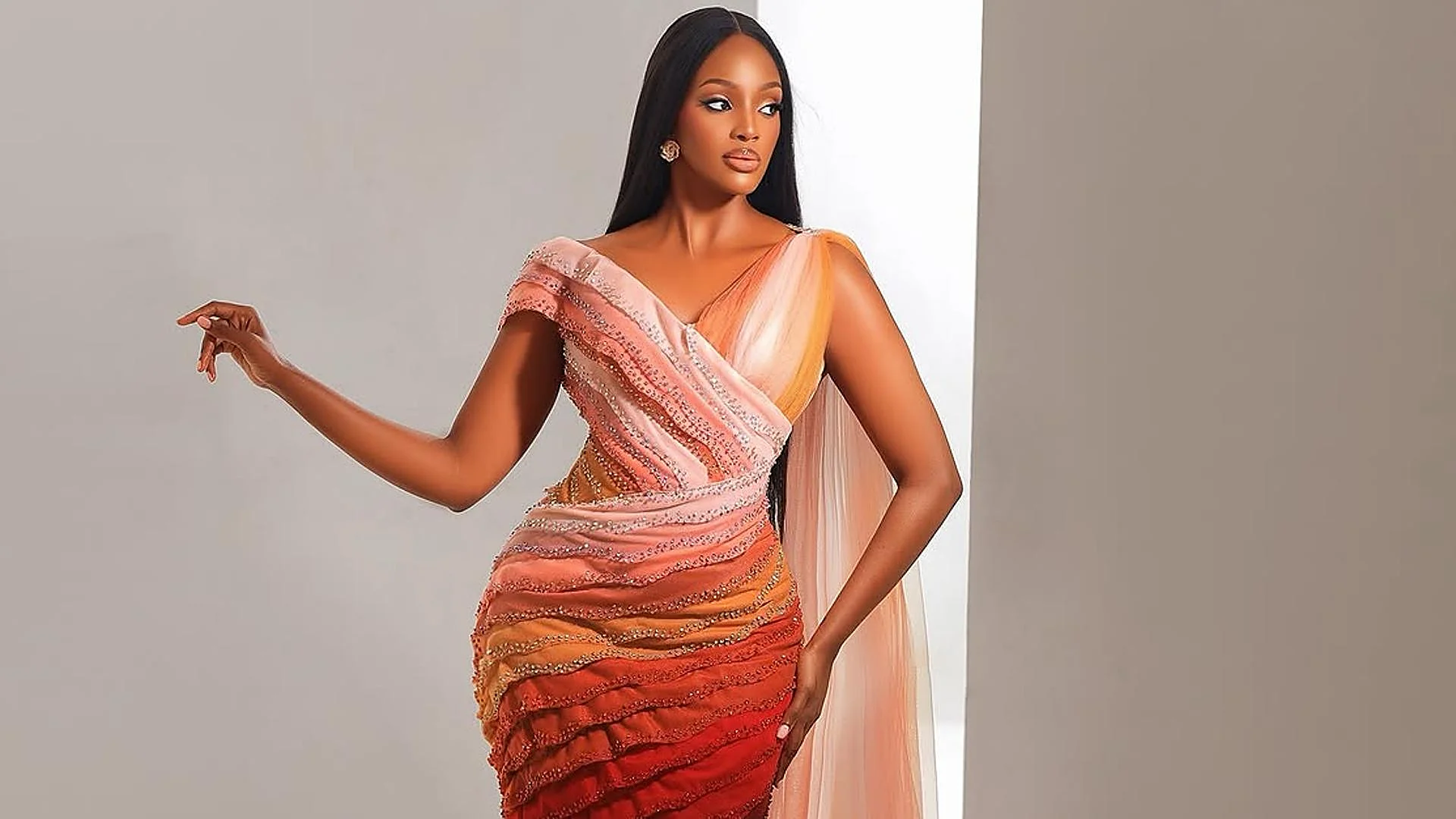
Anyone who thinks that fashion isn’t a powerful vehicle to convey a message has understood nothing. If not, tell that to Keesha Abdallah, the designer behind the latest viral dress on social networks whose showcase was, none other, the 73rd edition of the Miss World Festival held in Vietnam. She has dressed Trivia Elle Muhoza, the current Miss Uganda, with one of those pieces that promise to go down in history, and indeed her dress Layers of life is inspired by nothing less than a cesarean section.
What seemed like a spectacular Haute Couture dress turned out to be quite a statement of intent through which the Ugandan designer wanted to pay homage to the female body, to birth, and especially to all those mothers who have undergone a cesarean. To this end, Abdallah undertook a process of studying the parts of the body involved in a cesarean, in order to transfer those structures to the dress with the utmost fidelity to the medical process.
The way she managed to reflect all of this in a dress was through layers and colors, which, although at first glance do not explicitly recall this idea, do manage to perfectly capture the anatomical details involved in the process. Thus, each shade alludes to structures such as the skin, fat, fascia, abdominal muscles, the peritoneum, the uterus or the amniotic sac, only this time they appear in the form of satin, tulle, embroidery and a chromatic play in line with the reality of the interior of the human body.
In an interview for NDTV, Keesha Abdallah explained that her inspiration was «the miracle of childbirth», something she found while seeking a concept «fresh, original and very inspiring» to bring to the Vietnam pageant. «Once the sketch was approved by Miss Uganda, we had to embark on a complicated journey to create it and bring it to life. Choosing the right colors was quite a challenge due to the number of tones available. Fortunately, we found the ones I thought would work, although I also knew we were entering a trial-and-error zone», the designer noted.
The striking nature of the garment quickly sent it from the contest to social media and became a viral phenomenon that has left no one indifferent. In light of such repercussion, the designer herself has posted a message on her Instagram profile explaining the creative intention behind the garment and debunking rumors and erroneous theories that, as expected, did not take long to appear.
In the statement she says that the starting point was always «the woman and the incredible layers she carries inside her body, layers that we all share regardless of where we come from or the color of our skin».
This clarification has been motivated by those accusing the creation of representing only one race, to which she responds in the same letter: «Precisely because of this we have called it Layers of life (layers of life). Because life does not belong to a single race, a single country or a single color. Life does not understand colors. Life is universal», and she ends by declaring: «This dress has been created to celebrate femininity, the human body and the miracle of life – something that connects us all».
Other creations in fashion history inspired by the human body
The original concept that Miss Uganda has shown the world has drawn a lot of attention precisely for using the art and techniques of fashion to pay homage to a process that had until now been relegated to the intimacy of operating rooms, but it has not been the first time that the human body inspires designers to create iconic pieces that have gone down in history. In 1938 Elsa Schiaparelli, in collaboration with Salvador Dalí, presented her already legendary Skeleton Dress, a dress that pulls bones out of the skin in a trompe-l’œil that sought, precisely, to valorize human anatomy.
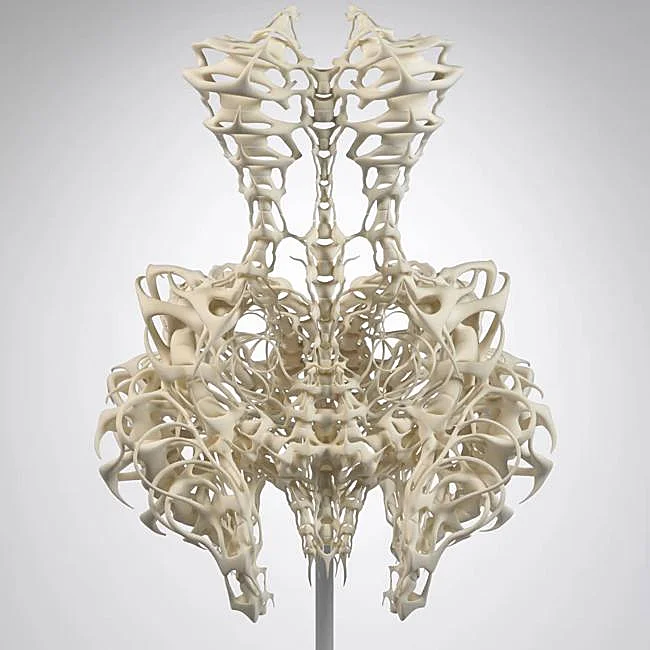
Decades later, another designer, Iris van Herpen, renewed Schiaparelli’s concept and launched her own Skeleton Dress, this time incorporating the 3D printing technique in a creative process where she abandoned conventional haute couture techniques. Iris van Herpen presented her novel creation in the autumn-winter 2011-12 collection, and since then, it has become one of the most fascinating pieces of the past decades in the fashion universe.
Skeleton Dress, Iris van Herpen
In recent years we have seen numerous examples that demonstrate the inseparable relationship between the human body and fashion and that go far beyond the obvious. Balmain or Gaultier naked dresses that play with trompe-l’œil to reveal silhouettes with all the details and Schiaparelli’s corsets in the shape of lungs or vertebral columns are some of the most evident. But if we have to choose a collection that highlighted the inspiring power of our own anatomy when creating the most surprising proposals, that is the collection Dresses of the Soul that designer Robert Wun presented for the autumn-winter 2024-25 season.
In it, Wun delved into the four deepest layers of the human body: soul, skin, flesh and bones. He masterfully played with colors, materials and staging. Thus, while the soul was represented by Swarovski crystals that represented the ethereal and the spiritual, the flesh was achieved through rough, voluminous pieces that alluded to the weight of the musculature.
Whether to seek provocation, to explore new concepts, to delve into the beauty of the human body or to pay homage to something as heroic and elemental as bringing life, fashion and anatomy have a relationship that always yields fascinating results. Miss Uganda’s dress – and the power of the message it transmits – has been the latest example of how, in our body (and what it is capable of doing), lies enough potential to leave a mark on the history of fashion.