If you often have trouble falling asleep, you’ve probably tried a thousand supposed solutions without the results you expected. If nothing has helped, perhaps you want to simplify your bedtime routine and, instead, use a yoga mat. Instructor Chloe Kernaghan makes it easier for you and advises three simple poses that will support your sleep and improve your rest at age 50.
Yoga can help you sleep better because there are quite a few poses with a relaxing effect. There are scientific reasons that explain why its practice contributes to rest. Thus, yoga and breathing techniques help calm the nervous system and reduce cortisol, which provides the body with a more relaxed state, ideal for falling asleep.
According to Chloe Kernaghan, cofounder of Sky Ting Center, yoga helps sleep better for two weighty reasons: it helps to relax the racing mind and calm the nervous system. It’s good because it focuses on finding mental peace, which is usually the opposite of the state someone is in when they have trouble sleeping; that is, when the mind is racing.
It’s true that yoga includes mindfulness elements, but it is also a physical practice known for helping to calm the body’s stress response, or the nervous system, through breathing and the performance of specific poses. The physical practice can help calm the nervous system and shift from the sympathetic to the parasympathetic mode, ideal for resting and achieving deep sleep.
Yoga and cortisol
Recent studies suggest that practicing yoga can reduce cortisol levels, the hormone associated with stress. The degree of cortisol reduction may vary depending on factors such as the frequency and intensity of practice. Additionally, some research has shown promising results regarding yoga’s impact on symptoms of depression. Yoga could be a great complement to traditional treatments and contribute to promoting overall well-being at age 50 and beyond.
Cortisol levels significantly influence sleep patterns. Higher levels are often associated with difficulty falling asleep and staying asleep. Studies say that incorporating yoga into your routine can positively affect insomnia symptoms and improve the quality and overall health of sleep. Chloe Kernaghan recommends the following three poses:
Supported Child’s Pose
Forward folds are relaxing for the body, and by bending the knees and hips they can also be a good stretch for the hips and the lower back. Make sure the head is supported and, if necessary, add another pillow for extra comfort.
• Start with hands and knees touching the floor, the mat or the bed.
• Separate the knees about the width of a yoga mat, with the big toes touching behind and the hips resting on the heels.
• Place a thick pillow or a sofa cushion along between the legs so that the torso stretches forward.
• Feel free to turn the neck to one side and breathe.
• Hold this pose for three to five minutes, turning the head halfway if the neck is turned.
Goddess Pose with support
The Goddess Pose is a perfect hip opener to disconnect and relax at age 50. Deeply bending the legs can help with digestion, and letting the body rest on the floor is an excellent way to release any tension accumulated during the day. Follow these steps:
• Sit with the legs extended.
• Bring the soles of the feet together, with the knees open, and use two pillows (one under each thigh/knee) as support.
• Lie the torso on the floor. You can use a folded blanket under the nape of the neck.
• Place the hands on the abdomen or extend the arms to the sides.
• Cover your eyes if you wish and stay like this for three to five minutes.
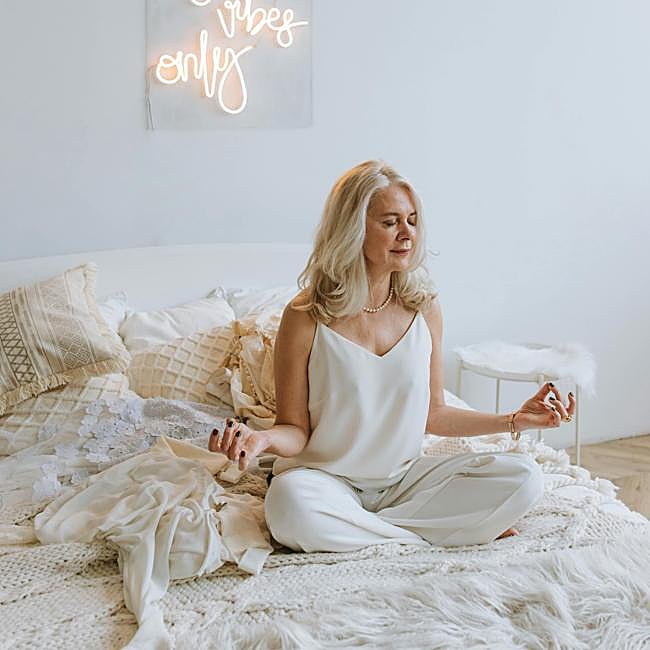
Woman practicing yoga in bed.
Legs on the Wall
This pose is fantastic for many things, but for sleep it is great because it is a gentle inversion. The legs relax for a few minutes, which helps circulation and reduces the body’s restlessness when falling asleep. You can even do it in bed by swinging the legs over the headboard. This pose is just as its name suggests…
• Sit close to a wall. Move the torso to the floor and swing the legs up toward the wall.
• If your legs or the lower back are tense, keep the knees slightly bent.
• You can place a pillow under the hips so that the pelvis is slightly higher than the heart.
• Hold this pose for three to five minutes.
• If you feel tingling in the legs, you can bend the knees and open them in a butterfly pose with the feet together.