Lorenzo Meazza is one of those people who leave no one indifferent. Funny, quick-witted, generous, with an overwhelming personality and exquisite taste, this Milanese Italian is one of the most recognized interior designers in Europe. Currently head of Interiorsmo for IKEA Italia, Meazza was, to a large extent, the architect of the Swedish giant’s success in our country as head of Interiors and Creative Director for the Spanish market. Before, he had been globally responsible for the creation and development of the firm’s events, as well as a trend consultant for the Swedish parent company in charge of the European market.
For Meazza, a home is “the place where we will spend a large part of our time and the refuge in which, apart from commitments outside, we can be ourselves.” Hence his passion is “inspiring people with ideas and solutions that help them realize their dream of having a beautiful and functional home, a happy place to live,” convinced that “any person, without need for complications or excessive resources, can aspire to have the home of their life”: a possibility we all should enjoy regardless of location, budget or square meters.
In 2019 he published The Homes of Our Lives (Esfera Libros), a blend between a life diary and a practical decorating manual. “A sentimental journey around the world, where through the houses of my life I trace the stages and moments I have lived. And practical, because for each stage I have created a scene.” If you follow him on Instagram, where he gathers close to 50,000 followers, you’ll see that he himself is now seeking the new dream home in his native Italy.
Lorenzo Meazza’s Deco Predictions for 2026
“I have dedicated the last twenty years of my professional life to houses. To mine and to those of many other people, with the constant aim of turning a specific space into a home. The stage of many of the most important moments of our lives,” he tells us. So I found no better expert on my schedule to request some deco predictions, not trends of use, for 2026.
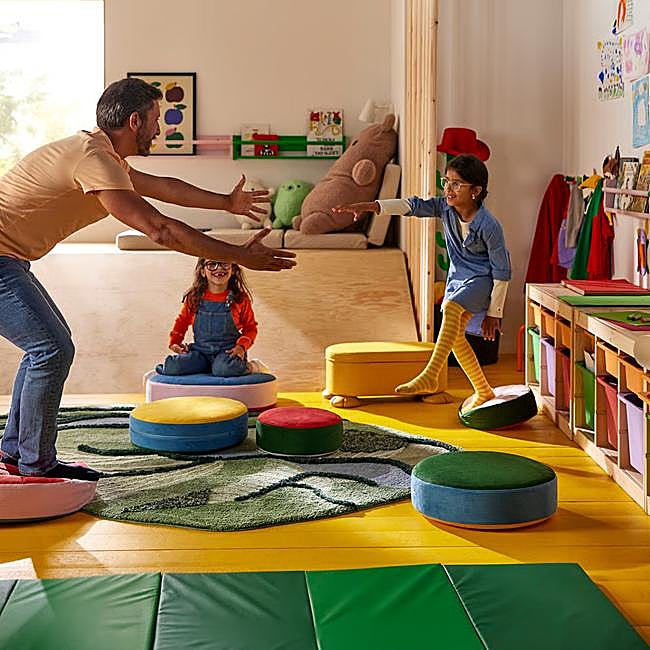
New GREJSIMOJS collection from IKEA.
The House That Plays (and Invites Us to Play)
Not cloud-dancer atmospheres nor magazine living rooms like those of our grandmothers, the ones that are only used when there are visitors. Lorenzo Meazza is clear that this 2026 “the living rooms stop behaving and the house stops being a showroom to become a playmate.” And whoever loves living this way, “is about to have a lot of fun.” That said, he also leaves a note for those who love absolute order: “attention, because energy changes this year,” he assures.
As if a clairvoyant of decoration, Meazza foresees “cheerful homes, that do not demand propriety but sit on the floor, laugh, mix, invent. This is the house that invites play, not only electronic, but human; that calls people to be together, to socialize without instructions, to feel comfortable right away,” as we already anticipated with the new rise of conversation pits. To achieve it, the interior designer invites us to let ourselves be guided by “colors that dare, personalities that explode and corners that become tiny personal worlds. Nothing is too perfect to be believable,” and, peering into his crystal ball, “I see imperfect objects, instinctive choices, pieces that tell stories more than styles.”
Look Up (the Return of Frescoes)
We have long been predicting, in this section, the central role of the structural elements of our home in decoration. Beyond the thousands of storage options they offer, their ornamental value is extremely high. And Meazza also sees it this way. “I see walls that no longer settle for simply being covered. I foresee ceilings that begin to tell stories again. To wallpaper lovers: beware, because in 2026 it might seem… too artificial.” So the designer advocates the return of “an almost ancient desire: to paint frescoes at home. Not only on walls, but also on ceilings, those we have ignored for years.”
Meazza bets on lifting the gaze at home again because “the ceiling is no longer a limit, but an invitation to imagine,” so “I see imaginary skies above the sofa, suspended landscapes in the bedroom, dreamlike themes that invite you to dream with your eyes open.” And, as he himself assures, “you don’t need to be a Renaissance master. I predict a flood of artists who work on commission, at all scales and budgets. The fresco becomes the decorative gesture of our century: freer, more personal, more accessible.”
The Domestic Oasis (Nature Takes Space)
We never tire of repeating in this section: having plants at home is not only beautiful, it is healthy. “The green space is not a luxury, but an emotional necessity,” says Lorenzo Meazza. Perhaps that is why biophilic design is gaining more and more followers. And this direction seems set to grow, as our expert predicts. “I see leaves where before there were only surfaces. I foresee houses that breathe better. Rooms that transform into small private oases, corners that become mini private parks, terraces that stop being accessories to behave like real gardens.”
That said, the interior designer warns lovers of greenery that it is not just a detail: “in 2026 nature asks for much more.” As he notes, “it is no longer about natural materials alone, almost a starting point, but about an integrated, living and functional nature. A new awareness grows: knowing where materials come from, how they are used and how they coexist with our way of living. And I see something even more concrete: cultivation enters the home. Herbs, plants, small domestic gardens that return natural time to daily routines.”
The House That Cares (and Slows the Pace)
True to his conception of housing as the place where we can be ourselves, Lorenzo Meazza bets in 2026 on “a house that does not stimulate but calms; that does not impress but welcomes.” And those who live like this feel it immediately because, the interior designer beautifully assures, “it’s like stepping into a hug that knows exactly what we need.” In this search for home, in its most intimate sense, “I see interiors that slow the pulse and houses that absorb everyday stress before we notice it.”
To achieve this house that cares through the senses, Lorenzo Meazza suggests betting on “relaxing fragrances that mark the transition from outside to inside, lighting that does not dazzle but accompanies, sounds that soften the noise of the world. Everything is designed to create a pause, even if brief, but real. I see increasingly enveloping shapes, generous volumes, soft lines that invite you to stop. Surfaces become tactile, to touch, not only to look. Colors calm, never assaultive, and materials become soft, almost comforting.”

The Kitchen That Teaches Us (Gently)
That the kitchen is the epicenter of the home is a fact. Not only is it the room where food is stored and menus are prepared, it is a place of gathering and community. Lorenzo Meazza is clear that this 2026 will no longer be merely functional because “it will no longer demand perfection, but awareness. They will be spaces that teach without judging.” And he warns lovers of ultramodern but impersonal kitchens: “attention, because in 2026 intelligence becomes human and technology is present, but does not impose its voice.”
Thus, Meazza speaks of a regenerative kitchen, “a domestic space that helps us create healthier and more sustainable eating habits, with zones dedicated to preparing natural foods, smart solutions to preserve ingredients better, compact composting systems that make waste reduction simple, integrated appliances that suggest what to cook with what we already have, that help plan, not waste, to choose better. Everything will be designed to be functional, intuitive and accessible.”