The scene repeats every summer. You apply sunscreen in the morning, without exception, also during the winter months. You reapply it mid-morning and every time you are about to leave the house. Yet the spots return as soon as those first powerful rays of the summer season appear. It is that paradox of the sun giving you sun only on the arms, but spots appearing on the skin of the face. The answer lies in a complex system of signals traveling through the body and stimulating pigment cells, even on a face that is protected.
The skin does not understand zones
For years we assumed that the effect of ultraviolet radiation was a matter of zones: if the sun hit the forearm, the forearm bore the impact. Today, experts speak of the skin as an endocrine and immune organ, with the capacity to send signals to the rest of the body. «The skin does not operate by isolated compartments, but as a whole organ», summarizes Gema Herrerías, pharmacist and nutritionist, founder of A5 Farmacia.
Thus it acts when exposed to the sun: «The hormonal pathway is stimulated through the production of proopiomelanocortin (POMC), a precursor protein of hormones capable of activating melanocytes and increasing melanin synthesis. On the other hand, it induces the activation of keratinocytes and fibroblasts, which in turn release factors that stimulate melanin production».
In other words: the radiation the body receives activates hormonal and cellular signals, which order the skin to manufacture more pigment, even if the face has not been exposed.
And the face pays the price
Ultraviolet radiation on parts of the body other than the face «generates certain signals that travel through the blood and can influence facial pigmentation», notes Dr. Cristina García Millán, dermatologist specializing in sensitive skin and director of Esthea Médica clinic (Madrid). «Ultraviolet radiation stimulates the production of Alfa-MSH, ACTH, peptides such as endothelin and certain growth factors. All of them are capable of modulating melanocyte activity and would reach the systemic circulation, which would explain the distant effects of the irradiated site», the expert adds.
The mirror of summer
To that hormonal route is added the inflammatory one. Dr. Ana Martínez-Lauwers Dolz, specialist in Medical-Surgical Dermatology and Venereology at IMR, describes what happens when the sun hits the skin: the «release of inflammatory mediators by the irradiated cells (Interleukin-1, Interleukin-6, TNF-alpha)» occurs. And there lies the key to the distant effect: «These substances do not only act in the exposed area. Some can reach the bloodstream and generate systemic responses», the expert concludes.
There are those who go further and point to the body as a whole. María Sánchez Bonmatí, pharmacist and nutritionist specializing in psychoneuroimmunonutrition, who collaborates on the new protective solar formula in Beso Sun & Glow nutricosmetics, created by Beso Beach in partnership with Proage by LFL (Lifestyle for Longevity), places the skin within a network that connects it to the rest of the body. «The skin is the most visible mirror of what happens inside us», she adds, a constantly conversing organ with metabolism, the gut, the immune system, hormones and stress. The outcome largely depends on this connection: «What we eat can foster an anti-inflammatory environment or, on the contrary, feed a chronic low-grade inflammation».
Sun, stress and more accelerators of spots
«The spot is only the tip of the iceberg. Treating it well is not about choosing a depigmenting agent, but about understanding what lies behind it», highlights Gema Herrerías. «I assess factors such as sun exposure, lifestyle habits, stress, barrier function status, inflammation, skin microbiota, and hormonal changes».
Martínez-Lauwers enumerates the fronts to which melanocytes respond:
- UV radiation
- Visible light
- Infrared and heat
- Hormones
- Inflammation
- Oxidative stress
- Growth factors
- Signals from blood vessels
And, on top of that, they do not give up
Sunscreen, though essential, only blocks a portion of the stimuli. To put it more succinctly, it covers the main door through which damage enters, but not all the windows. Heat, hormones or a baseline inflammation can keep ordering pigment production even if, on the surface, that radiation is blocked.
That explains why some spots do not yield. Martínez-Lauwers points to two features of melasma that make it stubborn: a chronic, low-grade inflammation —invisible, but enough to keep melanocytes awake— and a vascular component, «with greater presence of factors such as VEGF (Vascular Endothelial Growth Factor)», a protein the body produces to stimulate the formation of new blood vessels. Therefore, she concludes, «some spots are so persistent even in patients who are very disciplined with photoprotection».
Protection and shade
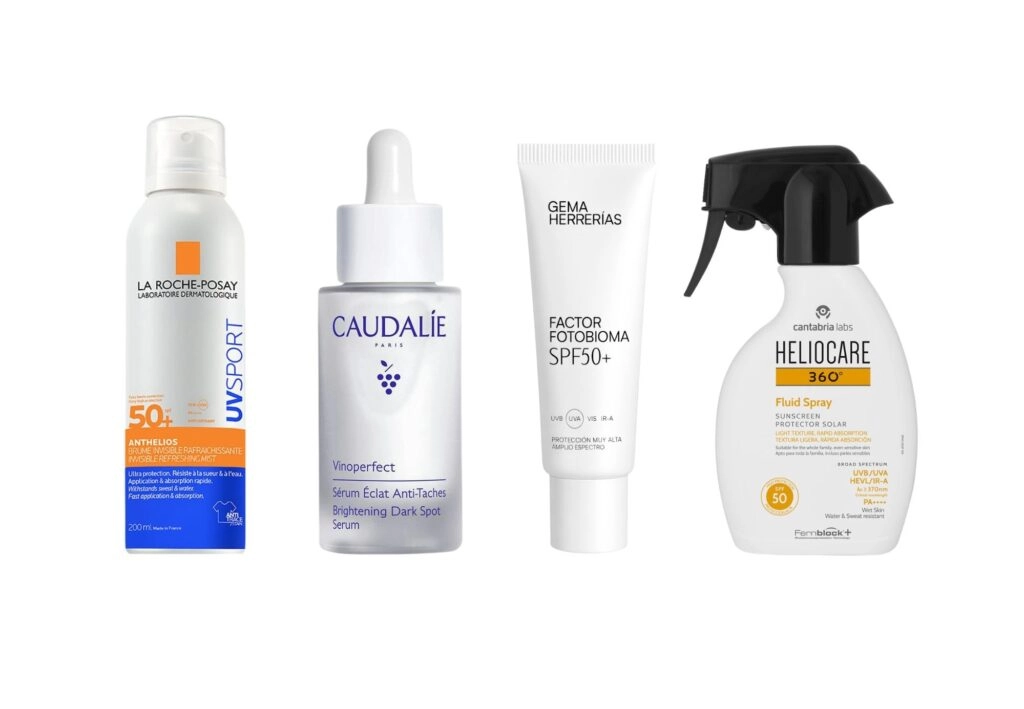
Experts agree that photoprotection is the baseline, but it has to cover the entire body. For skin prone to spots, Herrerías sets the standard: «I always recommend SPF50+ broad-spectrum sunscreen with very high UVA protection and coverage of visible light».
And one gesture almost no one respects, reapplication according to the day’s plan: «It is not the same a day in the office, where it may be enough to refresh at noon, as a beach day or outdoor activities», situations in which it is advisable to renew more often. And always after swimming or exercising.
Dermatologists also emphasize the importance of physical protection, such as wearing hats or seeking shade during the central hours of the day.
Taking care of the skin from within
Nutrition does not work as a solar shield, «but it can influence how well the skin tolerates and repairs sun damage», explains María Sánchez Bonmatí. The goal, she clarifies, is not «to take something so you can stay in the sun longer without control», but to reach summer with a greater capacity to adapt.
Its basis is a colorful plate: «Tomato, pomegranate, berries, olive oil, blue fish, vegetables and water». Supplementation can also help prevent and treat spots. Herrerías divides the work among actives: azelaic acid to slow melanin synthesis, vitamin C and vitamin E against oxidative stress, retinoids and glycolic acid to remove pigment already formed, and niacinamide or tranexamic acid to limit its transfer.
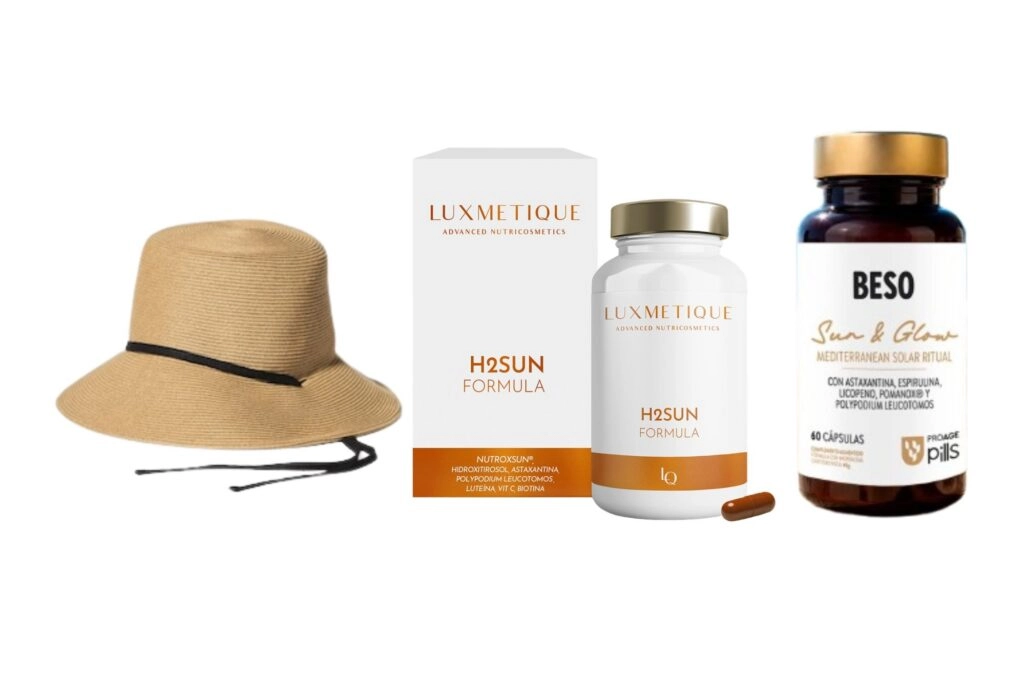
One ingredient appears in all four interviews as the most supported orally: Polypodium leucotomos, a fern with antioxidant action. For García Millán it is «an essential supplement in patients with melasma», for its effect on oxidative stress and solar damage. Martínez-Lauwers mentions it alongside nicotinamide — with evidence in prevention of skin cancer — and, under medical supervision, oral tranexamic acid.
The limits of pills
Supplements are not, by any means, the foolproof remedy against hyperpigmentation. «That a molecule stops melanin in the laboratory does not prove that a dietary supplement reduces spots in people», warns Herrerías. Moreover, in Europe there are no authorized health claims regarding reducing spots with supplements, «so when a brand promises it, it is claiming more than the regulations allow».
The conclusion is clear: to avoid lamenting pigment overgrowth, it is better to prevent every time we go out in the sun.