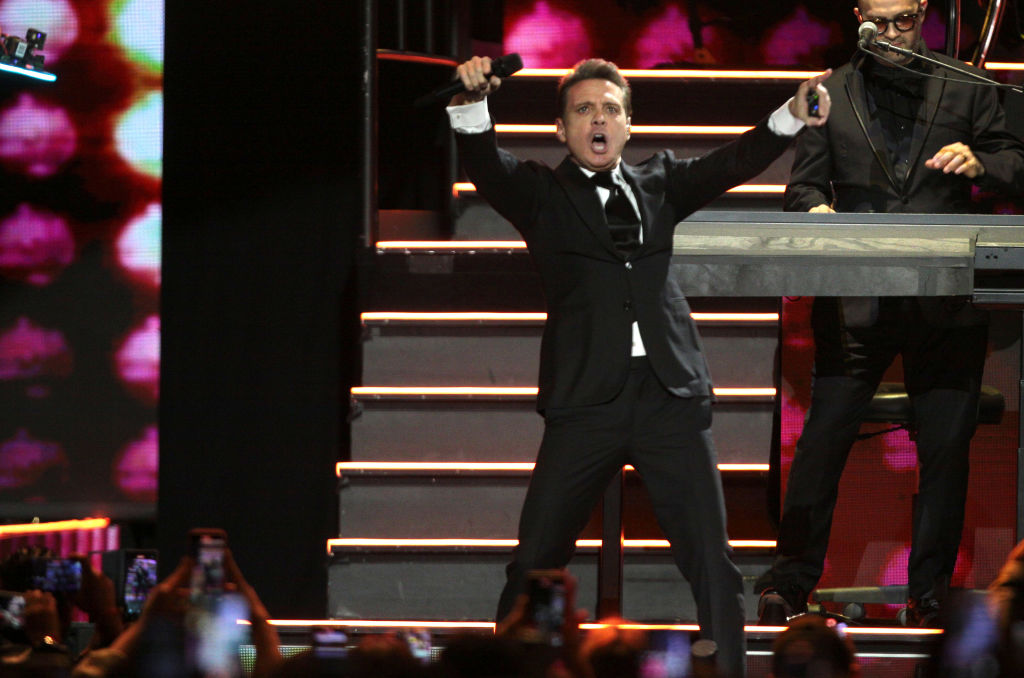
There is no one like the Mexican singer Luis Miguel to embody the nostalgia of a better time. At 56, he has just starred in Coca-Cola’s centennial campaign in Mexico. “Think about it with the cool-headed mind of a manager. Bringing Luis Miguel is not cheap (we’re talking about a million-dollar check with one of the planet’s most valuable brands). Why spend a fortune on an old-guard figure instead of going with the fashion content creator? Because nostalgia is the most powerful sales tool there is,” explains Gabriela Cuevas Salas, founder of Inspire and manager of collaborations for creators and speakers.
Note that it’s not the first time the ‘Sun of Mexico’ has collaborated with that soft-drink brand. He did it 35 years ago. “And now they touch again the Mexican’s sensitive fiber,” he adds. “The commercial is a journey through our traditions, the family table, the Day of the Dead altar, street tacos, and the classic ‘where two eat, three eat.’ And there, at the center of it all, El Sol serving his drink ice-cold as if time had not passed. They’re not selling us a soda; they’re selling us the memory of when we were kids, the Sunday gathering and that Mexican pride that makes our skin tingle.”
Luis Miguel’s partnership with Coca-Cola is the penultimate stage of a marketing trend: using nostalgia to sell.
The Good Old Days Sell Better
“The longing for the past, nostalgia, is the defining emotion of our time. Although we find abundant signs of anger on the internet, despair pops up everywhere and fear has become the fuel of politics; nostalgia eclipses everything,” writes Grafton Tanner in The Hours Have Lost Their Clock. Nostalgia Politics (Ed. Alpha Decay).
Political leaders always promise us a return to the times of yore, when everything was simpler, less unstable. The big media groups flood streaming platforms with remakes and reboots. Out-of-fashion styles are renewed, reimagined and adapted relentlessly to satisfy the appetites of the present. “It seems that, the more we move toward the future, the stronger nostalgia becomes,” he asserts.
The Past as a Goal
The author notes in his essay that nostalgia is often confused with other emotional states such as longing for the homeland or melancholy. He also points out something essential to understand why today we seem prisoners of nostalgia: far from being simply an emotion of memory, it is also an emotion tied to control.
“We become nostalgic when we feel we are losing control, when things seem completely out of control. Nostalgia can help us regain a certain sense of mastery, as it makes us evoke things that kept our feet on the ground, even if those things never existed in reality,” he says.
The World Cup Shirt Goal
The recent edition of the World Cup served as an example to prove how nostalgia sells.
David Beckham and Cantona appeared in Adidas and Nike ads for the World Cup, Iniesta took the opportunity to join Decathlon and even La Casera revived its iconic slogan ‘If La Casera isn’t there, we leave.’
Not to mention Spain’s white jersey that sold out. The key was a simple, retro design that captivated even those for whom football matters very little. It was the quintessence of 1990s nostalgia, Britpop and those wonderful years before the Internet.”And when a brand manages to connect with something that already has meaning for us, it doesn’t need to explain too much why we should choose it, notes María Eleonora Botello, communications consultant.
The cherry on top was Madonna and her extravagant performance in the final, flanked by Ronaldo Nazário and Ronaldinho in years of lean form. It was the reunion between the past and the present looking toward an uncertain future.
The Remake Culture
Every time I confront a reboot, no matter how much the new characters deepen the necessary diversity that the casting once lacked and even though those responsible for casting want to bet on figures that appeal to Generation Z to gain their support, it becomes clear that, in reality, that gaze toward the past is essentially for the millennials. Or for Generation X; let’s not fall into ageism by leaving them out of this nostalgia wave.
Their soundtracks give us goosebumps for those of us who were born without Instagram. Younger people pull up Shazam and search for the track, while those of us with more years (no need to go into how old, please) sink into memories.
What is clear from Hollywood’s urge to invest in reboots is that they try to play it safe. These are not times to take risks, so they resort to old formulas that worked at the time. The industry lives trapped in a cycle of revisiting the past in the face of the fear of failure.
Nostalgia bait without a mobile
There is talk of nostalgia bait, which Urban Dictionary defines as the ‘recovery of characters, concepts or ideas from classic films and series to introduce them into new productions to attract their followers and make them believe that something is good simply because it feels familiar’. It is not unusual to want to look to the past if we consider that we are talking about a world where we could really live offline.
It is attractive for those who did not live it and for those who did, because that life without notifications now seems irresistible. Even in the dating universe, that era without external glances is missed, as after years of sharing every thought and detail on social networks, many people seek to leave behind digital overexposure.
That is why there is growing nostalgia in the desire to reserve parts of life for oneself and for the closest circle, something especially relevant in the realm of romantic relationships and online privacy. Because in the era of smartphones and social networks, private life has become vulnerable.
Return to the Past
In Nostalgia: A History of a Dangerous Emotion (Ed. Picador), Agnes Arnold-Forster warns that, although nostalgia is pleasurable for those who experience it, its reputation as a force able to influence politics and society is by no means as friendly. “Despite all its transformations, it continues to carry a significant emotional baggage and, although it has long since lost its ability to kill, it remains accused of all kinds of evils. Some leftist commentators have criticized recent populist movements for relying on a nostalgic view of an idealized past.”
“From Brexit to Donald Trump’s Make America Great Again attempt, nostalgia is capable of persuading, deceiving and seducing people to influence their voting decisions,” he writes, before adding that for many, it is essentially a conservative emotion, typical of those who resist facing the modern world and prefer to retreat into the past.
Are We Dazzled by So Much Regression?
“The sociologist Yiannis Gabriel has defined it as ‘the last opium of the people.’ Populist movements around the world are repeatedly criticized for the use—and abuse—of nostalgia. The images they build of the past are often questioned for presenting societies that are overly white and overly masculine. Yet nostalgia is not the exclusive property of the right,” he clarifies.
Nostalgia is denounced by many and functions as a refuge for others, but the essential is not to end up trapped in the yesterday. Because things were not necessarily better in the past… Even though today they are not exactly brilliant either.