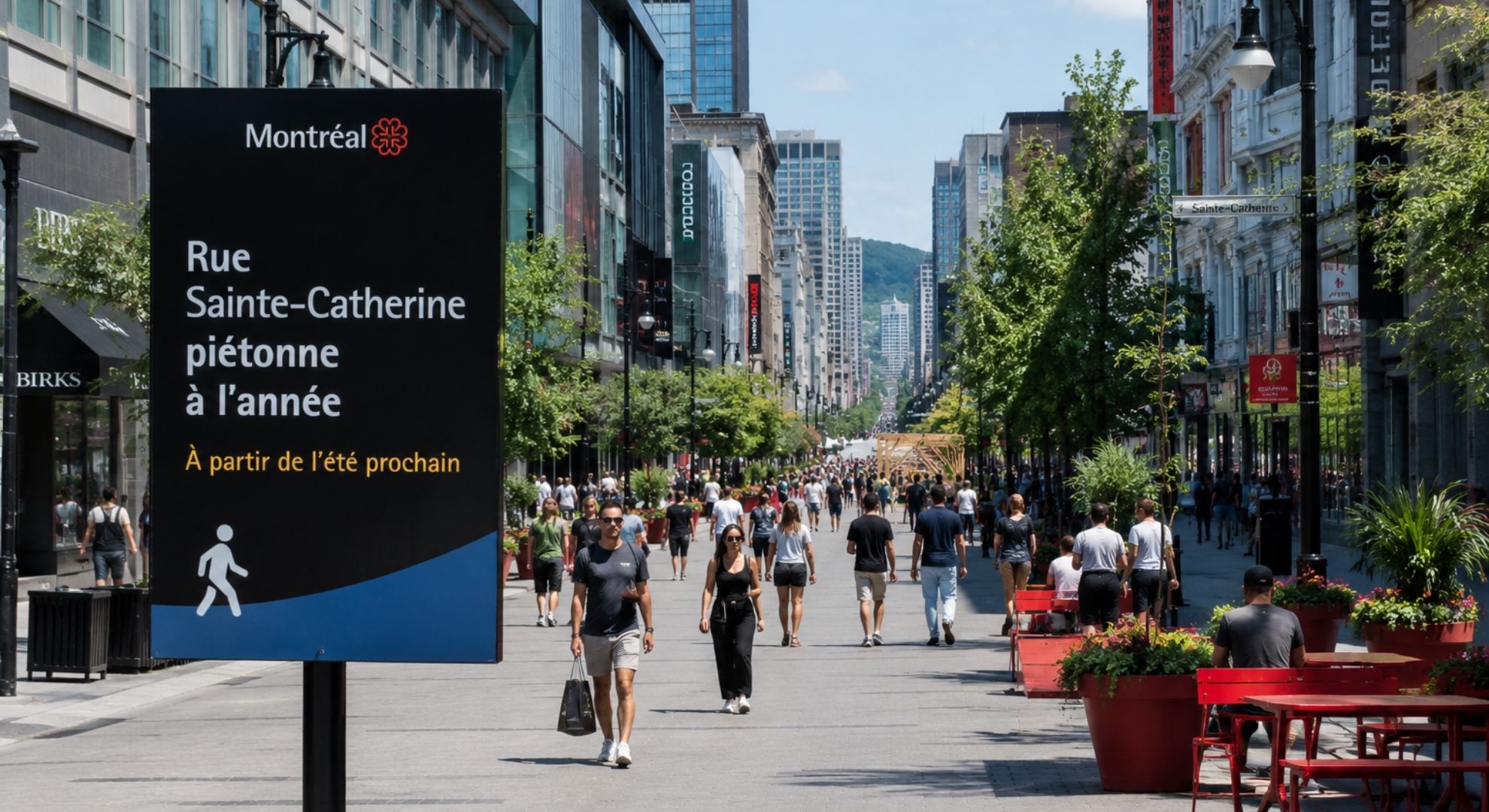
Montreal is preparing one of the most ambitious street transformations in its recent history. Sainte-Catherine Street East, one of the city’s best-known commercial arteries, is set to become a year-round pedestrian zone through the Village, a decision presented by city officials as a way to make the area safer, greener and more attractive.
The project concerns a roughly one-kilometre stretch between Berri Street and Papineau Avenue. According to the city’s plan, the redevelopment will include permanent pedestrianization, more than 225 new trees, additional seating, new public furniture, rain gardens and a large overhead lighting installation designed to be visible throughout the year. Construction is scheduled to begin in fall 2026, with the last sections expected to be completed by the end of 2030.
A major shift for one of Montreal’s most symbolic streets
Sainte-Catherine Street East has already been closed to cars during the summer months in the Village, drawing large numbers of pedestrians, tourists and terrace-goers. In 2026, the seasonal pedestrian zone is scheduled to run from May 14 to October 12 between Saint-Hubert Street and Papineau Avenue.
The city now wants to go much further by turning the seasonal model into a permanent one.
For Montreal officials, the logic is clear: the street is already a cultural and commercial destination, and the aging underground infrastructure needs to be replaced. The city says this gives it an opportunity to redesign the area around pedestrians instead of simply rebuilding the street as it was before.
“This is not only a roadwork project. It is a complete redefinition of how the Village functions,” said one urban planning observer. “The question is whether the street can remain active in February, not just in July.”
Why supporters welcome the plan
Supporters argue that permanent pedestrianization could give the Village a stronger identity and help revive a district that has faced years of social, commercial and safety challenges.
The city says the project aims to improve the pedestrian and shopping experience, while consolidating the street’s role as a tourist, commercial, cultural and identity destination.
Several benefits are being highlighted:
- more space for pedestrians;
- a greener and more comfortable street;
- larger areas for terraces and public seating;
- improved safety for visitors and residents;
- stronger visual identity for the Village;
- the possibility of creating a winter destination, not only a summer promenade.
The city also says merchants will still be able to install terraces on part of the public space, with simplified rules and an extended period.
Business owners fear the long construction period
The strongest concerns are not necessarily about pedestrianization itself, but about the years of construction required to make it happen. The project is expected to be carried out in phases until 2030, a timeline that worries some local business owners.
For cafés, restaurants, bars and small shops, four years of work can mean reduced visibility, fewer customers, delivery problems and uncertainty over access.
The city has pointed to financial support programs for businesses affected by major construction, including subsidies based on loss of gross profit and a lump-sum grant for eligible establishments. But some merchants argue that compensation should reflect the real costs of each business, especially when rents and operating expenses vary widely from one address to another.
A divided reaction in the Village
The divide is therefore not simple. Many merchants support the vision of a greener, more walkable and more attractive Sainte-Catherine Street East. But others fear that the transition could be painful, especially if winter programming does not bring enough people into the area.
That is the central issue. Summer pedestrianization has already proved popular in several Montreal neighbourhoods. In 2026, seven streets across six boroughs are being pedestrianized for a combined seven kilometres, giving more than 1,260 businesses pedestrian access during the season.
But turning a summer success into a year-round model is more complex. Montreal winters are long, cold and commercially difficult. Without events, lighting, security, snow management and regular foot traffic, some business owners fear the street could become lively for only part of the year.
A test case for Montreal’s future streets
The Sainte-Catherine East project will be closely watched far beyond the Village. If it succeeds, it could become a model for other commercial streets in Montreal. If it struggles, it could reinforce fears among merchants who already see permanent pedestrianization as a risk.
For now, the city is betting that a permanent pedestrian street can do more than remove cars. It can create a destination.
The challenge will be proving that this destination works not only during festivals and terrace season, but also in the middle of winter, when local businesses need foot traffic most.