
With only four years old, he already told his parents that his dream was to become a fashion designer. And it has taken barely five to make history within an industry so competitive and unusual for someone his age. We are talking about Max Alexander, a ten-year-old American boy who is already known as the fashion prodigy and who recently became the youngest designer to present a collection at Paris Fashion Week.
It is one of those cases in which people talk about innate talent and a special taste that seems to be part of his own personality. And according to his family, the way he creates that has led him to the runways and to be recognized worldwide is completely intuitive and arises from anatural fascination with fabrics.
No formal training and no interest in fashion
Because Max hasn’t had time to study at major fashion design schools or to train himself through television, books or the internet. What is curious about this boy’s story is that no one knows where that talent comes from. According to Alexander himself, he didn’t watch fashion shows or have a particular interest in fashion. In fact, he didn’t even start by drawing.
His creative process is much more practical: he thinks of an idea, places the fabrics directly onto a dress form, sews and finishes the garment. It is the so-called draping method, which has led him to achieve a Guinness World Record, to present a collection in Paris, and even to star in a documentary about his life.
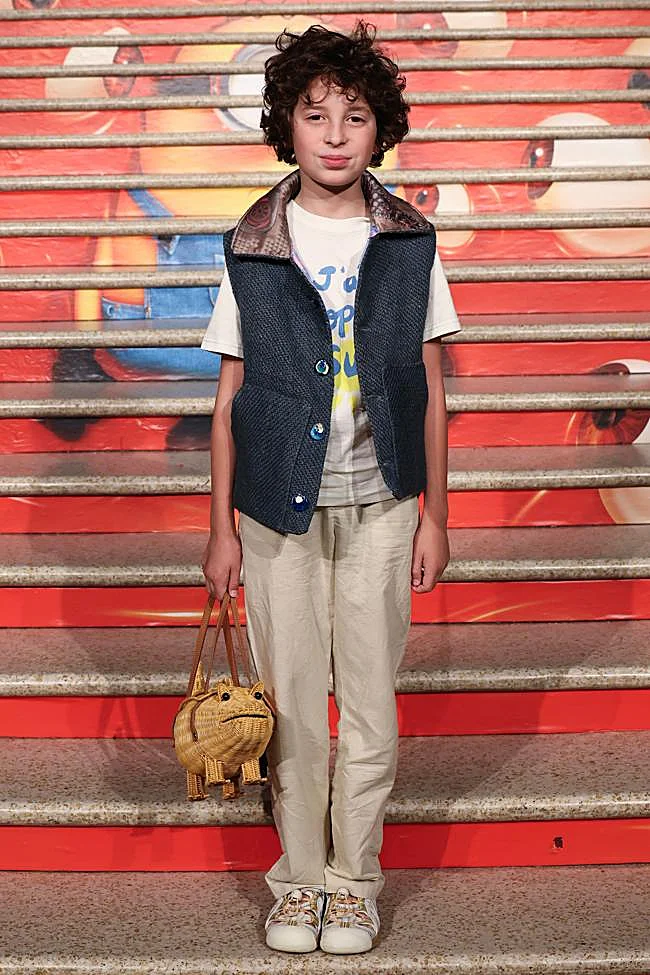
Max Alexander is ten years old.
He is the youngest runway designer in the world after presenting a collection at Denver Fashion Week. And this season he wowed in the French capital with a collection of fifteen looks very applauded, playing a role in which he felt surprisingly comfortable. He said it made him happy that people appreciated his work and that he was not afraid or embarrassed to come out and greet the audience.
Voluminous and theatrical silhouettes
But what exactly has made him a prodigy of the industry, recognized even by experts? His designs are characterized by voluminous and theatrical silhouettes, vibrant colors, floral details and a frequent use of recycled or reused materials. Because for Max sustainability is key when creating his outfits and, despite his young age, he uses interviews to talk about the problems of fast fashion. He even demonstrates how coffee sacks can be turned into an elegant garment.
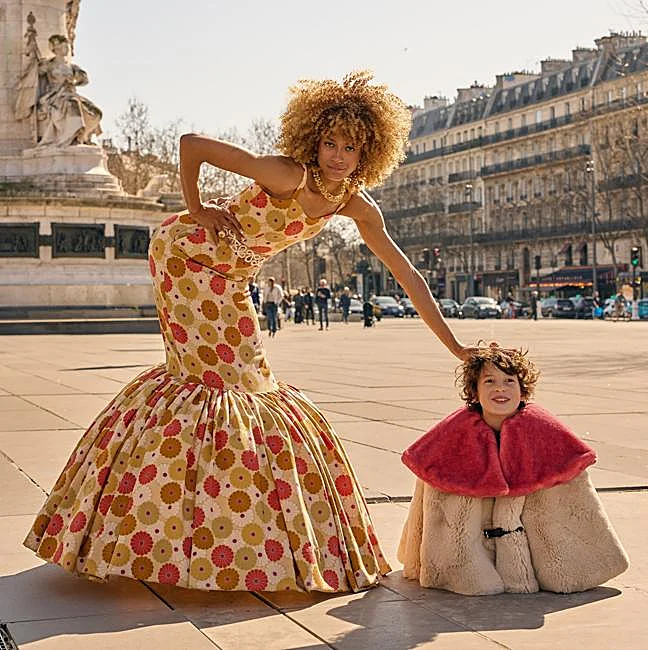
Because he believes that anything can be transformed into a dress. On one occasion he stated that pieces can be made with pickles, spoons, hangers, or practically any material, being this one of the best proofs of his innate creativity.
But, as is the case in all areas of fashion, inspiration and references are fundamental when creating. And although he has not yet reached his first decade of life, Max Alexander has already mentioned artistic and creative influences from which he draws to design his collections.
Bob Mackie, his favorite designer
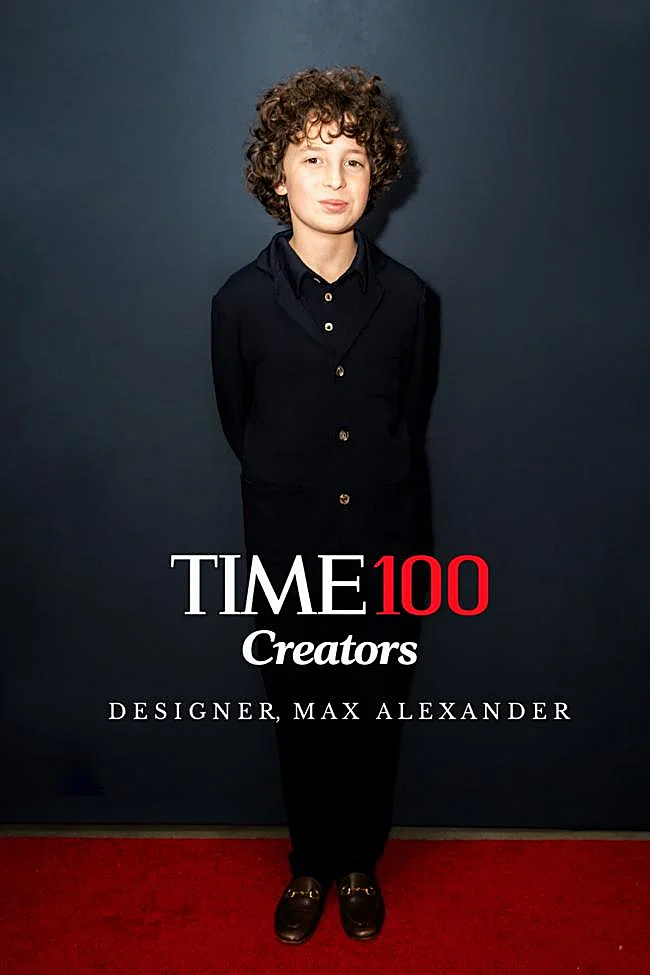
Bob Mackie is the designer he looks to the most, famous for dressing Cher, Diana Ross, or Tina Turner. He is known for his spectacular creations, full of shine, rhinestones, and drama, something that fascinates the young Max, who was able to fulfill one of his dreams by meeting him in person and giving him a tie he designed himself.
But not only does he draw inspiration from fashion. During his preschool stage, oriented toward the arts, Alexander was influenced by the colors of Van Gogh, the repetitive patterns of Yayoi Kusama, the expressiveness and visual richness of Frida Kahlo, and the sculptural shapes of Alexander Calder. Artistic references that have shaped his way of understanding color, forms, and composition, and that he has translated into haute couture.
Although, when asked where his ideas come from, his answer is always the same: nature, travel, and recycled materials that he finds. A combination of art, nature, and sustainability that, besides being very applauded, has also generated some debate. And indeed the exposure of the minor and the pressure that he may be subjected to in an industry like fashion does not convince everyone and has drawn criticism.