The Franco-Iranian writer, illustrator and filmmaker Marjane Satrapi, best known for the book and the film Persepolis, has died in Paris at the age of 56. Her family announced in a statement that the author, one of the most prominent figures in international comics, “died of a broken heart a little over a year after the death of Mattias Ripa, her husband and the love of her life.” Ripa, a producer, actor and screenwriter, passed away on April 8, 2025.
“Marjane Satrapi’s works have had a very important impact, both globally and among Iranians,” her friend Azadeh Kian, a political sociology professor at the University of Paris-Cité, told France Info shortly after the news of her death became known. She also confirmed that the death of her husband was a blow Satrapi never recovered from and that “she loved her country deeply, even though she was very critical of the regime.”
Born on November 22, 1969, in Rasht, in the northwest of Iran, Satrapi grew up in a middle-to-upper-class family in Tehran, where she attended the French lycée during her childhood. Her parents were politically engaged and supported leftist activism against Iran’s last shah, Mohammad Reza Pahlavi, and subsequently against the restrictions of the Islamic Republic.
Satrapi, who was nine years old when Pahlavi was overthrown and Ayatollah Khomeini came to power in 1979, recounted her experiences growing up under his draconian government in the graphic novel Persepolis. In what is, for many, one of the best ever published, she tells the Iranian Islamic Revolution seen through the eyes of a girl who watches in astonishment the profound changes that her country and family undergo, while she must learn to wear the veil.
Marjane Satrapi: From Persepolis to Hollywood
Intensely personal and deeply political, Satrapi’s autobiographical narrative examines what it means to grow up in an environment of war and political repression. In this context, the author was an activist throughout her life against Iran’s Islamic regime and the restrictions it imposed on women’s lives and on society in general. Her publication earned her meteoric success in Europe and the United States.
In a 2023 Deadline interview, after the protest movement dubbed Women, Life, Freedom, she recalled how her parents went out to protest the imposition of the hijab on women by the ayatollah regime in 1983. “He was one of the few men; at that time they did not understand that women’s rights are the rights of society,” she said referring to her father.
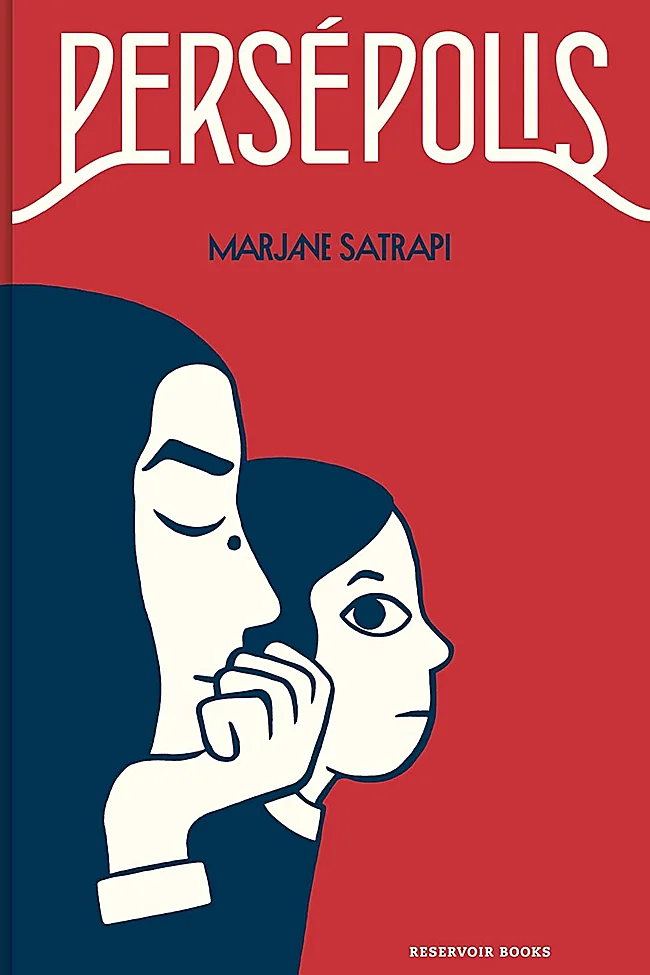
Cover of Persepolis.
Marjane Satrapi never hid either that she had received threats and insults from the regime in relation to Persepolis and her other activist activities. “They have called me liar and spy, but I have learned in life not to be afraid. It is not that I am fearless or reckless, but there are young people in my country who are being shot at and are 17 years old, while I have lived for more than half a century.” Among her protests, she highlighted organizing a flash mob outside the Iranian embassy in Paris in 2023 in solidarity with five teenagers who were detained for posting a video on TikTok dancing to a Selena Gomez song.
In 2007 she turned Persepolis into an animated feature, co-directed with Vincent Paronnaud, which won the Jury Prize at the Cannes Film Festival and was nominated for Best Animated Feature at the Oscars. Satrapi and Paronnaud teamed up again on a second animated feature, Chicken with Plums, which premiered at the Venice Film Festival in 2011. Adapted from another of her graphic novels, this time inspired by a relative of hers who lives in Iran, the film centers on a musician whose life is turned upside down when his wife destroys his beloved violin.
An award for her activism
In 2024, Marjane Satrapi was recognized with the Princess of Asturias Award for Communication and Humanities for her defense of human rights and freedom. The awards jury described her then as “an essential voice” who, due to “her audacity and artistic production, is considered one of the most influential people in dialogue between cultures and generations.” It was also noted that her graphic novel Persepolis “exemplarily captures the pursuit of a more just and inclusive world.”
However, a year later the author declined to be decorated with the French Legion of Honor, due to her “principles” and her “attachment to her homeland.” Marjane Satrapi justified her decision as follows: “I cannot ignore what I perceive as France’s hypocritical attitude toward Iran, especially toward women and Iranian youth, but also toward its French compatriots held as hostages there.”