All you have to do is take a look at the streets of cities like Milan or Paris, at the windows displaying the new collections or at the latest runways held, to realize that there is a trend that is poised to be one of the favorites of the next season. And it is none other than the trend of tying a knit sweater at the waist.
Yes, this small detail associated with the posh has become the trick people rely on today to give a twist to a boring look. A trend that has emptied the original meaning of a gesture that many still relate to a social class and that goes back much further than what we know as the classic preppy detail.
Everything in fashion has its reasons. Clothes have always been another element of expression and have even served as a way to identify with a social and even political group. An additional communication tool that evolves with time and develops in harmony with history. And this is what has happened with the tied-knit sweater we see so much today.
The 80s Style Trick
Although in the 80s and 90s, the combination of polo with a knotted knit sweater with dress pants or chinos and loafers became popularly associated with the wealthy classes or those who wanted to project that image. The history of this movement goes back much further.
Carlton Banks, from The Fresh Prince of Bel-Air, is almost a textbook character to explain the phenomenon.
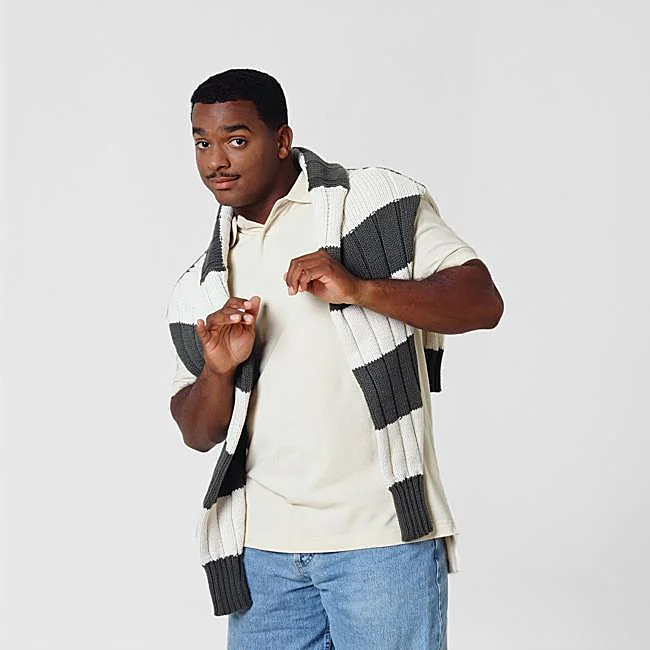
Back in those days, the knotted sweater functioned almost like a small visual code of belonging. In fact, it did not have to be an especially luxurious garment; what mattered was what it evoked: an elite university life, sports clubs, country houses, vacations, sailing, tennis… An imagery that the preppy had turned into a uniform.
However, its origin lies in the sports and university wear of the American East Coast. During the first half of the 20th century, elite universities such as Harvard or Yale were creating a recognizable dress code known as Ivy Style: polos, shirts, loafers, tweed jackets, knitted garments, and apparel inspired by sports such as tennis, rowing, or rugby.
A universe in which the tied-knotted sweater over the shoulders or at the waist gained great importance. A look of studied naturalness—key to the preppy—that in the 80s left the campuses and merged with the yuppie phenomenon, the urban youth of that decade. Again, it lost its initial meaning.
Dominates Milan’s Street Style
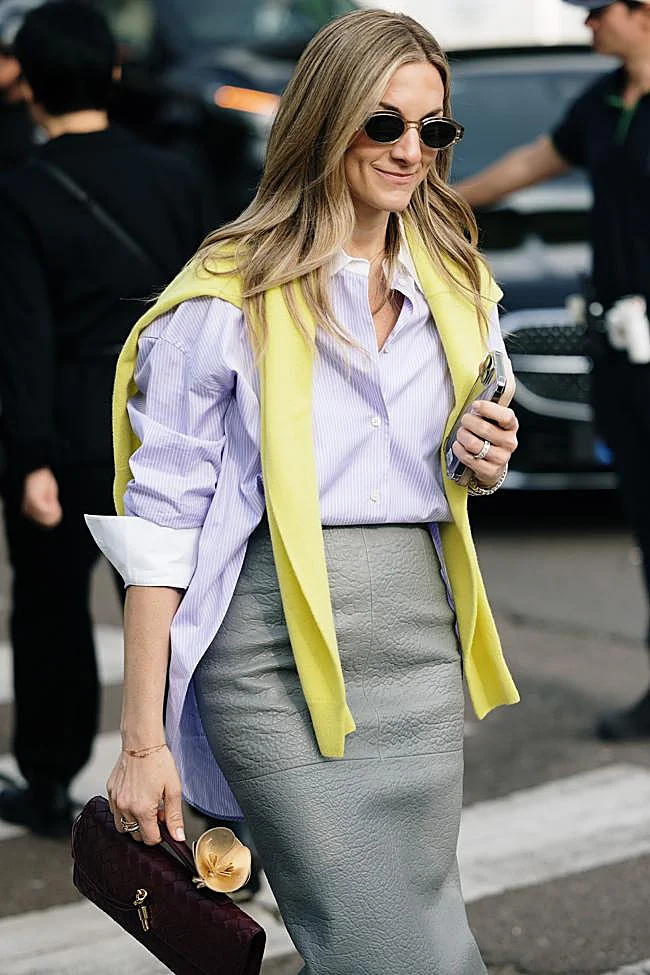
The neck-worn knit has swept Milan.
In fact, in 1983, The Washington Post already spoke of young people on the streets of Milan who wore sweaters tied around the hips, to the point that some Italian designers incorporated that idea into their collections. In other words, the gesture could have very different readings depending on who wore it.
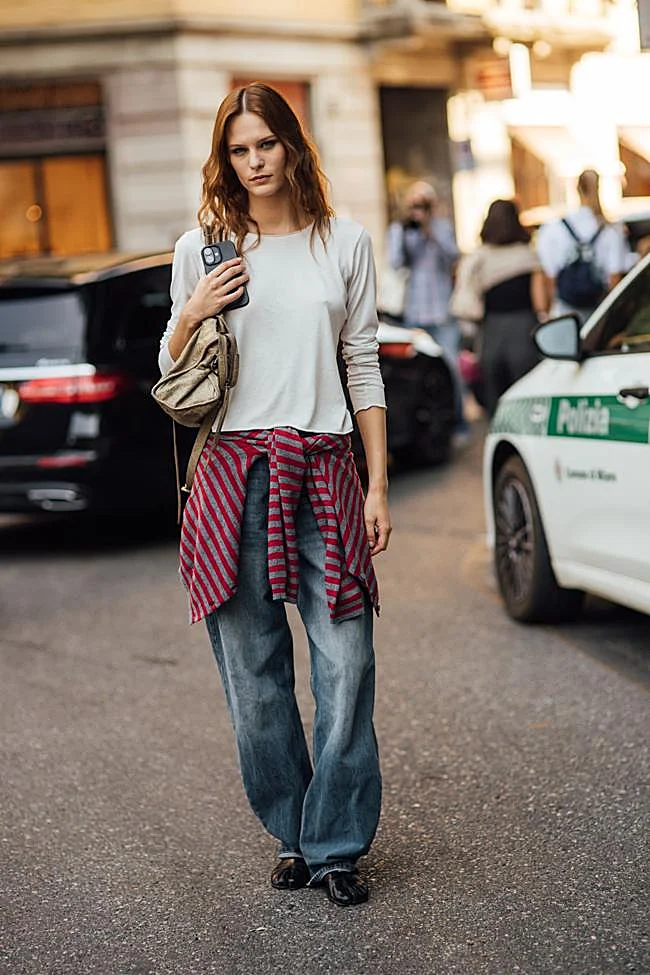
It has also been worn with denim jeans in a more casual version.
Something that has happened again today. Milan Fashion Week’s street style has confirmed a spectacular return that completely changes the original meaning of this way of wearing the knit. No longer about posh or social classes, the hip crowd have adopted the inclusion of this detail as just another accessory.

A look from Milan’s street style.
They are worn with more elegant outfits, but it is also a way to add layers in the in-between season without fuss. It is the color touch for a look with denim, and it’s not only done with knitted garments, but also with long-sleeve T-shirts—the quintessential item of the season—and even with shirts.