Very few buildings in our country combine so much history and controversy as the Pazo de Meirás. This Galician manor house located in Sada, in the province of A Coruña, was built by order of the writer Emilia Pardo Bazán in 1893. But it is best known for later becoming the Franco family’s summer residence during the dictatorship. Now, after years of litigation, the Supreme Court has ruled unanimously that the Franco family must return the Pazo de Meirás to the State. They must also be compensated for the expenses incurred in the property.
Meirás was a literary landmark until the death in 1921 of Emilia Pardo Bazán, the great Galician author in Spanish. There she spent several months a year and installed her library in the Tower of the Chimera, the highest tower of the estate, where she worked. The writer wished to be buried there, but she died in Madrid in 1921. The building remained in the hands of her daughter Blanca and of Manuela, the widow of her son Jaime, who died in 1936. They wanted to donate it to the Society of Jesus, but there was no agreement.
In the midst of the Civil War, local authorities offered the manor to the Franco family as a summer residence. To adapt it, money was raised through the Provincial Junta Pro Pazo del Caudillo in 1937. Franco, who held Ministers’ Council meetings there during the time he spent at the estate, and his family made changes to the property and a large iron gate was installed at the main entrance.
On February 19, 1978, a major fire broke out at the manor and many valuable works of art were destroyed. The Pazo de Meirás was declared a Bien de Interés Cultural in 2008, a status that required its owners to open it to the public four days a month. But visitors could not access it until 2011 and full access to its interiors was not permitted. After Carmen Franco’s death in 2018 her heirs decided to put the manor up for sale for eight million euros, but now its ownership has finally returned to the State.
This is what the Pazo de Meirás looks like inside
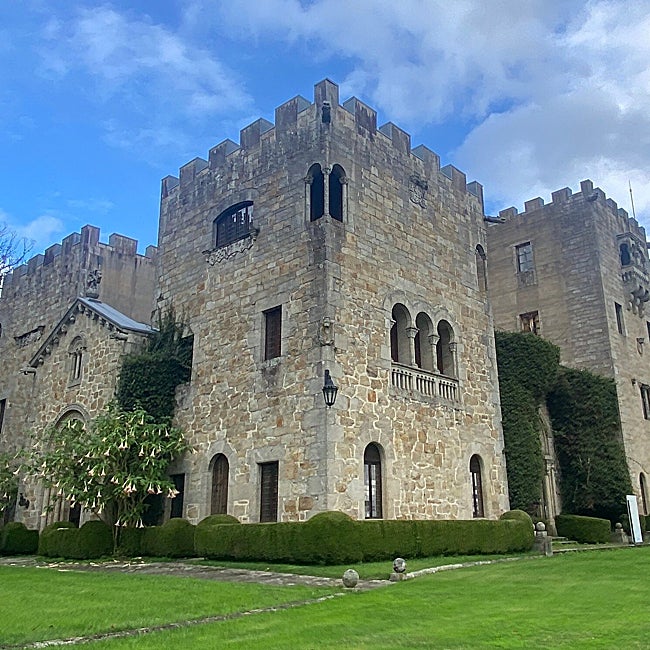
Located on a vast plot of more than 66,000 m2, the Pazo de Meirás is of Romantic style and consists of three crenellated towers of square plan and varying heights. The two lower ones serve as living quarters. The residence was built on the ruins of an ancient fortress erected in the 14th century by Ruy de Mondego, lord of las Mariñas. Inside, according to the records of Patrimonio Nacional, there are about seven hundred objects of great historical value.
Together with the Valle de los Caídos and the Palace of El Pardo, it became one of the main symbols of Franco’s dictatorship; entering its walls is to step into a piece of Galicia’s and Spain’s history. The exterior evokes a castle, with its two towers: the Poniente (West) tower, the lower one, and the Levante (East) tower. There lies the Balcony of the Muses, which served as a source of inspiration for Emilia Pardo Bazán.
The exterior of the Pazo de Meirás.
A grand main staircase of granite that opens into two branches provides access to the offices, the sacristy and the bedrooms. Busts, tapestries, carpets, shotguns, deer heads and enormous lamps decorate the rooms. Two more floors, integrated into the towers, lead to more rooms and to the libraries that house up to 13,000 books. Among the curious objects that remain there are a display table that belonged to the Queen Victoria Eugenia’s music room, silk fabrics that were used as curtains in the Royal Palace, or an eighteenth-century sofa, carved and gilded in wood.
In the exterior of the house stands O Paciño, the games house built for Franco’s daughter, with its own scaled horreo. And in the chapel two twelfth-century baptismal fonts catch the eye. Also the empty sarcophagus that still awaits the remains of the former owner of the manor to rest in its home. The two statues attributed to Mestre Mateo, the creator of the Portal of Glory of the Cathedral of Santiago, that Carmen Polo took to the manor in 1954, are no longer there; the family returned them at the end of last year and they are now in the Galician People’s Museum.
Weddings, Holidays and Proposals
If during his holidays at the Pazo de Meirás Franco used to sail the Azor yacht, fish for salmon, and attend social events in La Coruña, his descendants continued to use it for many more years as a holiday home. But its rooms and gardens were also the scene of major family events. There, for example, the engagement of Luis Alfonso de Borbón to Margarita Vargas took place. Although their wedding was ultimately celebrated in the Chapel of St. Stanislaus of Kraków, in one of the most exclusive zones of the Dominican Republic, Meirás has hosted up to four Franco weddings.
The first was in 1977, when María del Mar Martínez-Bordiú married Jimmy Giménez-Arnau. In 1996, María Aranzazu Martínez-Bordiú said “I do” at the Pazo de Meirás with the lawyer Claudio Quiroga Ferro. Already in the 21st century, Jaime Ardid Martínez-Bordiú celebrated his wedding there to Carmen Panadero in 2004. Four years later, the last marriages to take place on the property were Leticia Giménez-Arnau and Marcos Sagrera.