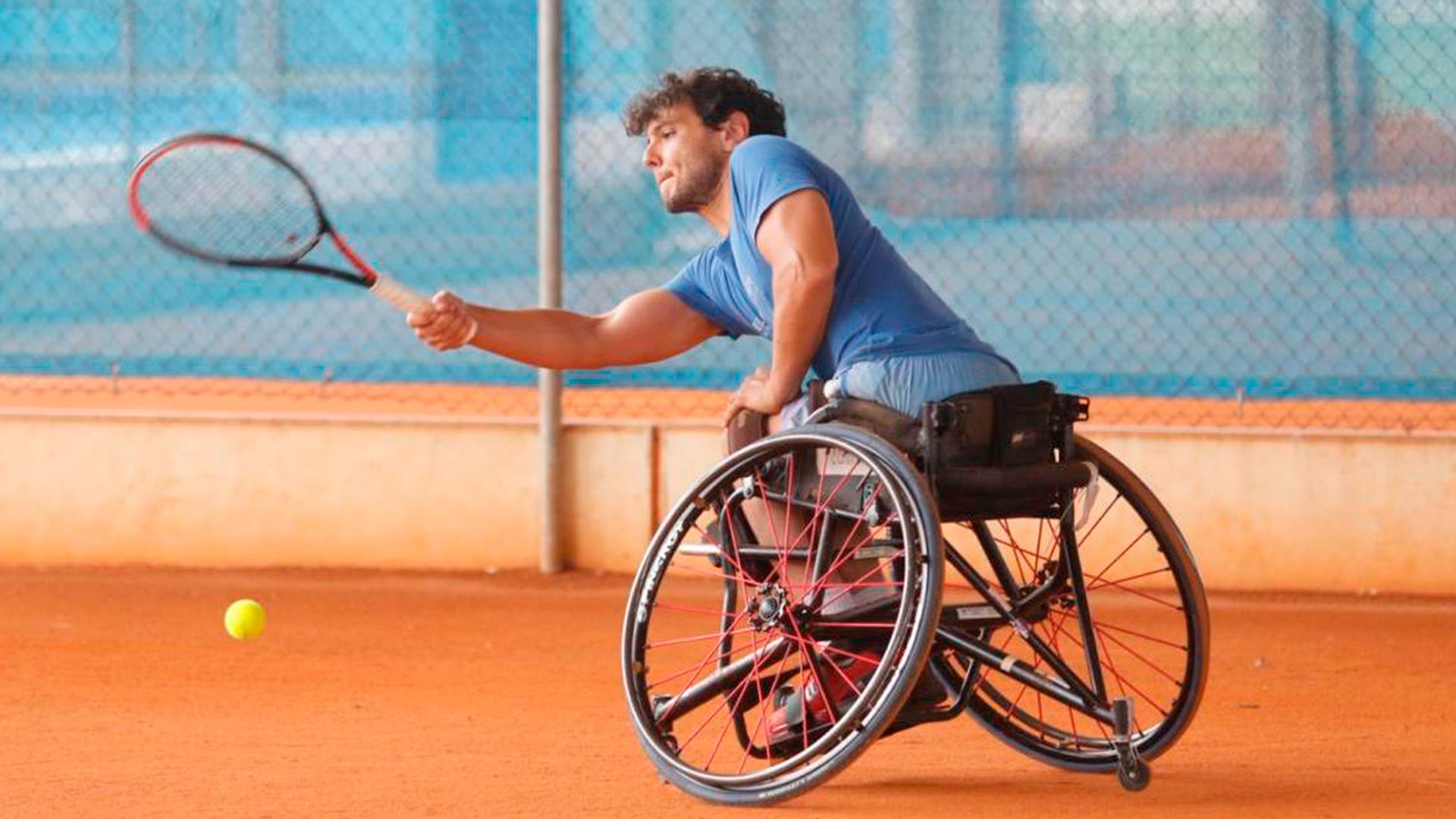
A Cordoban, lawyer, Paralympic tennis player and expert at facing (very) unfavorable situations with courage and dignity. Cisco García is all of that, but above all he wants to be seen as just another citizen who, instead of walking, moves around in a wheelchair. Nothing more. His life changed forever on December 28 at the Mayrhofen ski resort in Austria. A lapse while practicing a snowboard jump ended with a serious fall in which he broke his back and became paraplegic. Far from getting stuck in that moment, he decided to seek a new purpose in life. In his own words, he resisted “to be a poor little thing”.
Today he is the world runner-up in wheelchair tennis. And, not content with shining in this discipline, he has long since ventured (and with considerable success) into para-kickboxing. From resilience, courage, and the drive to take on the world, he will speak at WeLife Festival 2026 on October 24, 2026.
Inclusion, real or just formal?
Moving around in a wheelchair to go to the supermarket, travel by metro or enter a restaurant is a challenge. Cities are not always adapted, and people still look at you with bewilderment. Still, the athlete believes that everything is arriving little by little in an organic way. He acknowledges that he has “few complaints. In Spain the situation is relatively privileged, compared with other destinations outside Europe where I have been, where people still are surprised to see someone young in a wheelchair, but I can understand it because there aren’t that many. Even I am surprised when I see someone in a wheelchair in the supermarket!”
He answers with the natural ease of someone who has accepted what his body is and what his daily reality has been since the day of the injury. It is others who still have a learning curve in inclusivity.
Visible (and invisible) barriers
But it is not the physical barriers that worry Cisco García the most. The mental obstacles he sees as more difficult to remove. “When I was at the National Paraplegic Hospital my psychologist always told me that the problem of the wheelchair ‘goes to people’s heads’, that they only see that. They stay at the ‘poor little thing’ —he repeats this term— and they do not see beyond. But that is something that is also changing little by little. You cannot force it”, he says.
He insists that a person with a physical disability should not receive condescending or overprotective treatment. “We are normal people, not someone on a wheelchair,” he complains, referring to that instinct loaded with good intentions, but also of an infantilizing and paternalistic tone. “It bothers me when people offer me help without having been asked; I see it as an intrusion”, he confesses.
He is also aware that these situations arise from mere lack of knowledge. “I know these are reactions born of goodwill, but people have to understand that we don’t need help for things we do every day. I, when I need it, ask for it without any problems,” he says, forcefully.
An imperfect world for imperfect people
Anyone living with a disability knows their possibilities and their limits. Crossing paths with them on the street as they go about their daily life is not an immediate call for help and, as Cisco García rightly notes, that they act normally toward them is all they expect from the rest of the world. “When you convince yourself of this you also find it easier to convey it to others,” he concludes forcefully.
The speaker also points out a fact that affects any human being, with or without a disability: we live in an imperfect world where anyone can encounter a difficulty. “If you expect everything to be accessible 100%, you’re not living in reality,” he adds. He suggests that in the face of difficulties there is no other option but to adapt and keep moving forward to achieve your goals.
Physical disability does not define people
Cisco García is not a wheelchair as that blind person is not simply their lack of vision. “People, in general, are not so used to seeing people in wheelchairs everywhere,” he explains, “Perhaps the image they have of us is after having seen a campaign by the DGT and they think we are all very unfortunate people,” referring to the stereotypes that advertising or audiovisual media often promote.
Is that why society sees people with disabilities as automatic examples of overcoming simply by living a normal life? “It’s understandable that people think they couldn’t endure in your situation. In that sense, we become an example of how to push forward.” But I don’t see it as bad, although I want to stress that what I aspire to is to have an existence like that of the rest of the world: going to bars, restaurants, to the beach, to the gym… That was my struggle and that of many others and it is what I am most proud of, having achieved that everyday life”, he concludes.
“Really, we don’t like to feel sorry for ourselves, anyone faces adversities throughout life and there are many ways to accept them. I, over the years, no longer consider my wheelchair as something so serious, I have it completely naturalized”, he continues. And to be called heroes? “To me, being considered heroes is not something that bothers me much; I see it as natural,” acknowledges the paralympic athlete.
A first step: more accessible cities
We wouldn’t have to see them as heroes if the cities made things a little easier. And that means the elimination of architectural barriers. “It is common sense to try to make everything accessible for everyone,” he adds. It may be because today you have to use crutches, because you want to stroll with a baby stroller without having to weave around obstacles as if it were a TV show, or because you want to grow older and perhaps need help to move around. “Ramps, for example, are necessary for many different cases. Those of us who use wheelchairs have benefited from that common sense and the legal regulations that have allowed there to be more and more,” he concludes.