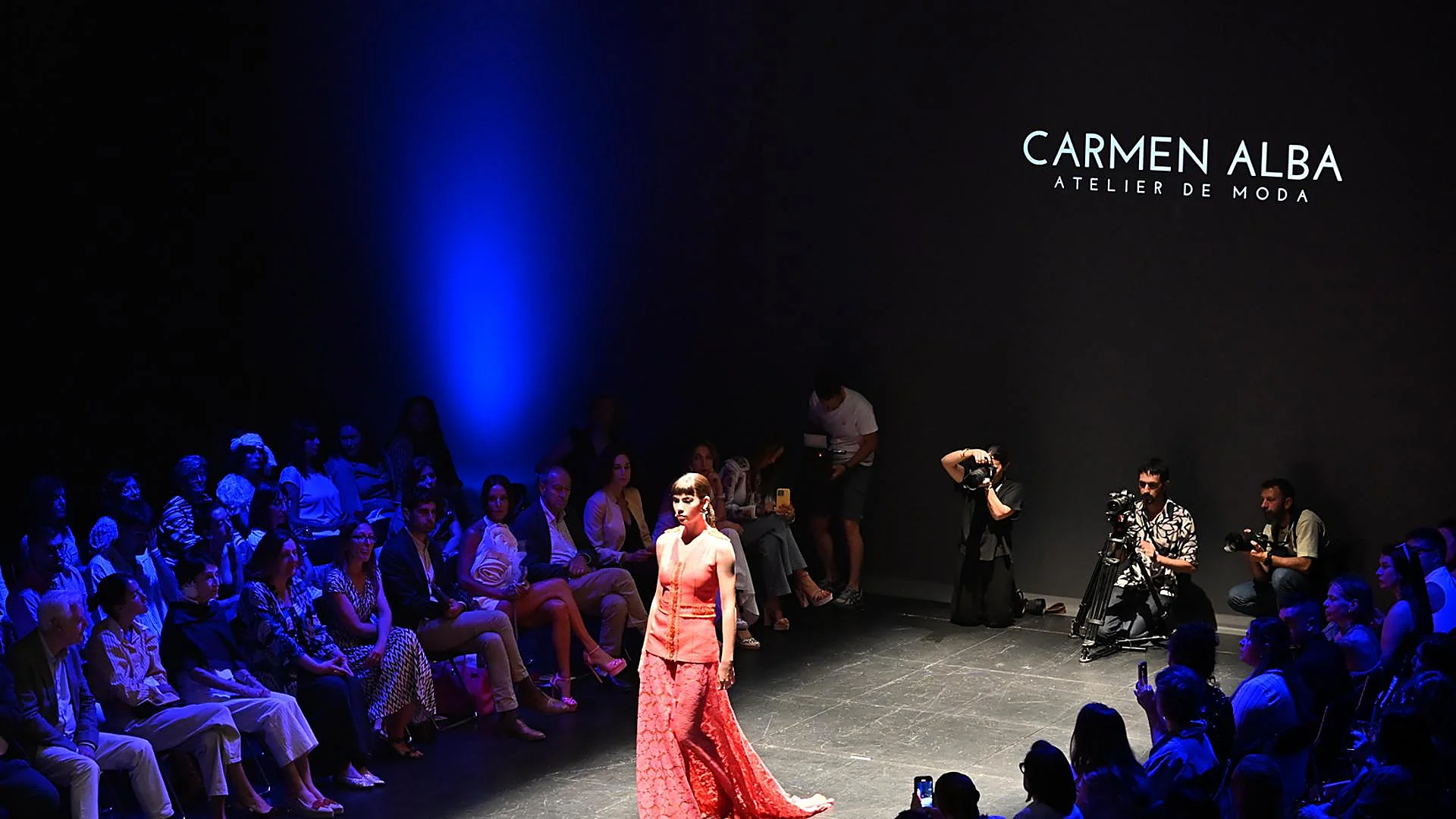
The Mercedes-Benz Fashion Week Madrid once again became one of the leading showcases of Spanish fashion, and among the names and proposals that were part of this edition, there was also room to advocate for craftsmanship and the talent of Castilla-La Mancha.
On September 18, the designers Carmen Alba, Señorito Ortega and Antonio Rabadán participated in the first edition of Castilla-La Mancha Fashion & Lunch, an initiative promoted by the regional government through Legado Artesano that brought to Madrid three different ways of interpreting fashion from the tradition and the Castillanomanchegan identity.
The event, held at the Campus of Nebrija University in Madrid within MBFW Madrid, also represented a further step in Castilla-La Mancha’s presence within the grand Madrid fashion week. After participating in it since 2022 and having since 2025 its own promotional space, this year the region debuted its first own runway under the Legado Artesano brand.
Three designers united by craftsmanship
Although Carmen Alba, Señorito Ortega and Antonio Rabadán have different creative and aesthetic languages, all three share a connection with culture, crafts, and the artisan production of Castilla-La Mancha.
Under the concept A living legacy. Three contemporary universes, the initiative brought together the three creators for the first time in a single project, focusing on how traditional techniques and knowledge can find new forms of expression within contemporary fashion.
And indeed a large part of the cultural identity of Castilla-La Mancha is linked to artisanal disciplines with centuries of history. Ceramics, damascening, sword-making, embroidery, esparto, and glass are part of a heritage that continues to evolve and also serves as a source of inspiration for new generations of designers.
Precisely that connection between past and present was one of the axes of Fashion & Lunch: to demonstrate that craftsmanship does not have to be limited to reproducing traditional codes, but can also be incorporated into contemporary design.
A format different from the traditional runway
The staging also moved away from the conventional runway concept. The proposal was conceived as a more immersive experience, in which the models formed part of a living exhibition that combined static moments with choreographic sequences.
A format designed so that attendees could view the garments from different perspectives and pay closer attention to the details, materials, and techniques present in the creations.
Although each designer maintained their own creative identity, the three proposals were integrated into a joint staging that sought to reflect the diversity of Castilla-La Mancha fashion.
When tradition becomes contemporary fashion
The initiative also put on the table one of the issues increasingly present in the industry: the recovery of traditional trades, local production, and the value of artisanal processes.
In the face of a fashion long marked by speed and the constant renewal of trends, interest in manual techniques and local know-how has been gaining ground. Embroidery, textile work and artisanal processes that for decades were mainly linked to cultural heritage are now appearing reinterpretations in contemporary collections.
A way of understanding fashion in which not only the final result matters, but also who made a piece, how it was produced and what knowledge lies behind it.
Much more than a fashion presentation
The first edition of Castilla-La Mancha Fashion & Lunch was not limited to presenting the proposals of the three designers. The project also included a professional meeting aimed at fostering contact between designers, buyers, specialized media, distributors, stylists and other professionals in the sector.
In addition, an exhibition area was set up with a selection of representative pieces from the collections, thereby extending the designers’ presence beyond the presentation itself.
With this initiative, Legado Artesano reinforced its presence within Mercedes-Benz Fashion Week Madrid and focused on a generation of creators who find in traditional trades a tool to build contemporary proposals.
Because if one thing was clear from this first edition, it is that looking at heritage does not necessarily mean looking to the past. In the hands of new designers, techniques with centuries of history can also become a way of speaking about fashion in the present.