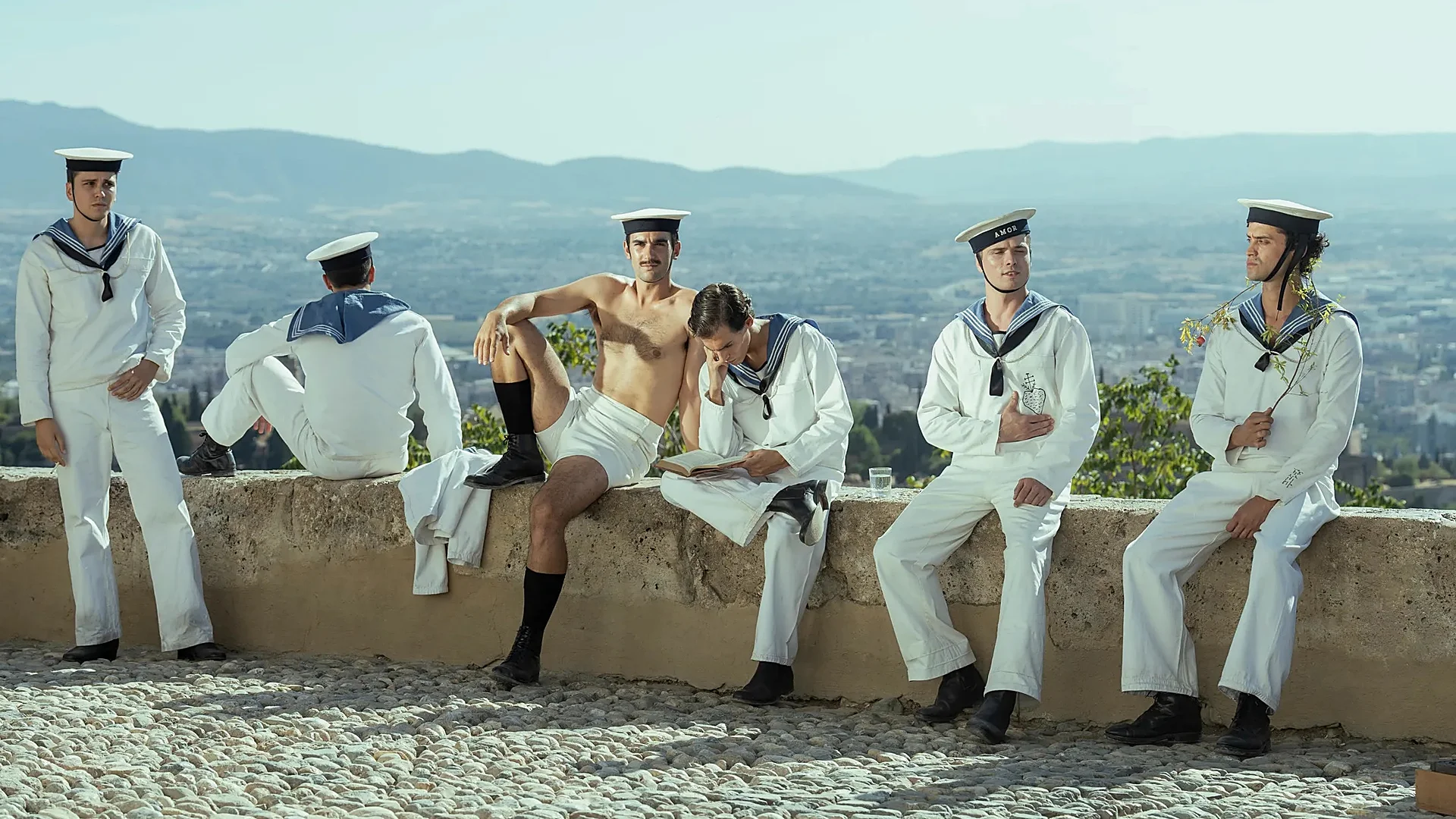
Of all the prints left to us by La bola negra, between the popular and the avant-garde, we keep the one of the sailors on the lookout at San Miguel Alto in Granada. From there you can see everything and nothing is left out. In this almost painterly composition are contained the verses of the Nocturnal Song of the Andalusian Sailors, which Federico García Lorca wrote in 1933: «Ay, boy, boy, the waves carry away my horse!». The director Javier Calvo himself cited them to refer to the “delicate eroticism that interests us.” The one about Federico’s drawings and the paintings by Yannis Tsarouchis (1910-1989), added the filmmaker.
Athens itself appears in the film. There, the character Alberto (Carlos González), a historian and playwright, travels; in truth he is Alberto Conejero, author of The Dark Stone, the play from which La bola negra begins, of which he is also a co-writer. Conejero is passionate about classical culture, about Homeric epic and Sophoclean tragedy. Exactly the world of Tsarouchis, who was born in Piraeus, the Athenian port, from where ships depart to the islands of the Aegean. His artistic career was forged at the School of Fine Arts in the Greek capital, as far from reigning academicism as it was close to the avant-gardes, before heading to Istanbul, Paris and, of course, Italy.
In Yannis Tsarouchis there is the imprint of Matisse and his wild use of color, with which he embraced the Mediterranean nature of his sailors, but above all, of his men with wings, who display odyssean bodies as if they were under the Taormina sun and posed for Baron Wilhelm von Gloeden. Gloeden was a German photographer who turned the Sicilian volcano city into “the preferred destination of the wealthy homosexuals seeking Socratic friendships.” María Belmonte recounts it in her book Peregrinos de la belleza(2015). Said differently, and also by her, “an earthly paradise that represented the lost homeland of homosexuals.” An ephebic Greece at the end of the 19th century.
Who is Yannis Tsarouchis
The painter’s first male nude figures date from 1936. They are not studies or volumes playing at revealing themselves through shadows. They are frontal nudes. A longing to reveal itself that is echoed in the film by Javier Ambrossi and Javier Calvo. Those bodies out in the open on a Cantabrian beach. Those sailors stationed on the lookout: one with his chest bare, another reading, a third smoking. In the dark frame of the white Lepanto, the embroidered word “amor” appears, as in Federico’s poetic drawings.
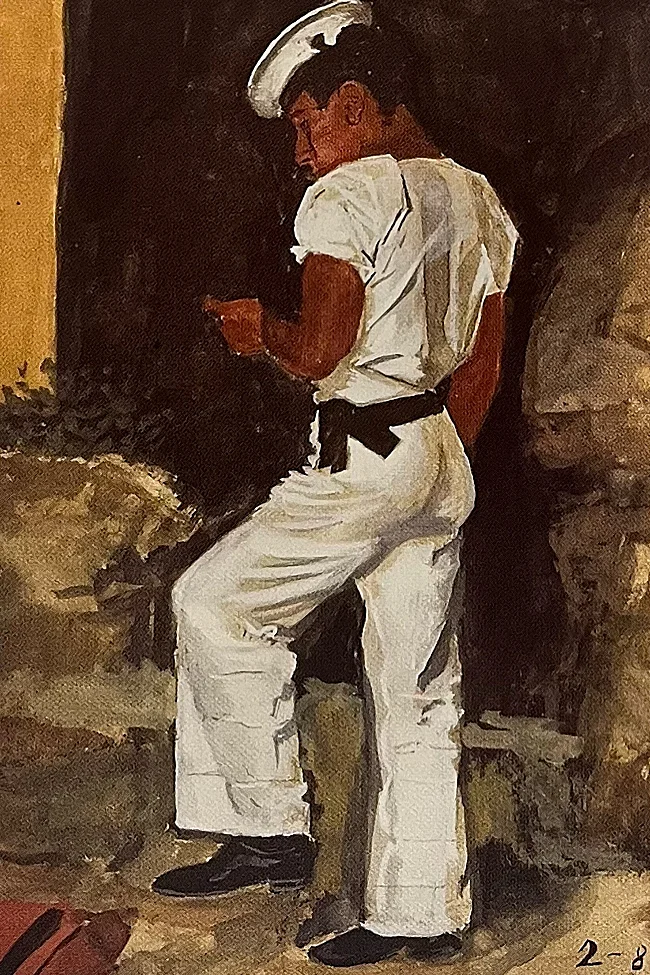
Sailor standing reading, painting by Yannis Tsarouchis, 1962.
There is costumbrismo: the esparto blind, the tavern table and chairs, the cobblestones. But there is also boldness: undershirts, classical statues, the postures, camaraderie. “Only the mystery makes us live, only the mystery,” Lorca wrote. A line we see stamped on the sleeve of the uniform of these exposed seafaring men on land. The Javis leave nothing to chance.
Who is Gregorio Prieto
Not only Tsarouchis, whose life and work can be studied in depth at his studio-home in the Athens neighborhood of Marousi, who sublimated the male form. He is also Gregorio Prieto (1897-1992), the painter from Valdepeñas who painted in secret from his father, who wanted him to be an engineer. Prieto entered the San Fernando School of Fine Arts in Madrid and had Julio Romero de Torres as a professor. He quickly befriended Rosa Chacel, Maruja Mallo, Rafael Alberti, Luis Cernuda, Vicente Aleixandre and, yes, Lorca as well. From Madrid he went to Paris, where he absorbed cubism and surrealism, and then to Rome to continue his studies at the Spanish Academy of Fine Arts.
Prieto visited Taormina, Capri, Athens, Thera, Delphi, Naxos, Pompeii. Perhaps our Tsarouchis. He fell in love with Italy and Greece. From that moment he became fixated on the ruins of Greco-Roman culture. For the sailors, whom he also considered a symbol of freedom, to the point of strolling around dressed like them. And for homoerotic iconography, with the mannequin playing a major role. When the Spanish Civil War broke out, the Manchego took refuge in London, sleeping in parks and seeking shelter in friends’ homes or monasteries, until the Spanish community offered him support and he became a portraitist of English high society.
Sailor’s dream, painted by Gregorio Prieto around 1930.
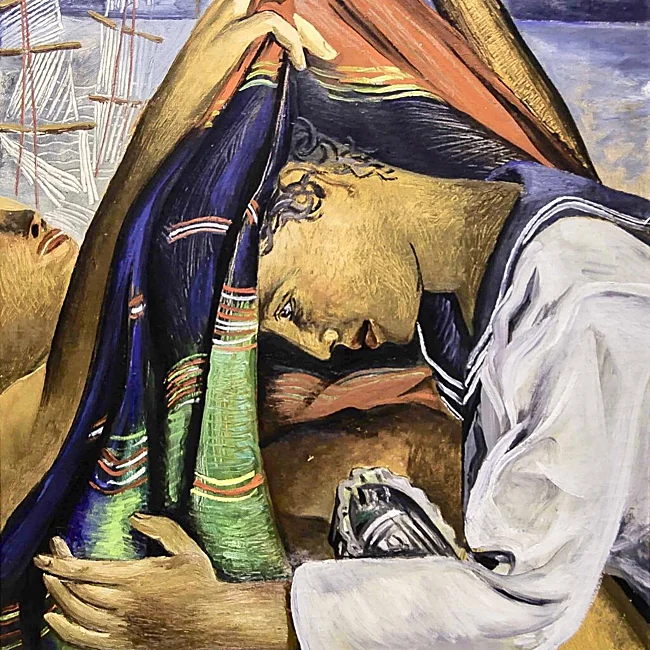
In London he reencounters Luis Cernuda and they decide to share a flat. From Cernuda comes precisely the poem The Sailors Are the Wings of Love, from his book The Forbidden Pleasures. While from Gregorio Prieto there is, for example, Sailor’s Dream (around 1930). Everything fits. Next comes the return to Madrid, the long-desired trip to New York, and his unstoppable editorial work. He ends up publishing more than a hundred books as author or illustrator. And he confirms his artistic audacity by inaugurating the castizo pop art.
A museum in Valdepeñas
Prieto, framed within the Generation of ’27, about to reach his centenary, must be discovered and rediscovered because his work anticipated all beauty. And there is no better place to do it than in the museum that bears his name in his hometown, Museo Gregorio Prieto, housed in a 17th-century manor. It houses, among other treasures, some of the portraits he painted of Federico García Lorca, as well as the letter Lorca wrote to him from the Residencia de Estudiantes: “What I would give, Gregorio, to have a portrait made by you. With that portrait you would join us for eternity as Góngora and Velázquez.”