Jane Austen continues to arouse passions, as is fitting. With Ang Lee’s Sense and Sensibility (1995) in mind and about to add a new cinematic version of the literary classic to our imagination, in charge of Georgia Oakley, we wander through the real world of the acclaimed British writer. We follow her footsteps not only through these pages, which she published in 1811 under the pseudonym A Lady, but on the ground. To immerse ourselves more in the skin of the Dashwood sisters, her protagonists: Marianne and Elinor. The guide Jane Austen: A Journey through the Real Places That Inspired Her Novels (Geoplaneta), by Antje Gerstenecker, has made it easy for us.
Following in the footsteps of the author also known for Pride and Prejudice or Emma is to travel through the most romantic England to end up in the loving arms of literature. The England of elegant cities, majestic mansions, picturesque towns, the evocative coast and those overwhelming landscapes where nature seems to continuously erupt. “It is still possible to immerse oneself in the universe in which this author lived: in the world that inspired her and that she described so well in her books,” Gerstenecker notes. Even further afield, because the successive cinematic adaptations of her works have created a parallel Austenian world. A preferred destination for Janeites. The term is not new. That is how Rudyard Kipling called one of his tales, The Janeites (1924). And it was about Jane Austen.
The heart of this travel corpus is, without a doubt, Chawton, a captivating village in Hampshire, where Jane spent the last eight years of her life with her mother and sister, the two Cassandras. With the father deceased, the women of the family found themselves in a financially precarious situation, and Edward, the best placed of the brothers, welcomed them into a cottage of his own. There, in a decidedly bucolic atmosphere, the author returned to literary forays. She revisited Pride and Prejudice, Sense and Sensibility or Northanger Abbey. And she wrote Emma, Mansfield Park and Persuasion.
Pilgrimage to Chawton
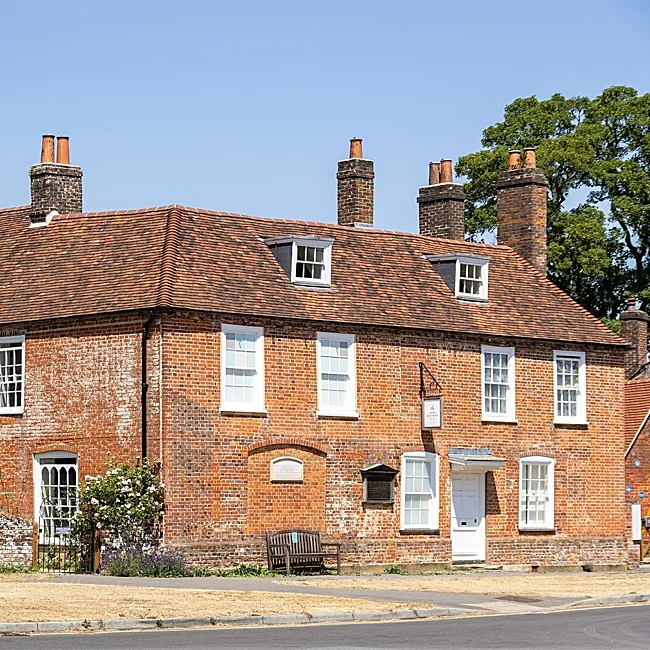
Chawton, with a little more than 500 inhabitants, has become a pilgrimage site. It all began when, shortly before World War II, the Scottish artist Dorothy Darnell, a great admirer of Austen, bought that cottage with the aim of opening it to the public. By founding the Jane Austen Society she was laying the first stone of the house-museum, the current Jane Austen’s House, where you can see her writing tools, her letters, jewelry, furniture and a countless number of objects. This space to unleash Austen mania, or for non-devotional literary commemoration, is complemented by the Cassandras Cup, a blend of a charming village shop and a cafe where you can have tea with a slice of cake in Austen style.
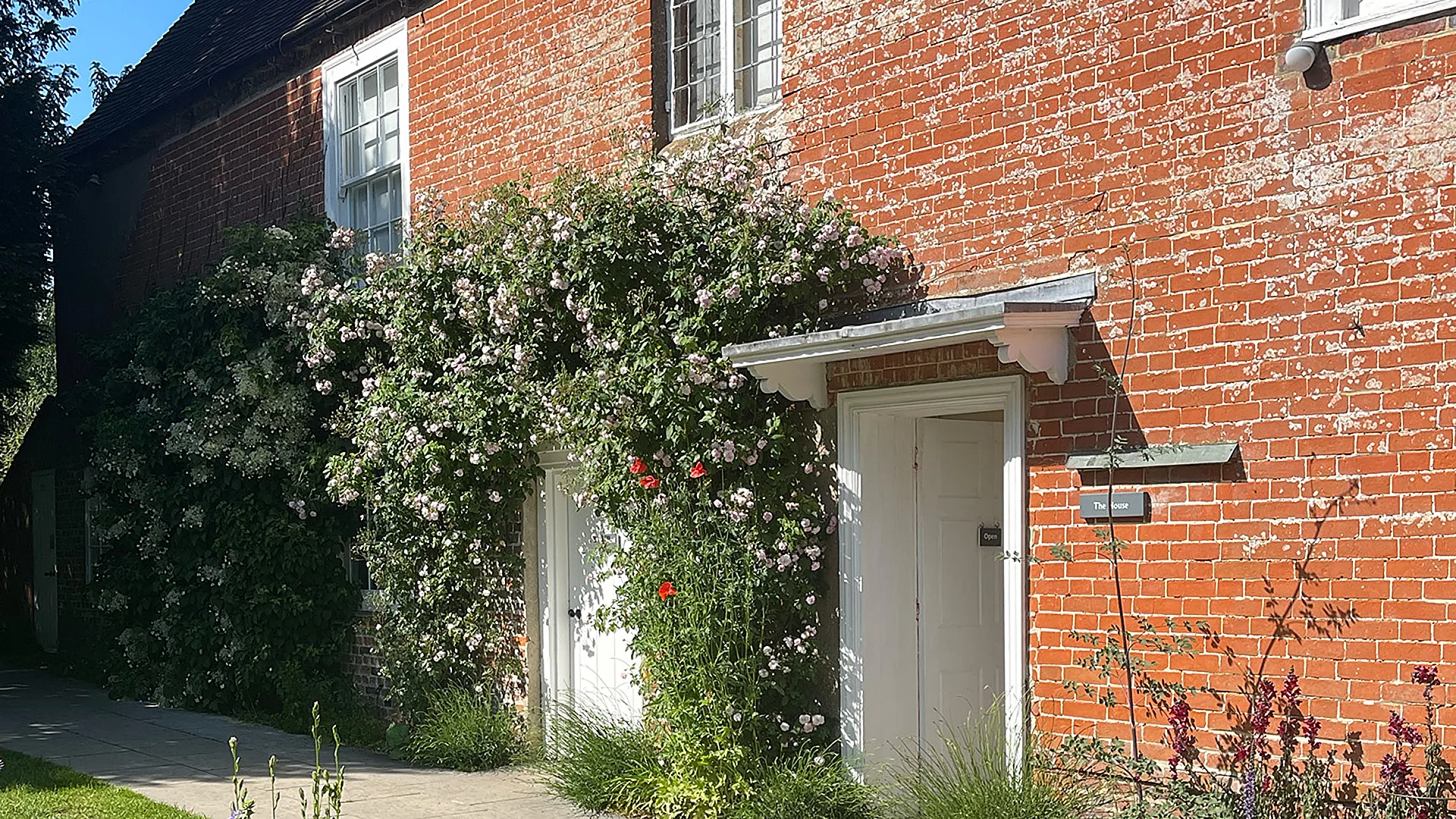
Jane Austen’s House is a cottage located in the charming village of Chawton.
We could stay longer in this town, tempted by crossing the threshold of Chawton House, the mansion of the mentioned Edward, whose impressive library Jane, the restless, used to frequent; but we must change scenery. Not without saying that in this manor house it is possible to spend the night and that a stone’s throw away lies St Nicholas Church. In its cemetery lie the graves of Mrs. Austen and her other daughter. She, however, is buried in the Winchester Cathedral, built in the 11th century and one of the largest in Great Britain. Jane Austen had moved to this city together with her inseparable sister Cassandra.
Steventon, birthplace of Jane Austen
However, if you want to start with the first chapter of her life, you have to go to Steventon, where Jane was born on December 16, 1775, the seventh of eight children of Reverend George Austen and his wife. Another idyllic village in Hampshire, even smaller than Chawton, with only 250 souls, where her first 25 years passed. A rural setting and a social life dominated by the rural nobility and the clergy that was a continual source of inspiration for her novels. In the parsonage of Steventon, which no longer exists, she began to write Sense and Sensibility and Pride and Prejudice. As a landmark there is the red telephone box turned into a small public library with her name.
Moreover, the Austen family used to take excursions around the outskirts of Southampton. For example, Netley Abbey, a coastal site very frequented then with the ruins of a 13th-century Cistercian monastery. But where most of the settings of Sense and Sensibility lie is in Bath, a visit presented as “the best possible plunge into the Regency era.” To this city on the banks of the Avon River, famous for its hot springs that the Romans revered, the family moved when Mr. Austen retired in 1800. In six years they moved as many as four times.
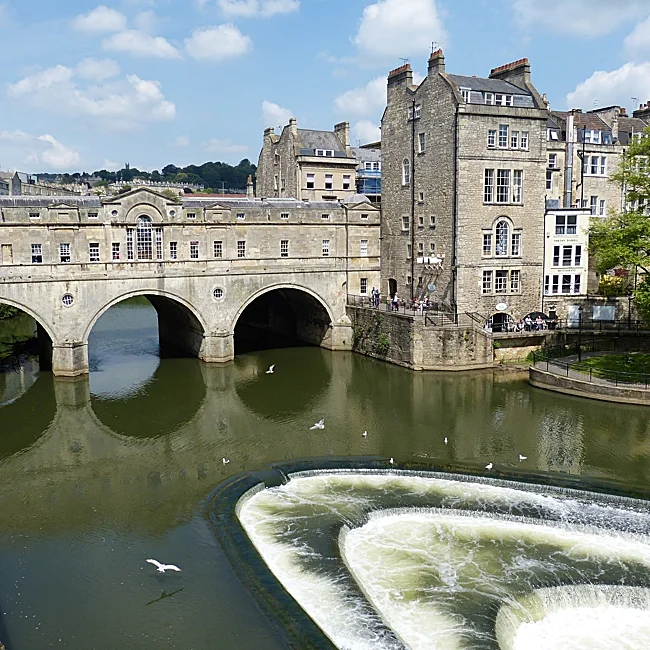
The Pulteney Bridge over the River Avon, with its distinctive horseshoe-shaped weir, in Bath.
Jane barely wrote in Bath. Was she missing the countryside? Yes, she immortalized her dazzling social life. In the Jane Austen Centre the Regency atmosphere is recreated with actors who embody the characters from her books. Of course, it has the usual souvenir shop and a tea room of its own. To top it off, there is a Jane Austen Festival, which has been held for 25 years, in the second week of September. In no other place will you see so many people dressed as if the times were the author’s.
Lyme Regis, the Sea
Her novels are not particularly sea-centric. Yet contemplating the sea left a deep mark on her. She faced it in Lyme Regis, on the Dorset coast, where it seems the Austen family spent holidays for two consecutive years. This is indicated, with some caveats, by a sign on the blue door of a white cottage. Although they used to go to Sidmouth, in nearby Devon, where Jane met a young man in 1801 who is said to have been her great love. He died, in a romantic twist, shortly after. “The more I know about the world, the more convinced I am that I shall never see a man whom I could truly love. I need him so much…,” she wrote in Sense and Sensibility.
Stourhead is one of the most beautiful parks in England.
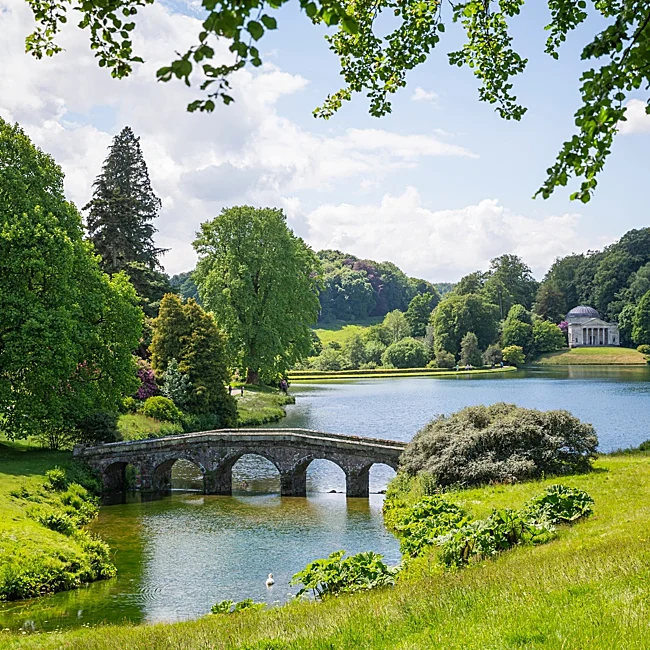
Beyond the purely biographical places, there are those that seem to have stepped out of her stories, which surely served as settings for her works and, in our days, have served as film sets. This is the case of Mompesson House, in the splendid medieval city of Salisbury, very close to the cathedral. Here some scenes from the 1995 Sense and Sensibility were filmed. Not without reason, because the family who lived there at the time had much to do with the Dashwoods of the novel. And the same goes for Stourhead, one of England’s most splendid parks. A visual feast. Through it ran, in the rain, Lizzie (Keira Knightley) from the film adaptation of Pride and Prejudice (2005), seeking shelter in the Temple of Apollo, where Mr. Darcy asks for her hand, unsuccessfully.
London and Jane Austen
Jane Austen also visited London in 1811, and stayed at No. 64 Sloane Street, the residence of her brother Henry and his wife Eliza; today the affluent Knightsbridge neighborhood. She had published Sense and Sensibility and wanted to correct and approve the first proofs. Henry Austen moved in 1814, after becoming a widower, to No. 23 Hans Place, an area very close to Harrods. Neither of these two houses survive, but in the surroundings a faint literary atmosphere lingers. Even the British capital can be seen through Jane Austen’s eyes. It is a matter of sharpening one’s gaze.