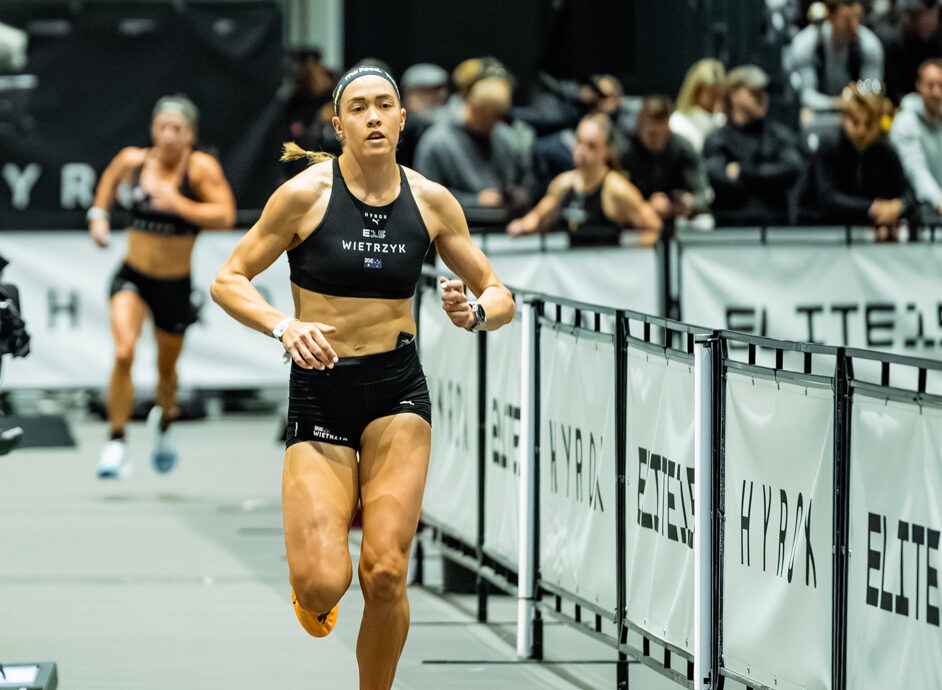
That’s enough. Enough with persecuting the athlete Joanna Wietrzyk and her unfortunate gastrointestinal incident during a Hyrox competition in Beijing. The headlines of these days have ranged from the mild (the least) to the rude and scatological (the most). To Google’s greatest glory, which knows neither ethics nor modesty, but traffic, there have appeared barbs such as ‘competed covered in feces’, ‘wins a Hyrox after defecating on herself’ or ‘why didn’t she hold it in?’.
The media storm turned into a tsunami when it reached social media, where she has been mercilessly skinned. So large has been the snowball that the Australian has apologized for not withdrawing after the incident, has relinquished the win and has announced a temporary retirement. At 24 years old and in her best physical form, the current Hyrox champion is stepping away from her job, which provides her livelihood.
Alone Before Nature
I wonder if, had something like this happened to Rafa Nadal or Cristiano Ronaldo, elite male athletes with friends in the media and influential sponsors, the matter would have been addressed with the same ferocity.
I won’t enter into the debate of whether she did right or wrong by competing to the end, nor into whether the organization acted without reflex by not offering her, at least, a towel to clean herself. I can even understand that an athlete whose week revolves around highly demanding training might push her body to the limit in a competition, because her salary depends on it.
I am terrified by the venom toward a woman who exudes confidence in herself and competes alone in a minority sport. A new form of competition where women have entered with force and already account for nearly 50%, a situation that hardly occurs in almost any other sport.
But I am even more outraged when many of those censures are wielded by those who live a sedentary life as a rule.
Two Decades Ago: Paula Radcliffe’s Episode
The incident reminds me of what distance runner Paula Radcliffe had to suffer when, during the 2005 London Marathon, she had to step aside to evacuate after a sudden intestinal upset. As with the Australian, her superiority was such that she ultimately prevailed in those 42 kilometers. The Englishwoman, one of the greatest athletes of all time, held the best marathon time from 2003 to 2019. Sixteen years in which no runner, of any nationality, with any kind of running shoe, could dethrone her. The best to date.
But if today we go to Google and type her name, the first result the predictive engine yields is ‘poo accident’ (the poop accident). Imagine if Sergio Ramos were remembered as the footballer who let the Copa del Rey slip from his hands and the celebratory bus crushed it? That Carlos Alcaraz would go down in history as the tennis player who vomited on a towel? If that doesn’t happen with men’s sport, why does the scatological anecdote always stay with female athletes?
The Menstruation Taboo
Let’s not even talk about social media’s glee when a endurance athlete runs with menstrual bloodstains. In 2024 Unilever launched the campaign ‘Every Stain Should Be Part of The Game’ advocating more naturalness about what is natural. And menstruation is natural.
However, 6 out of 10 athletes between 15 and 18 years old fear practicing sport with their period for fear of leakage and others seeing the stain.
It’s not the pain, the abdominal tension, that the chest grows by a size or the gastric discomfort that can accompany the first days of a period. It doesn’t happen in every cycle, can’t be predicted, but it can occur when you least expect it and, who knows, perhaps it was what precipitated Wietrzyk’s episode. What worries is that others scrutinize your crotch in search of blood, as if it were a dangerous radioactive fluid.
When that happens, 74% report feeling ashamed, 49% report anxiety and a troubling 33% feel embarrassment.
It Could Happen to Any of Us
Being a woman and competing is a greater challenge than doing so as a man. In particular, in those long, individual tests where there is no option to ask the coach for a change, nor a place to hide when nature turns against you suddenly. Hormonal fluctuations turn every competition into an exciting and mysterious journey where anything is possible.
I have run six marathons and several trails. I know what it is to feel phenomenal in the first kilometers of a training session in the Casa de Campo and suddenly the guts become playful. God bless the Madrid winter’s cold that day that led me to train in long tights and prevented the world from witnessing a disaster similar to the one experienced by the Australian.
I also remember with dread my first Navacerrada Night Cross, which caught me in a perimenopause in full torrent. When Adela Muñoz Páez, the professor of inorganic chemistry, recalled at ASISA WeLife Menopause Madrid how her last menstruations were true hemorrhages, I could not help but feel identified.
Now imagine living that in a mountain race. The terror that overwhelmed me as I left the comfortable darkness of the mountain to approach the finish line full of lights, audience and noise. Few times have I felt so strong running, so empowered by my athletic performance, and at the same time so terrified thinking that the tampon might collapse and my legs could become a Red Wedding.
Let Hormones Not Keep Us From Our Sneakers
But that is how we women compete. Science recognizes that the prevalence of gastrointestinal mishaps in women nearly doubles that in men. By nature we are more prone to irritable bowel syndrome and we must endure the impact of the gastrointestinal symptoms modulated by hormones. The maximal effort, the repeated impact of running and a sphincter control that becomes compromised with every stride can trigger disaster in a matter of seconds. In the forest there may be shelter behind a tree. In a competition center, as in a Hyrox race or in the middle of a gym, there isn’t.
Still, millions of women lace up their shoes every day, train hard, lift weights, burn kilometers, give their best and do not flinch in the face of setbacks. We are all, or can become, Joanna. Or, if you are a man, perhaps she could be your sister, your girlfriend, your mother or your daughter.
If we have already learned that other people’s bodies should not be judged, it is high time to abandon the easy joke when nature, simply, demands its place.

Salomé García Gómez
Journalist specializing in wellbeing, sustainability and conscious living. From the WeLife newsroom she drives content that combines science, inspiration and common sense to live better