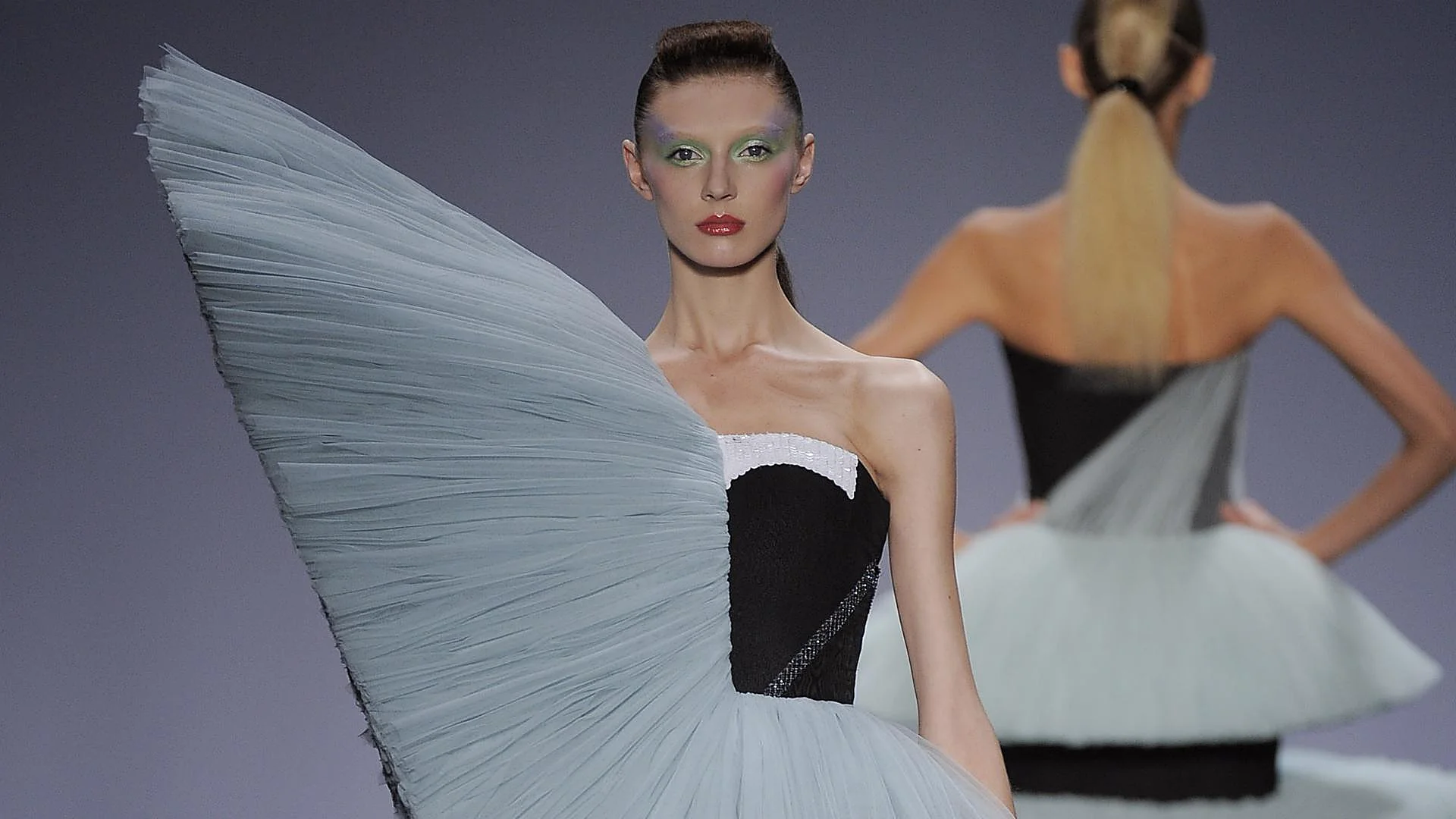
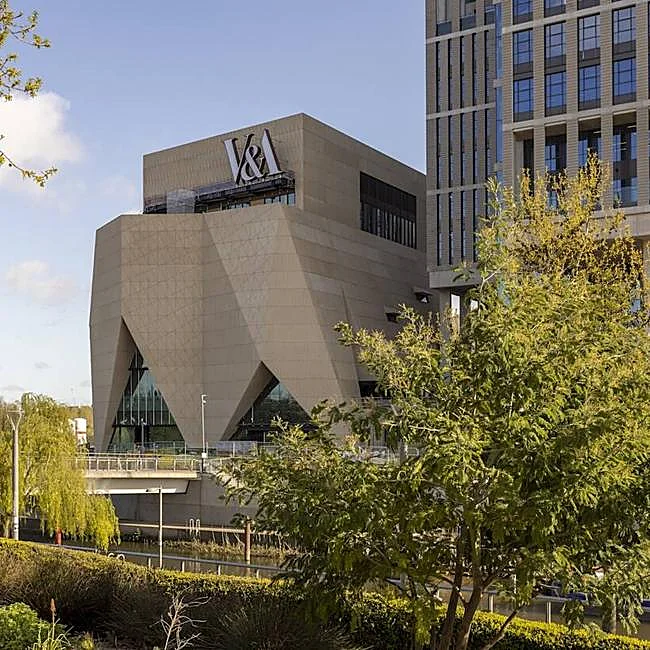
Last April, the new façade of the V&A East Museum was inaugurated in London’s Queen Elizabeth Olympic Park, a work by architects Sheila O’Donnell and John Tuomey. The most striking aspect of this project isn’t the 479 sand-colored panels and the visual spectacle of observing them from any perspective, since the heterogeneity of their designs means it never looks the same from any angle. What truly grabs attention is learning the source of inspiration for O’Donnell and Tuomey for this design: a Balenciaga dress.
The dress in question was part of an exhibition hosted by the museum itself in 2017 that highlighted the sculptural sense that Balenciaga, the designer from Getaria, imparted to his creations, something they have tried to bring over to the façade of the V&A East Museum. The objective was none other than to convey a sense of a “three-dimensionally folded dress” where movement, contrast, and the structure more typical of fashion garments would also be present in the architectural design.
Actually, this relationship between fashion and architecture is not something that catches us by surprise. Understanding both disciplines as artistic expressions, we see how throughout history they have sought to enrich each other and to explore how attributes inherent to one can elevate, transform, or differentiate the final results in the other. And after all, both fashion and architecture arise from a functional need in which the possibility of extracting beauty from elements that have proven to work equally well in both is discovered.
V&A East Museum of London
Perhaps the most evident association is found in how luxury brands seek renowned architects to raise their most impactful spaces, such as the Mobile Art Pavilion that Zaha Hadid built in 2008 for Chanel. Similarly, the staging of fashion shows has been key in establishing this link, whether by the added value that the location brings to the collection, as in the Fendi show of 2007 on the Great Wall of China, or by how the decoration transforms an emblematic place to serve the brands’ intent, as Chanel did in 2025 by turning the Grand Palais in Paris into a kind of galaxy.
Furthermore, it isn’t hard to find figures with a well-known name in their field who have cultivated both branches. Designers such as Paco Rabanne, Gianni Versace, Pierre Balmain, or Tom Ford also had training in architecture, something they made evident in many of their collections. Conversely, there are architects who have dabbled in the fashion world with accessory lines, mainly, such as Frank Gehry, Oscar Niemeyer or Zaha Hadid herself.
Buildings that have drawn inspiration from clothing
But let’s get to what interests us. Beyond this kind of symbiosis that feeds architects and designers, we have numerous examples that, like the V&A East Museum, seek to imitate specific works from the other discipline. And as we mentioned above, it’s nothing new, for already in ancient Greece architects looked to the drapery of tunics to create the fluting of the columns, seeking to reflect the proportion and harmony of the human body in architecture. Over time this tendency has continued as art evolved, leaving a legacy that ranges from elegant and subtle creations to more overt proposals.
The world’s tallest high-heeled shoe is in Taiwan, and far from residing in a dressing room, you can find it at Budai Marine Park in Taiwan. This gigantic high-heeled shoe made with blue glass panels is the High-Heel Wedding Church, one of the region’s most popular monuments, conceived to pay homage to all the women who, due to illness, could not wear high-heeled shoes on their wedding day.
The Haines Shoe House in Pennsylvania or The Big Shoe Repair in California also take the form of a shoe, created to promote businesses related to the footwear industry. But shoes have not been the only accessory that has inspired architecture; hats also play a leading role in this trend. For example, there is Idaho’s Miner’s Hat, in the shape of a miner’s helmet, or Lesotho’s Basotho Hat Shop, which recalls its traditional hat.
More subtle references can be found in iconic places such as the Guggenheim Museum Bilbao, the Sydney Opera House, or Libeskind’s Vanke Pavilion. Although they do not explicitly represent garments, they reference haute couture techniques in their form, such as lines, pleats, or textures that could easily appear in the collections of the world’s most important designers.
Fashion collections inspired by architecture
In recent seasons we have seen runways turn to architectural features in trends such as shoulder pads, peplum, volume, or corsetry, among others. Yet many designers have also sought to go a step further, inspiring both garments and entire collections in some of the world’s most emblematic buildings.
Perhaps one of the most memorable proposals is Viktor & Rolf in 2010, when they drew inspiration from the geometric lines and monumental volumes of the Sydney Opera House to create their Spring 2010 Ready-to-Wear collection. Through rigid, sculptural layers they sought to recreate those white sails so characteristic of the structure, giving rise to purely architectural dresses (including bridal designs) and to one of the Paris Fashion Week’s most iconic shows.
Viktor & Rolf Spring 2010 Ready-to-Wear show

Designer Guo Pei takes this relationship one step further: for her, fashion is the first space that the human body inhabits, and thus deserves to be treated with the dignity accorded to any architectural work. The ultimate expression of this was achieved with her 2018 Autumn-Winter Haute Couture collection, where she transformed Gothic cathedrals (spires and flying buttresses included) into the basis of a proposal that, through volumes and movement, managed to carry the creative concept into textiles.
But if we talk about designers who have maintained a close bond with architects, we must bring Issey Miyake into the conversation, who throughout his life was strongly influenced by the work of Zaha Hadid, with whom he also shared a close personal bond. Both creatives shared admiration and technique, bringing to their respective realms a very similar way of working. In Hadid’s dressing room, incidentally, there were no shortages of the Japanese designer’s structured coats.